



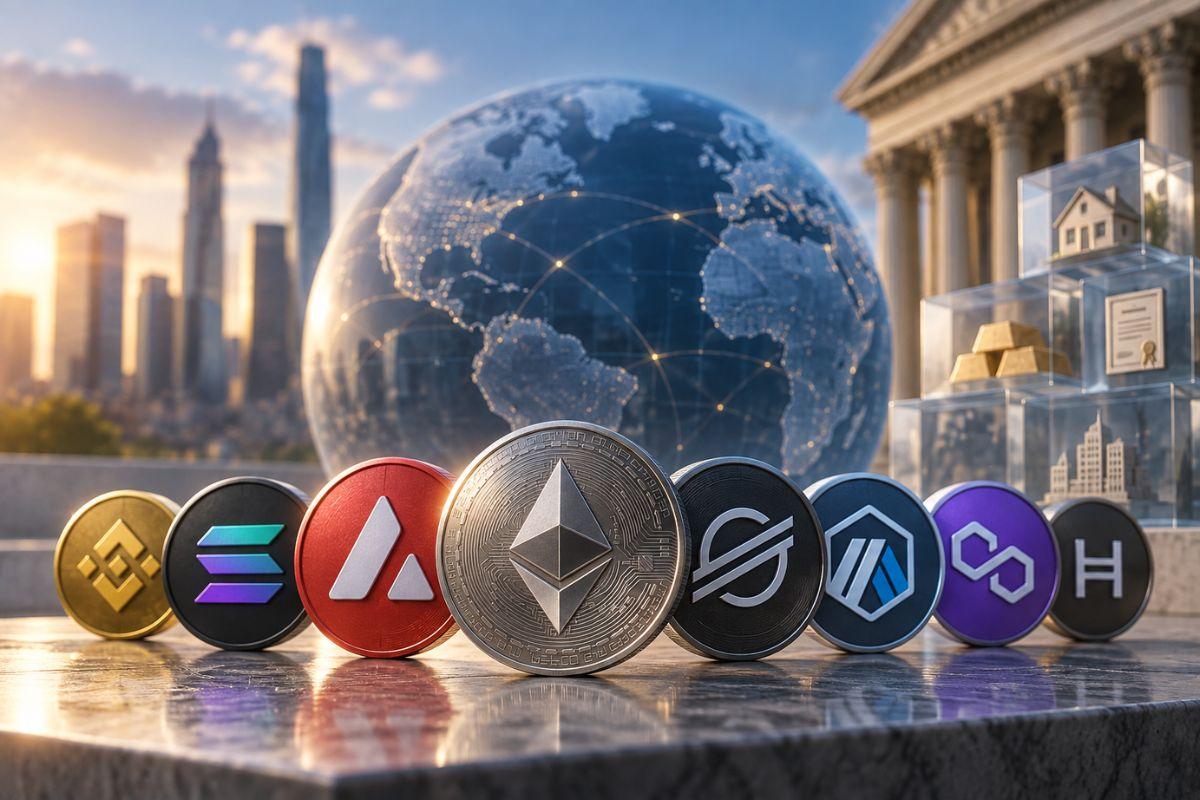


The leading blockchain networks for real-world asset (RWA) tokenization in 2026 include Ethereum, Avalanche, Solana, BNB Chain, Stellar, Arbitrum, Polygon, and Hedera. Ethereum remains the largest RWA ecosystem by tokenized asset value, while Avalanche stands out for combining an established institutional RWA ecosystem on its C-Chain with the option to launch dedicated Avalanche L1s with configurable compliance, access, privacy, and validator requirements.
There is no single best blockchain for every tokenized asset. The right network depends on whether an issuer prioritizes existing liquidity, institutional infrastructure, custom compliance controls, distribution, transaction performance, or the ability to operate a purpose-built blockchain.
Key takeaways
- Ethereum remains the largest RWA network by tokenized asset value, with the deepest existing ecosystem of issuers, custodians, tokenization providers, and onchain liquidity.
- Avalanche combines institutional RWA deployments on its public C-Chain with dedicated Avalanche L1s, giving organizations the option to create purpose-built networks with configurable transaction access, validator sets, privacy, and other requirements.
- Solana has developed one of the largest RWA ecosystems outside Ethereum, with growing activity across tokenized treasuries, private credit, funds, equities, and other assets.
- BNB Chain has expanded rapidly in tokenized funds and equities, including products associated with BlackRock, Franklin Templeton, VanEck, and Ondo.
- Stellar has a long institutional tokenization track record, particularly in tokenized funds, payments, and asset issuance.
- Arbitrum and Polygon give issuers access to EVM-compatible ecosystems with lower transaction costs, while Hedera offers an alternative enterprise-oriented governance and tokenization model.
- Choosing an RWA blockchain should be based on the requirements of the underlying asset and its investors, rather than transaction speed or fees alone.
Comparing the top RWA blockchain networks
| Network | Main RWA strength | Architecture | Notable RWA activity | Best suited for |
| Ethereum | Ecosystem depth and liquidity | Public L1 + L2 ecosystem | BUIDL, BENJI and extensive institutional tokenization infrastructure | Issuers prioritizing market depth and established infrastructure |
| Avalanche | Institutional deployments plus customizable infrastructure | Public C-Chain + dedicated Avalanche L1s | BlackRock, Franklin Templeton, Apollo, VanEck and other institutional assets | Institutions that may need purpose-built compliance, access or infrastructure controls |
| Solana | High throughput and broad asset distribution | Public L1 | BUIDL, BENJI, ACRED, WisdomTree funds and tokenized equities | High-volume issuance and distribution |
| BNB Chain | Scale, distribution and tokenized equities | Public EVM-compatible L1 | BUIDL, BENJI, VBILL and tokenized equities | Products targeting broad onchain distribution |
| Stellar | Tokenized funds and financial settlement | Public L1 | Franklin Templeton, WisdomTree and other regulated issuers | Payments, funds and regulated asset issuance |
| Arbitrum | Ethereum-aligned scaling and DeFi integration | Ethereum L2 | BUIDL, BENJI and other RWA products | Teams wanting Ethereum compatibility with lower execution costs |
| Polygon | Ethereum compatibility and enterprise tooling | EVM-compatible network | Institutional funds, payments and tokenized assets | Ethereum-oriented applications needing inexpensive transactions |
| Hedera | Enterprise governance and predictable costs | Public DLT | Regulated securities and enterprise tokenization projects | Organizations prioritizing governance and predictable network costs |
The ranking above considers institutional track record, architecture, compliance flexibility, ecosystem maturity, interoperability and production use. It is not a ranking based solely on tokenized asset value.
What makes a blockchain suitable for RWA tokenization?
Tokenizing a real-world asset is different from launching a typical crypto-native token.
An issuer may be dealing with securities laws, investor eligibility requirements, transfer restrictions, custody obligations, privacy rules and regulated counterparties. The blockchain therefore needs to support the operational and compliance requirements surrounding the asset, not simply record token transfers.
Five factors are especially important.
Institutional track record
A network that already supports regulated funds, asset managers, custodians and tokenization providers has fewer untested integration assumptions than one relying primarily on pilots or crypto-native applications.

Compliance configurability
Depending on the product, issuers may need to restrict who can transact, control who validates a network, enforce investor allowlists or limit where data is stored.
Some of these controls can be implemented at the smart-contract or token level. Other use cases may benefit from controls at the underlying network level.
Liquidity and interoperability
Tokenization becomes more useful when an asset can interact with stablecoins, qualified counterparties, exchanges, custody providers and other financial infrastructure.
An isolated token may technically exist onchain while providing little practical improvement over a conventional database.
Settlement performance and predictable costs
Fast finality and predictable transaction costs can matter for issuance, redemptions, payments, collateral movements and secondary transfers, particularly as transaction volumes increase.
Ecosystem maturity
Custody, identity, compliance, tokenization platforms, oracles, wallets and interoperability infrastructure all contribute to whether an institution can move from a proof of concept to a production deployment.
1. Ethereum
Best for: existing liquidity and the broadest institutional blockchain ecosystem
Ethereum remains the largest blockchain ecosystem for real-world assets.
RWA.xyz data at the end of August 2026 placed approximately $17.3 billion in tokenized RWA value on Ethereum, excluding stablecoins, ahead of every other individual blockchain network.
Its advantage goes beyond asset value. Ethereum has an extensive network of tokenization providers, custodians, stablecoin issuers, DeFi protocols, institutional wallet providers and counterparties that already support the network.
Major tokenized products such as BlackRock’s BUIDL have also helped establish Ethereum as a default settlement environment for institutional tokenization.
Ethereum’s Layer 2 ecosystem extends that infrastructure into environments designed for lower transaction costs and higher transaction throughput.
The trade-off is that organizations requiring highly specific network-level rules may need to implement those requirements through smart contracts, applications, an L2 or other infrastructure rather than changing Ethereum itself.
Best fit for: issuers that prioritize the broadest existing RWA ecosystem, liquidity and counterparty network.
2. Avalanche
Best for: institutional RWA deployments with the option for purpose-built blockchain infrastructure
Avalanche has developed a significant institutional RWA ecosystem while taking a different architectural approach from conventional shared blockchains.
The first part of that model is the Avalanche C-Chain, a public, EVM-compatible blockchain.
Avalanche’s current ecosystem documentation lists tokenized products or integrations from institutional asset managers including BlackRock, Franklin Templeton, Apollo, VanEck, WisdomTree, KKR, Janus Henderson and Galaxy as available on the C-Chain.
Examples include:
- BlackRock’s BUIDL, its tokenized institutional liquidity fund, which Avalanche lists as available on C-Chain.
- Franklin Templeton’s BENJI, associated with the Franklin OnChain U.S. Government Money Fund.
- Apollo’s ACRED, which provides tokenized access to Apollo’s diversified credit strategy and launched across Avalanche and several other networks.
- VanEck’s VBILL, a tokenized U.S. Treasury fund launched through Securitize across Avalanche and other blockchains.
The second part of Avalanche’s model is Avalanche L1s.
An Avalanche L1 is a sovereign network that can define its own validator membership and execution rules. Unlike deploying another application on a shared public blockchain, organizations can create a network around the requirements of a particular market or application.
Avalanche L1s can support controls including permissioned validator sets, transaction allowlists and restrictions on who may deploy smart contracts. Avalanche also documents private configurations where network data is available only to approved participants.
That distinction is particularly relevant to regulated markets.
An institution can use the public C-Chain when a shared, open EVM environment fits the product, while a use case requiring more control over validators, transaction access, privacy or execution can instead use a dedicated Avalanche L1.
This does not mean every RWA on Avalanche operates on its own L1. Major products such as BUIDL, BENJI, ACRED and VBILL are examples of Avalanche’s C-Chain RWA ecosystem, while Avalanche L1s represent an additional infrastructure option.
That distinction is central to Avalanche’s RWA proposition.
Best fit for: institutions that want public-chain RWA infrastructure today while retaining the option to build a dedicated, configurable blockchain for a regulated asset, market or financial application.
3. Solana
Best for: high-throughput RWA issuance and distribution
Solana’s RWA ecosystem expanded substantially during 2026.
By the end of August, RWA.xyz placed Solana at approximately $4.1 billion in tokenized RWA value, making it one of the largest networks in the category.
Its institutional ecosystem now includes products and initiatives involving BlackRock, Franklin Templeton, Apollo, VanEck, WisdomTree and other asset managers. Solana reported approximately $3.7 billion of non-stablecoin RWA value by late July 2026, spanning treasuries, funds, private credit, equities, commodities and other asset classes.
Solana also provides token-level features that can support regulated issuance, including transfer restrictions, allowlists and other compliance controls through its token infrastructure.
Its combination of low transaction costs, high throughput and growing RWA liquidity makes it particularly relevant where assets are expected to move frequently or reach a large number of holders.
Unlike the Avalanche L1 model, however, most Solana applications operate within the same primary execution environment rather than launching an independent blockchain for each institutional use case.
Best fit for: issuers prioritizing throughput, inexpensive transactions and broad onchain distribution.
4. BNB Chain
Best for: large-scale distribution and tokenized equities
BNB Chain has become a major RWA network in its own right.
RWA.xyz placed it second by tokenized RWA value at the end of August 2026, behind Ethereum, with approximately $5.7 billion in assets excluding stablecoins.
Its institutional ecosystem includes BlackRock’s BUIDL, Franklin Templeton’s BENJI, VanEck’s VBILL and products from Ondo.
BNB Chain has also developed particularly strong activity around tokenized equities. By June 2026, the network reported more than 700 tokenized stocks and ETFs available across its ecosystem.
The network is EVM-compatible, which lowers the technical barrier for projects already familiar with Ethereum development infrastructure.
For institutions, BNB Chain’s main attraction is less about running a dedicated blockchain and more about combining inexpensive execution with a large existing user, stablecoin and DeFi ecosystem.
Best fit for: issuers seeking broad distribution, particularly for tokenized securities designed to interact with existing onchain markets.
5. Stellar
Best for: regulated asset issuance and financial settlement
Stellar has one of the longest track records in blockchain-based financial asset issuance.
Franklin Templeton’s tokenized money market fund has been one of its most visible institutional use cases, while WisdomTree has also issued multiple digital funds on the network.
A 2026 institutional infrastructure report published by Stellar cited 67 tokenized RWA products from 10 regulated issuers, including Franklin Templeton, Spiko and WisdomTree.
Stellar also has asset-level controls designed for regulated issuance, including authorization, freeze and clawback functionality.
Its architecture has historically been particularly aligned with payments, asset issuance and financial settlement rather than general-purpose DeFi.
Best fit for: institutions focused on regulated funds, payments, cross-border settlement and straightforward asset issuance.
6. Arbitrum
Best for: RWA applications that want to stay close to Ethereum liquidity
Arbitrum is one of the largest Ethereum Layer 2 ecosystems and has developed a meaningful RWA footprint.
Its RWA ecosystem includes products associated with BlackRock, Franklin Templeton, WisdomTree and other issuers.
RWA.xyz placed approximately $800 million of tokenized RWA value on Arbitrum at the end of August 2026.
The main attraction is straightforward: applications retain compatibility with Ethereum’s EVM ecosystem while gaining lower transaction costs and greater execution capacity than Ethereum mainnet.
That can make Arbitrum particularly useful when tokenized assets are intended to interact with Ethereum-aligned DeFi infrastructure.
Best fit for: teams that want Ethereum-compatible RWA infrastructure with lower execution costs and strong DeFi connectivity.
7. Polygon
Best for: Ethereum-compatible institutional applications with inexpensive execution
Polygon has established RWA infrastructure spanning tokenization, stablecoins, payments and enterprise applications.
Its RWA ecosystem includes institutional issuers and tokenization infrastructure providers, with Polygon reporting more than $800 million in represented asset value across its broader tokenization offering.
Polygon’s main advantage is its close alignment with Ethereum development standards combined with inexpensive transactions and an established enterprise ecosystem.
Compliance restrictions such as allowlists and role-based controls can be implemented at the token or application level, while organizations requiring more dedicated infrastructure can use Polygon’s broader chain-development stack.
Best fit for: teams that want familiar Ethereum tooling combined with lower costs and established enterprise integrations.
8. Hedera
Best for: enterprise governance and predictable transaction costs
Hedera takes a different approach from most networks on this list.
Rather than relying on conventional open validator participation, Hedera is governed through the Hedera Council, giving the network a more formal enterprise governance structure.
Its tokenization infrastructure supports assets including securities, commodities and other real-world instruments, with a focus on predictable transaction fees and enterprise operations.
Institutional activity has continued in 2026. For example, regulated digital asset platform Archax expanded its tokenized securities infrastructure on Hedera to support near-real-time distribution of cash flows to investors.
Hedera therefore represents an alternative for organizations that place particular weight on predictable costs and formal network governance.
Best fit for: enterprises that prioritize predictable fees and a council-governed network model.
How to choose the right blockchain for RWA tokenization
The best network depends on what the tokenized asset actually needs to do.
Want the largest existing RWA ecosystem and deepest infrastructure?
Ethereum is the strongest starting point.
Want institutional RWA infrastructure plus the ability to create a purpose-built blockchain?
Avalanche is particularly differentiated because organizations can choose between the public C-Chain and a dedicated Avalanche L1.
Need high throughput and broad onchain distribution?
Solana is a strong candidate.
Want a large consumer and DeFi ecosystem for tokenized assets and equities?
BNB Chain has developed significant traction.
Focused on regulated asset issuance and financial settlement?
Stellar has an established institutional track record.
Want to remain closely connected to Ethereum while reducing execution costs?
Arbitrum or Polygon may be appropriate.
Prefer an enterprise-governed network with predictable transaction pricing?
Hedera offers a different infrastructure model.
For institutional issuers, however, blockchain selection should normally follow the structure of the asset rather than precede it. Investor eligibility, jurisdiction, custody, privacy, liquidity, settlement, transferability and compliance requirements should define the infrastructure decision.
Frequently asked questions
What is real-world asset (RWA) tokenization?
Real-world asset tokenization is the process of representing ownership or economic rights associated with a traditional or physical asset using blockchain-based tokens.
Assets that can be tokenized include U.S. Treasuries, money market funds, private credit, private equity, bonds, real estate, commodities and equities.
The blockchain provides a programmable ownership and settlement layer, while the legal structure, custody arrangements and regulatory obligations determine what rights the token actually represents.
What is the best blockchain for RWA tokenization in 2026?
There is no single best blockchain for every RWA.
Ethereum has the largest existing RWA ecosystem by tokenized asset value. Avalanche is particularly differentiated for institutions that want both a public EVM network and the option to deploy a purpose-built L1 with configurable infrastructure. Solana and BNB Chain have developed large RWA ecosystems focused on high-volume distribution, while Stellar, Arbitrum, Polygon and Hedera serve different institutional requirements.
The best network depends on the asset, investor base, compliance requirements, required liquidity and intended use of the token after issuance.
Is Ethereum or Avalanche better for RWA tokenization?
Ethereum generally offers the larger existing RWA ecosystem, deeper liquidity and a broader network of integrated blockchain infrastructure.
Avalanche provides a different architectural advantage. Institutions can issue assets on the public, EVM-compatible Avalanche C-Chain or create a dedicated Avalanche L1 when they need greater control over areas such as validator participation, transaction access, privacy or execution rules.
For issuers primarily seeking access to the largest existing onchain ecosystem, Ethereum may be preferable. For applications requiring a more purpose-built blockchain environment, Avalanche can offer greater infrastructure flexibility.
What is the difference between Avalanche C-Chain and an Avalanche L1 for RWA tokenization?
The Avalanche C-Chain is a shared, public, EVM-compatible blockchain. Institutional tokenized assets such as products from BlackRock, Franklin Templeton, Apollo and VanEck are available within Avalanche’s C-Chain ecosystem.
An Avalanche L1 is a separate sovereign network that can define its own validator membership and execution rules.
An institution might therefore use the C-Chain when public shared infrastructure meets its needs, while choosing an Avalanche L1 when it requires a dedicated blockchain with more specific access, validator, privacy or compliance controls.
Why would an institution use an Avalanche L1?
A dedicated Avalanche L1 can be useful when an institution needs network-level controls that are difficult to achieve on a shared permissionless blockchain.
Avalanche L1s can support permissioned validator sets, transaction allowlists, contract-deployment restrictions and private network configurations.
Potential applications include regulated trading venues, structured credit infrastructure, institutional settlement networks and other financial systems where participation or data access must be controlled.
Not every tokenized asset requires this architecture. Assets that benefit from public liquidity and interoperability may be better suited to a shared network such as Avalanche C-Chain.
Which blockchains are used for tokenized private credit?
Private credit has increasingly moved onchain across multiple networks.
One prominent example is Apollo’s ACRED, a tokenized feeder fund providing access to Apollo Diversified Credit Fund. ACRED initially launched across Aptos, Avalanche, Ethereum, Ink, Polygon and Solana through Securitize.
Private credit is therefore not tied to a single blockchain. Network selection depends on investor distribution, liquidity, compliance requirements and how the tokenized credit product is expected to interact with other financial infrastructure.
Does RWA tokenization require a public blockchain?
No.
Real-world assets can be tokenized using public, permissioned or private blockchain infrastructure.
Public networks can provide broad interoperability, transparent settlement and access to existing stablecoin and liquidity infrastructure. Permissioned or private networks can provide tighter controls over who validates, transacts on or views the network.
Hybrid architectures are also possible. For example, an institution could operate a permissioned Avalanche L1 for regulated activity while connecting to other Avalanche networks when interoperability is required.
How is an RWA token different from a stablecoin?
A stablecoin is a particular type of tokenized asset designed to track the value of a currency or other reference asset, most commonly the U.S. dollar.
RWA tokenization covers a much broader range of assets, including government debt, investment funds, private credit, equities, commodities and real estate.
The underlying legal rights can also differ significantly. A tokenized Treasury fund, for example, represents an interest in an investment product rather than simply functioning as a blockchain-based dollar.
The bottom line
RWA tokenization is moving beyond experiments into production financial infrastructure, but different blockchain networks are optimizing for different parts of that market.
Ethereum remains the benchmark for ecosystem size and existing liquidity. Solana and BNB Chain have rapidly expanded asset distribution and tokenized-market activity. Stellar retains a strong position in financial issuance and settlement, while Arbitrum, Polygon and Hedera offer distinct scaling, enterprise and governance models.
Avalanche’s distinction is architectural as well as ecosystem-driven. Institutions can access a growing RWA ecosystem on the public C-Chain, including products associated with major global asset managers, while Avalanche L1s provide a separate path for applications that need their own validator, access, privacy or execution requirements.
For institutions evaluating blockchain infrastructure for tokenized assets, that makes the central question less about which network is universally “best” and more about which architecture most closely matches the regulatory, operational and market requirements of the asset being brought onchain.


