






TLDR
- Bitcoin fell below $76,000 on Friday, down around 2.3% to $75,933, heading for a second straight week of losses
- $200 million in crypto liquidations hit in 24 hours, triggered by rising rate hike expectations tied to oil-driven inflation
- Spot Bitcoin ETFs saw $1.26 billion in net outflows over five trading sessions
- Crypto analytics firm Santiment says these outflows are a “counter-indicator” and may signal a buying opportunity
- ETF analyst James Seyffart says total ETF inflows are near their all-time high at $60 billion, and expects the record to break
Bitcoin (BTC) dropped below $76,000 on Friday, May 22, extending a slide that has dragged the world’s largest cryptocurrency into a second consecutive week of losses. BTC was trading at $75,933, down 2.3% on the day and roughly 3% for the week.
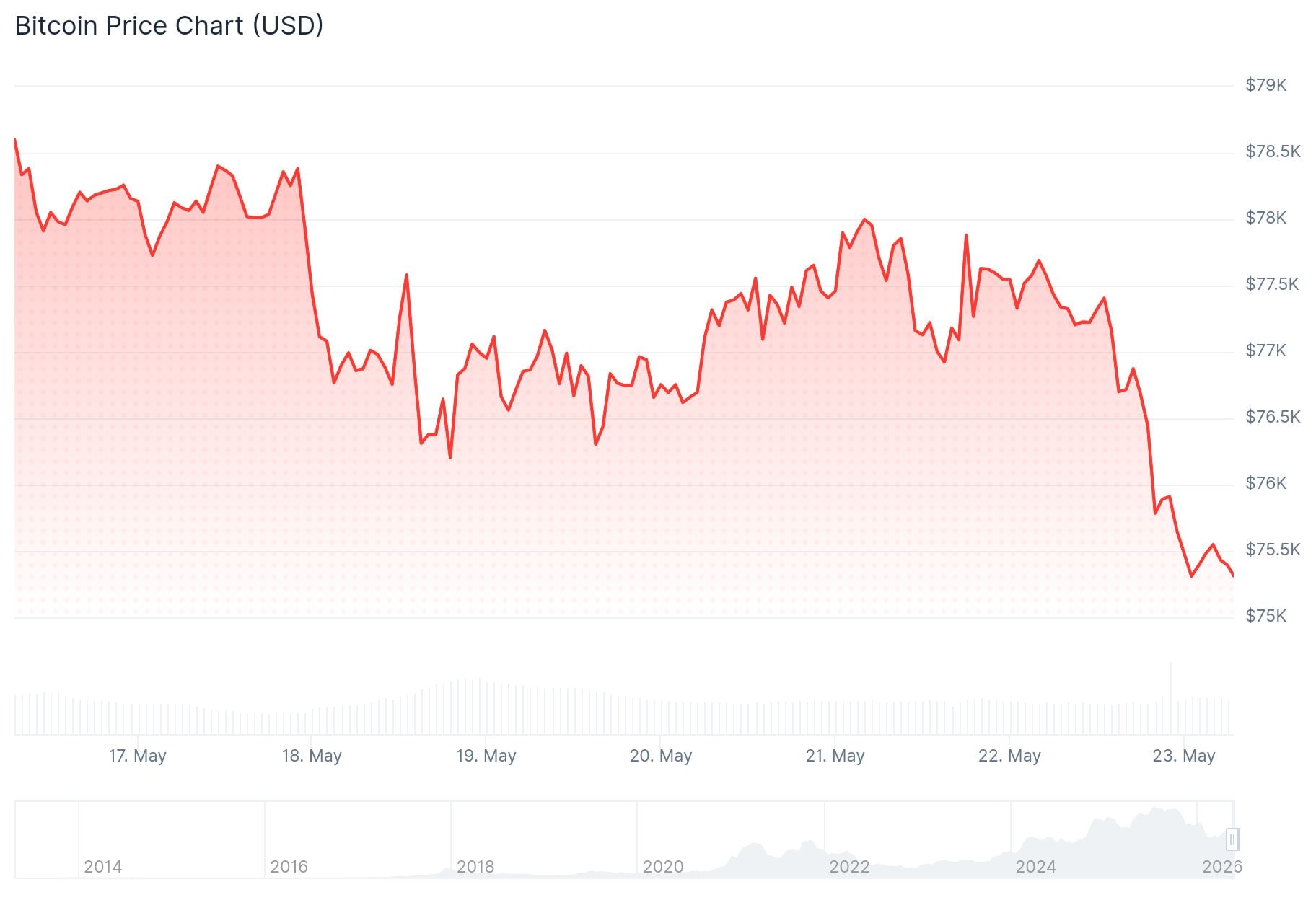
The drop was driven by a combination of macro pressure and leveraged position blow-ups. CoinGlass data showed $200 million in crypto liquidations in a single 24-hour period.
Traders ramped up bets on interest rate hikes this week as oil prices surged due to the ongoing Middle East conflict. Iran has effectively closed the Strait of Hormuz since late February, cutting off a waterway that carries about a fifth of the world’s oil and gas supply.
BREAKING: A source close to Iran's Ghalibaf says Iran's "third struggle" plan announced by the IRGC will close Bab el-Mandeb Strait "by fire" and disable the seven submarine internet cables under the Strait of Hormuz, in immediate response to upcoming US strikes that Iran has…
— The Hormuz Letter (@HormuzLetter) May 23, 2026
That supply shock has stoked inflation fears. Minutes from the Federal Reserve’s April meeting showed most policymakers are now open to rate hikes if energy-driven inflation continues.
Kevin Warsh was sworn in as the new Fed chair on Friday, taking the role at a difficult moment. President Trump has pushed for rate cuts, but the current inflation environment makes easing look unlikely.
Nexo Dispatch analyst Dessislava Ianeva noted the cross-asset picture shifted sharply mid-week. “U.S.–Iran de-escalation headlines pulled Brent from above $110 to $105.7 a barrel, while hawkish April FOMC minutes pinned long-end yields near cycle highs,” she said.
Crypto trader Daan Crypto Trades (@DaanCrypto) posted on X that BTC still has a clear path forward on the chart. He said Bitcoin needs to clear the low $80K zone, where both the horizontal resistance and the daily 200-day moving average are sitting. He described this as the first major pullback since Bitcoin’s April rally, and said bulls need to form a higher low or risk confirming a lower high in what has been a broader downtrend since the October 2025 all-time high.

$BTC It is still pretty straight forward from here looking at the chart.
Bitcoin needs to clear that low $80Ks region with the horizontal and Daily 200MA/EMA sitting right around the same region.
This is the first "bigger sell off" this leg up after the April move higher.… pic.twitter.com/01yL1CqatF
— Daan Crypto Trades (@DaanCrypto) May 22, 2026
ETF Outflows Cross $1.26 Billion
Spot Bitcoin ETFs recorded outflows across six straight trading sessions. The 11 US-based funds lost a combined $1.26 billion in net outflows over just the last five days, according to Farside data.
According to SoSoValue data, on May 22 (ET), U.S. spot Bitcoin ETFs recorded a total net outflow of $105 million, marking the sixth consecutive day of outflows. Spot Ethereum ETFs saw a total net outflow of $6.67 million, extending their outflow streak to 10 days. pic.twitter.com/lX95yAUmuC
— Wu Blockchain (@WuBlockchain) May 23, 2026
Bitcoin failed to hold above $80,000 in May, hitting a high of $79,052 on May 16 before pulling back. It was trading at $75,410 at the time of Santiment’s report on Friday.
Santiment Calls It a Buy Signal
Crypto sentiment firm Santiment pushed back against the bearish reading of those outflows. The firm said ETF flows mostly reflect retail investor behavior, not institutional positioning.
“Sustained ETF outflows have historically correlated with conditions favorable for patient accumulation rather than panic,” Santiment said.
ETF analyst James Seyffart said on a YouTube podcast that Bitcoin ETFs have clawed back most of the $9 billion in outflows seen between October and February. Total inflows now stand near $60 billion since launch, close to the all-time high. Seyffart said he expects that record to be broken, with more ETF products still coming to market.


