





TLDR
- Gold climbed above $4,400 an ounce on Thursday, rising 0.9% to $4,429.23
- A weaker US dollar and falling Treasury yields drove the rebound
- Fed’s NY President John Williams said inflation is continuing to ease
- US companies added just 38,000 jobs in August, cooling rate hike expectations
- Friday’s nonfarm payrolls report is now the key focus for gold traders
Gold prices pushed back above $4,400 an ounce on Thursday, extending a rebound that began in the previous session. The metal rose 0.9% to $4,429.23, while gold futures gained 1.4% to $4,474.75.
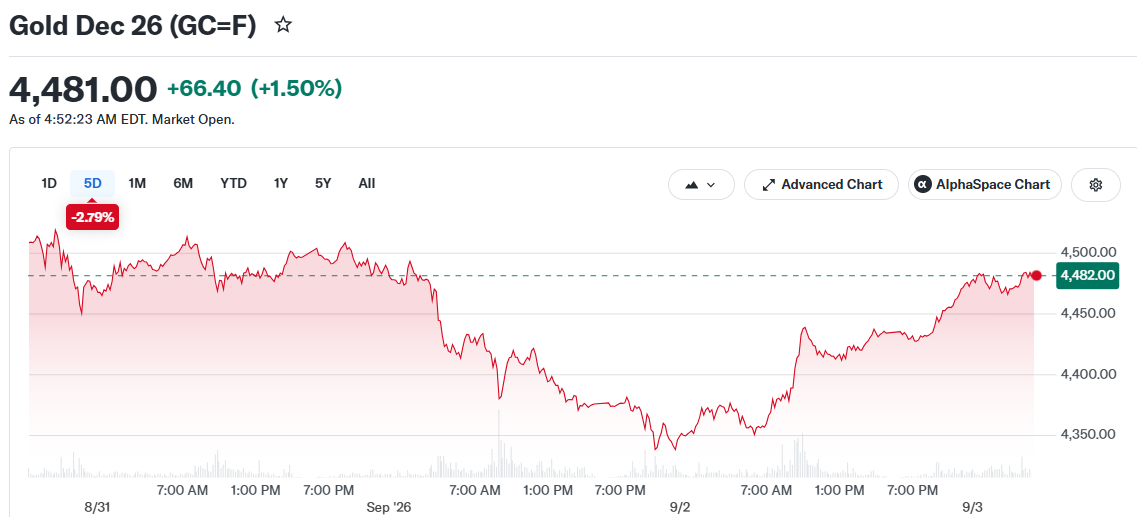
The move higher came as the US Dollar Index slipped 0.2% to 99.39. A weaker dollar typically supports gold, as the metal becomes cheaper for buyers holding other currencies.
Treasury yields also pulled back from recent highs. Lower yields reduce the appeal of income-generating assets, making gold more attractive by comparison.
Silver joined the rally, with the spot price rising 0.6% to $65.75 an ounce. Platinum also gained, up 0.8% to $1,774.92.
Fed Signals and Labor Data Cool Rate Hike Bets
Federal Reserve Bank of New York President John Williams said there is evidence that US inflation is continuing to ease as the effect of tariffs fades. He added that higher energy prices are not spreading into other services.
That was a softer message than the tone set by Fed Chair Kevin Warsh, who delivered a hawkish speech at Jackson Hole last Friday. Warsh’s comments had raised expectations for a rate hike when policymakers meet in about two weeks.
New labor market data backed up the softer outlook. US companies added just 38,000 jobs in August, according to the ADP employment report. That slower pace of hiring eased pressure for aggressive Fed tightening.

Higher interest rates tend to weigh on gold because the metal does not generate income. When yields rise, investors have more reason to hold bonds and other interest-bearing assets instead.
Iran Tensions and Oil Prices in Focus
Gold had touched a near four-week low on Wednesday before bouncing back. Part of the pressure came from oil-driven inflation concerns linked to renewed US strikes on Iran.
President Trump said the strikes would likely be short-lived. That comment helped slow oil’s recent rally and reduced some of the inflation fears that had been weighing on gold.
Sustained disruptions to energy supplies could push oil prices higher, which feeds into broader inflation. That in turn could keep the Fed on a tighter policy path, which is negative for gold.
The sharp rise in the Japanese yen also played a role, putting currency intervention back in focus and pushing the dollar lower on Wednesday.
What Comes Next
All eyes are now on Friday’s US nonfarm payrolls report for August. A weak jobs number could lower rate hike expectations and extend gold’s bounce.
A stronger print, however, could lift Treasury yields again and cap gold’s gains, according to Tickmill analyst Joseph Dahrieh. Spot gold was last trading 0.7% higher at $4,423.17 an ounce.
Despite the recent bounce, some analysts warn that gold could still face downward pressure if the jobs data comes in hot.
Stop guessing and start investing with confidence. KnockoutStocks gives you the AI insights, market intelligence, and stock research you need to spot opportunities, cut through the noise, and make smarter investment decisions — all in one powerful platform.
Sign up today and get 50% OFF full access to our premium stock picks.
Simply use coupon code SPECIAL50 at checkout to claim your exclusive discount.
Get 3 Free Stock Ebooks
Discover top-performing stocks in AI, Crypto, and Technology with expert analysis.
- Top 10 AI Stocks - Leading AI companies
- Top 10 Crypto Stocks - Blockchain leaders
- Top 10 Tech Stocks - Tech giants



