





TLDR
- South Korea’s KOSPI fell 4.3% on Monday after returning from a public holiday
- The index is now more than 25% below its June peak, confirming a bear market
- Samsung Electronics and SK Hynix both opened down more than 5% before recovering slightly
- Foreign investors bought 278.4 billion won in chip stocks while retail investors sold
- US hyperscaler earnings this week could decide if chip stocks stabilise or fall further
South Korea’s KOSPI index fell sharply on Monday, its first trading session after the Constitution Day holiday on Friday. The index dropped as low as 6,498 points before recovering slightly to close around 6,520.
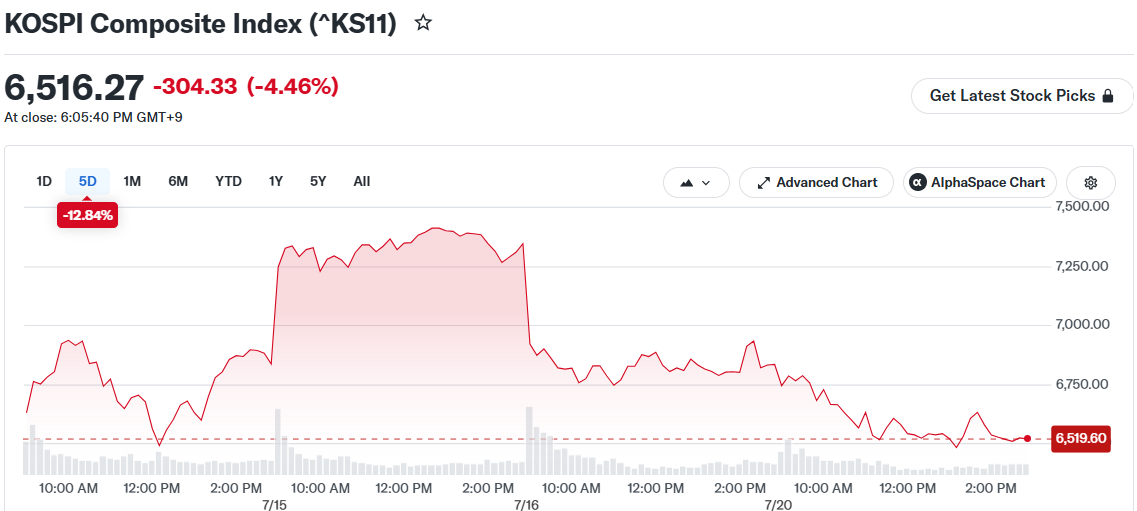
The decline pushed the index more than 25% below its June peak. That crosses the threshold for a technical bear market, which the index entered earlier in July.
Samsung Electronics and SK Hynix opened down more than 5% each. Both stocks were among the worst performers on the index, with Samsung closing down around 4.1% and SK Hynix down about 3.5%.
The chip sector has been under pressure for several weeks. Investors have been selling memory and semiconductor stocks to lock in profits after a long AI-driven rally.
Last Friday, while Korean markets were closed, the Philadelphia Semiconductor Index fell 4.3%. TSMC reported strong earnings but it was not enough to stop the sector’s slide.
Chip Stocks Face Multiple Pressures
Rising questions about whether AI-driven growth in the chip sector is sustainable have weighed on valuations. Concerns about high capital spending in the industry have also added to selling pressure.
KB Securities said in a recent note that markets are now valuing AI investments based on funding costs rather than long-term growth. The brokerage flagged that rising interest rates are adding to pressure on chip stocks this time around.

Chinese AI competition has also been a factor. Rising competition from Chinese AI models has added further pressure on the memory chip trade.
Foreign investors moved in during early trading, buying a net 278.4 billion won ($187.1 million), focused on electronics stocks. Retail investors sold a net 300.8 billion won over the same window.
Currency and Geopolitical Pressure Add to Selling
The South Korean won also weakened, with the won-dollar rate opening at 1,488.3. Oil prices climbed on fears that an escalating US-Iran conflict could disrupt the Strait of Hormuz.
A stronger dollar adds to import price pressure in South Korea. The Bank of Korea also raised rates for the first time since 2023, adding another layer of pressure on the economy.
Han Ji-young, a researcher at Kiwoom Securities, noted that Samsung Electronics, SK Hynix, and Samsung Electro-Mechanics have each dropped between 30% and 40% from their peaks.
Despite the recent losses, the KOSPI remains the best-performing stock market in the world in 2026, with a 51% year-to-date gain.
Alphabet reports earnings on July 22, followed by Microsoft, Meta, and Amazon before the end of the month. Their capital spending guidance is expected to be the next key signal for chip stocks.
Stop guessing and start investing with confidence. KnockoutStocks gives you the AI insights, market intelligence, and stock research you need to spot opportunities, cut through the noise, and make smarter investment decisions — all in one powerful platform.
Sign up today and get 50% OFF full access to our premium stock picks.
Simply use coupon code SPECIAL50 at checkout to claim your exclusive discount.
Get 3 Free Stock Ebooks
Discover top-performing stocks in AI, Crypto, and Technology with expert analysis.
- Top 10 AI Stocks - Leading AI companies
- Top 10 Crypto Stocks - Blockchain leaders
- Top 10 Tech Stocks - Tech giants



