






TLDR
- Oil fell for a third straight session after shipping through the Strait of Hormuz began recovering
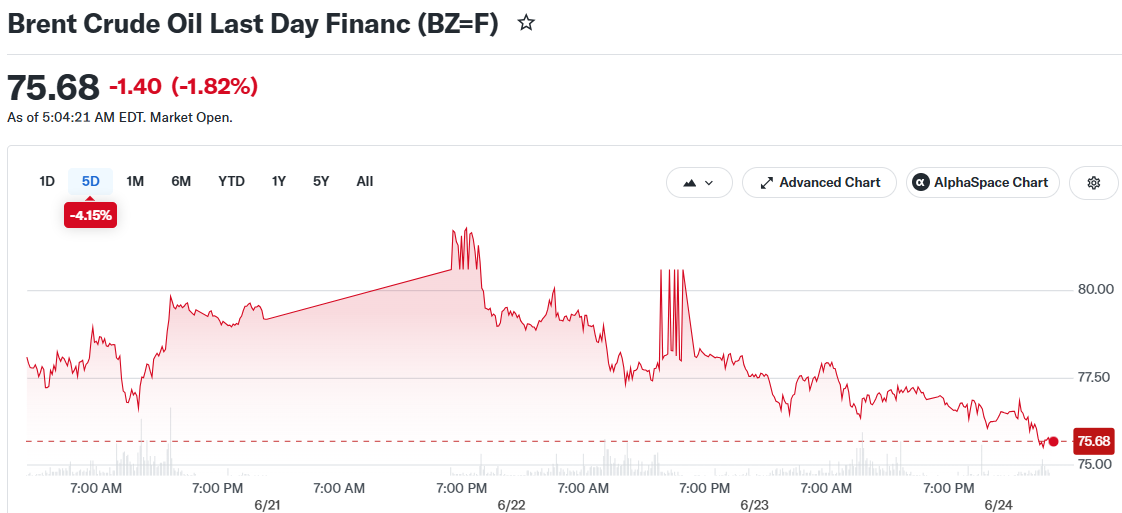
- Brent crude dropped 1.1% to $75.93 and WTI fell 1.3% to $72.31 in early European trading
- The U.S. granted a temporary sanctions waiver allowing certain Iranian oil exports through August
- U.S. and Iranian negotiators agreed to a 60-day roadmap toward a broader settlement
- U.S. crude inventories dropped by 765,000 barrels last week, less than analysts expected
Oil prices have now dropped for three days in a row as early signs of recovery in Middle East energy flows ease supply concerns.
Brent crude fell around 1% to $76.46 a barrel in early trading on Wednesday, June 24. West Texas Intermediate dropped by the same margin to $72.65. Both benchmarks settled near four-month lows in the previous session.
The Strait of Hormuz, which normally carries about 20 million barrels per day, was disrupted during a months-long regional conflict. The strait is one of the world’s most important energy chokepoints.
Tankers Moving Again
Traders are watching shipping activity closely. Several supertankers that had been stranded in the Gulf have now successfully exited carrying crude cargoes. Qatar-linked liquefied natural gas vessels have also resumed voyages through the waterway.
JUST IN: Ship traffic in the Strait of Hormuz over the last 24 hours. pic.twitter.com/x3P3QODSVg
— Watcher.Guru (@WatcherGuru) June 23, 2026
Analysts at ING said roughly 6 to 7 million barrels per day are now moving through the strait. That is still well below the normal 20 million.
However, ING added that oil supply from the Persian Gulf could return to pre-war levels if flows through the strait reach around 14 million barrels per day, given pipeline alternatives available to Saudi Arabia and the UAE.

U.S.-Iran Talks Move Forward
Diplomatic developments have added to the downward pressure on prices. U.S. and Iranian negotiators have agreed to a 60-day roadmap aimed at reaching a broader settlement.
Washington also granted a temporary sanctions waiver allowing certain Iranian oil exports to resume through August. That move has raised expectations of more crude supply coming to market in the coming weeks.
Analysts at MUFG said markets are pricing in a gradual normalization of Middle East energy flows. They noted that the U.S. sanction waiver has strengthened expectations of a meaningful increase in regional crude supply.
Despite the selloff, ING analysts said they believe the drop is overdone. They noted that the market is still tightening and that price moves suggest traders expect a fairly rapid recovery in Persian Gulf supply.
Elsewhere, U.S. crude inventory data offered a mixed picture. The American Petroleum Institute reported that crude stockpiles fell by 765,000 barrels in the week ended June 19. Analysts had expected a larger draw.
Crude stocks at the Cushing, Oklahoma delivery hub fell by 1 million barrels. Gasoline and distillate fuel oil stocks each rose.
Traders are waiting on official weekly inventory figures from the U.S. Energy Information Administration, due later Wednesday, for further confirmation of supply trends.
As of June 24, both oil benchmarks remain near their lowest levels in four months, with Brent trading around $75.93 and WTI around $72.31 a barrel.
Stop guessing and start investing with confidence. KnockoutStocks gives you the AI insights, market intelligence, and stock research you need to spot opportunities, cut through the noise, and make smarter investment decisions — all in one powerful platform.
Sign up today and get 50% OFF full access to our premium stock picks.
Simply use coupon code SPECIAL50 at checkout to claim your exclusive discount.
Get 3 Free Stock Ebooks
Discover top-performing stocks in AI, Crypto, and Technology with expert analysis.
- Top 10 AI Stocks - Leading AI companies
- Top 10 Crypto Stocks - Blockchain leaders
- Top 10 Tech Stocks - Tech giants



