





TLDR
- Oil prices fell sharply Sunday after Trump said a US-Iran peace deal would be announced “shortly”
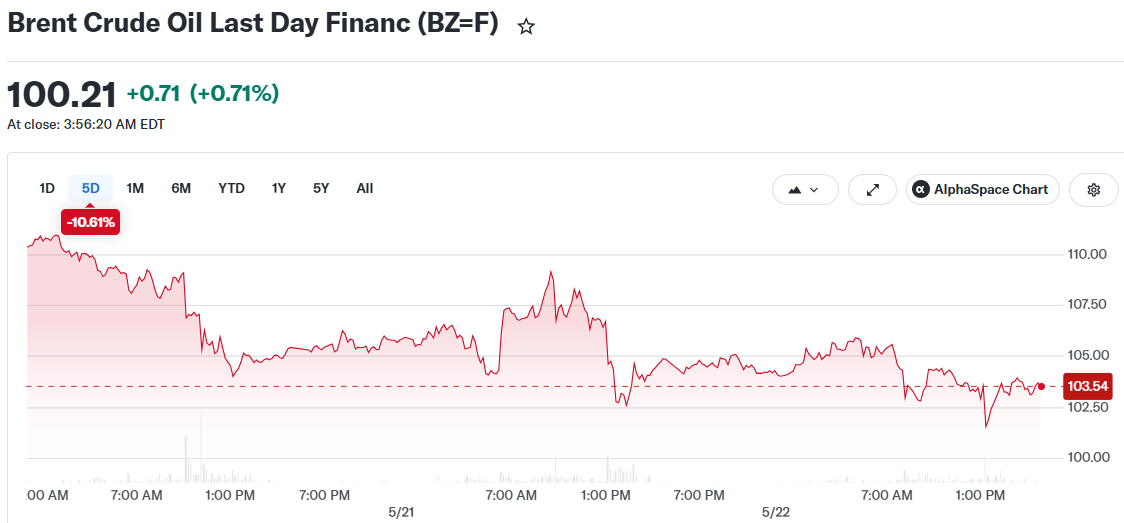
- Brent crude dropped 4.9% to $98.45 a barrel; West Texas Intermediate fell 5.4% to $91.38
- The Strait of Hormuz has been closed since late February, cutting roughly 1 billion barrels from global supply
- Key sticking points remain, including frozen Iranian assets and Iran’s nuclear program
- US energy firms added oil and gas rigs for the fifth straight week, the first such streak since February 2025
Oil prices fell sharply on Sunday and into Monday after President Trump said the US and Iran were close to announcing a peace deal that would reopen the Strait of Hormuz.
Brent crude dropped 4.9% to $98.45 a barrel. West Texas Intermediate fell 5.4% to $91.38. Both benchmarks hit their lowest levels since May 7.
Trump said on Saturday that an agreement had been “largely negotiated” and would be announced shortly. He posted the update on Truth Social, saying the framework was subject to finalization between the US, Iran, and several other countries.
🚨 "An Agreement has been largely negotiated, subject to finalization between the United States of America, the Islamic Republic of Iran, and the various other Countries, as listed…" – President Donald J. Trump pic.twitter.com/Z49bOkkUoh
— The White House (@WhiteHouse) May 23, 2026
By Sunday, Trump had pulled back slightly. He said the US would not rush into a deal and that time was “on our side.” He later added that a deal “isn’t even fully negotiated yet.”
Secretary of State Marco Rubio said more news could come Sunday, but US officials told Bloomberg the country was not ready to sign anything.
What’s Still Holding Up a Deal
The two sides remain at odds on several key issues.
Iran has called for the unfreezing of its assets held by the US Treasury Department. The US has so far refused. Iran’s Supreme Leader Ayatollah Mojtaba Khamenei also said last week that Iran’s nuclear material cannot be removed from the country, which conflicts with a stated US red line.

Iran’s foreign ministry described talks as being in the “final stage” of drafting a memorandum of understanding. But state-run media reported the deal could still collapse.
If a deal is reached, it could include a full ceasefire, a reopening of the Strait of Hormuz, and a gradual easing of sanctions on Iranian oil. Nuclear issues would be handled in later negotiations.
Why the Strait of Hormuz Matters
The Strait of Hormuz carried about one-fifth of global oil and liquefied natural gas shipments before the conflict began in late February.
Since it closed, the global market has lost roughly 1 billion barrels of oil, according to the International Energy Agency. That makes it the largest supply shock on record.
Analysts say even if a deal is signed, a return to normal oil flows could take months while damaged facilities are repaired.
“We’ve been at this stage before, only for talks to break down,” said Warren Patterson, head of commodities strategy at ING. “The market will likely be more cautious about overreacting.”
MST Marquee analyst Saul Kavonic said there is now “some light at the end of the tunnel,” but risks remain.
In the US, energy firms added oil and gas rigs for the fifth week in a row. The rig count rose by seven to 558 in the week to May 22, its highest since June 2025. Baker Hughes noted the total was still down 1% from a year ago.
Stop guessing and start investing with confidence. KnockoutStocks gives you the AI insights, market intelligence, and stock research you need to spot opportunities, cut through the noise, and make smarter investment decisions — all in one powerful platform.
Sign up today and get 50% OFF full access to our premium stock picks.
Simply use coupon code SPECIAL50 at checkout to claim your exclusive discount.
Get 3 Free Stock Ebooks
Discover top-performing stocks in AI, Crypto, and Technology with expert analysis.
- Top 10 AI Stocks - Leading AI companies
- Top 10 Crypto Stocks - Blockchain leaders
- Top 10 Tech Stocks - Tech giants



