





TLDR
- Oil prices rose for a third straight session on Wednesday, with Brent reaching $85.23 and WTI at $79.67 per barrel
- The U.S. resumed its maritime blockade on Iranian shipping through the Strait of Hormuz on Tuesday
- Trump threatened further strikes on Iran, including power plants and bridges, if Tehran doesn’t return to talks
- Trump dropped a proposed 20% transit fee on Hormuz cargo after pushback from Gulf allies
- Shipping through the strait has slowed, though not fully stopped, as the conflict escalates
Oil prices climbed for a third day in a row on Wednesday as tensions between the U.S. and Iran pushed supply fears higher. Brent crude rose 0.6% to $85.23 a barrel, while West Texas Intermediate gained 0.4% to $79.67.
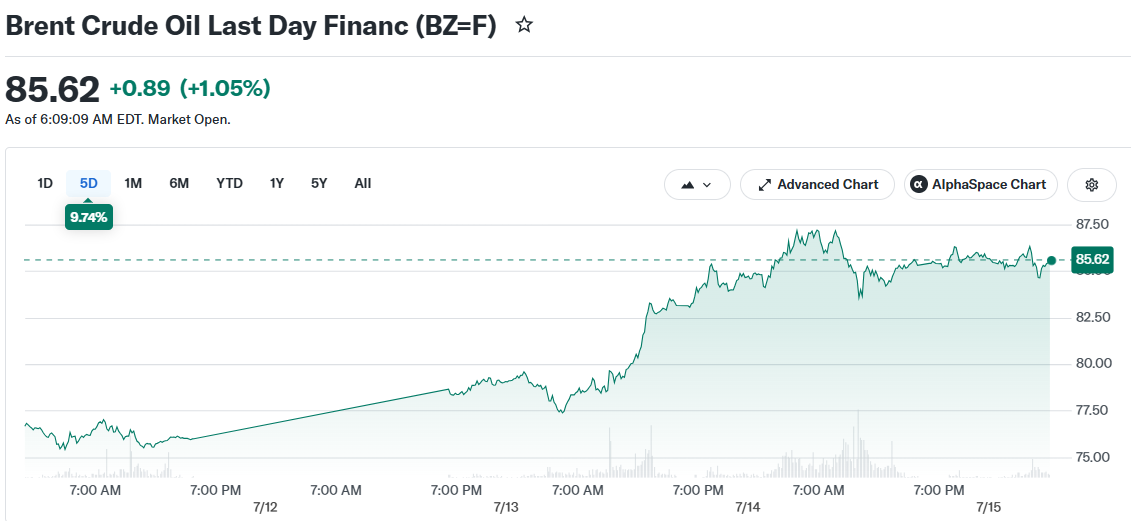
Both benchmarks are sitting near their highest levels in about a month. They had already surged nearly 10% in the first two sessions of the week.
U.S. Strikes and Blockade Renew Supply Fears
The U.S. military launched fresh strikes on Iranian targets early Wednesday. The stated goal was to degrade Iran’s ability to attack commercial ships in the Strait of Hormuz.
BREAKING: President Trump held a Situation Room meeting on Tuesday to discuss a "massive offensive" in Iran, per Axios.
Details include:
1. The offense will include strikes that are wider in scope than the current strikes around the Strait of Hormuz
2. Trump was joined in the…
— The Kobeissi Letter (@KobeissiLetter) July 15, 2026
President Trump said in a Fox News interview that the U.S. would keep striking Iran unless Tehran came back to the negotiating table. He warned that power plants and bridges could be targeted as early as next week if no deal is reached.
Trump also said energy facilities would be spared for now.
The U.S. formally resumed its maritime blockade on Iranian shipping Tuesday evening. The blockade came one hour after the latest round of military strikes.

Trump had earlier proposed a 20% transit fee on cargo passing through the Strait of Hormuz. He dropped the plan after Gulf allies pushed back against it. He said the lost revenue would be replaced by direct investments from Gulf states, though no amounts or country names were given.
Hormuz Chokepoint Under Pressure
The Strait of Hormuz carries roughly one-fifth of global oil and liquefied natural gas. Shipping through it has slowed but not stopped entirely.
Energy specialist Scott Shelton of TP ICAP said the situation remains unclear. “Are we at war? Will the U.S. be able to control the Strait of Hormuz and enable non-Iranian ships to get through? As of today, nothing is getting through,” he said.
Iran-backed Houthi fighters in Yemen also fired ballistic missiles and drones at Saudi Arabia. It was the first major escalation between the two sides since their 2022 ceasefire.
U.S. crude inventory data from the American Petroleum Institute showed a draw of about 600,000 barrels last week. That was well below the expected draw of around 2.7 million barrels.
The ceasefire between the U.S. and Iran collapsed, prompting the fresh wave of hostilities. The conflict has brought shipping in the strait to a near-standstill, with no clear resolution in sight.
Stop guessing and start investing with confidence. KnockoutStocks gives you the AI insights, market intelligence, and stock research you need to spot opportunities, cut through the noise, and make smarter investment decisions — all in one powerful platform.
Sign up today and get 50% OFF full access to our premium stock picks.
Simply use coupon code SPECIAL50 at checkout to claim your exclusive discount.
Get 3 Free Stock Ebooks
Discover top-performing stocks in AI, Crypto, and Technology with expert analysis.
- Top 10 AI Stocks - Leading AI companies
- Top 10 Crypto Stocks - Blockchain leaders
- Top 10 Tech Stocks - Tech giants



