





TLDR
- Oil prices edged higher Thursday after a sharp 5.6% drop on Wednesday
- Trump said the US is in “final stages” of talks with Iran but warned of potential strikes
- Iran launched a new “Persian Gulf Strait Authority” to control Hormuz traffic
- US crude inventories fell 7.9 million barrels last week, nearly triple expectations
- Full oil flow recovery from Hormuz closure not expected until well into 2027
Oil prices climbed on Thursday after a steep selloff the day before, as mixed signals from US-Iran peace talks kept traders on edge.
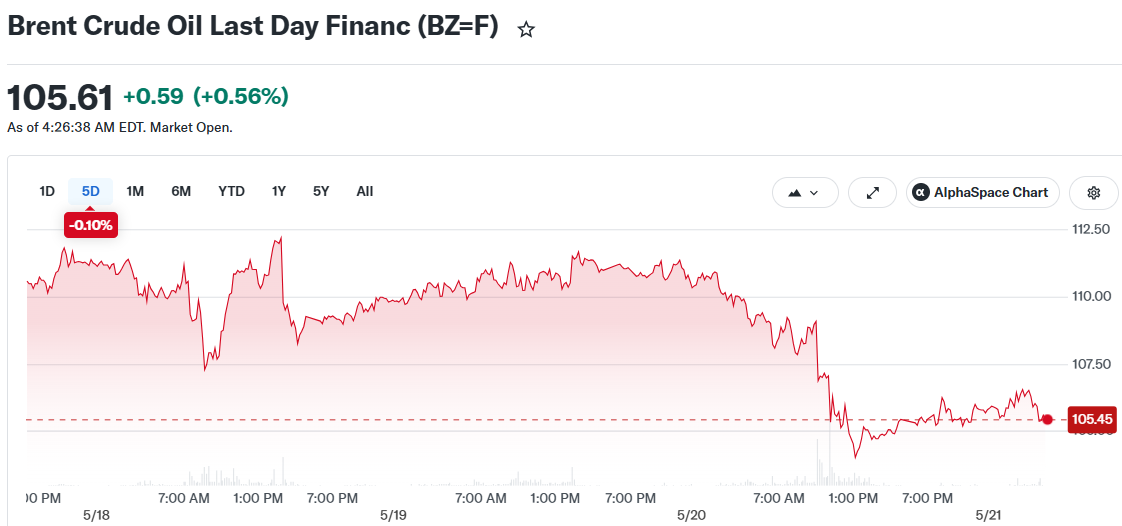
Brent crude neared $106 a barrel after sliding 5.6% on Wednesday. West Texas Intermediate was above $99. The moves followed a series of conflicting statements from both Washington and Tehran.
President Trump told reporters the US is in the “final stages” of negotiations with Iran. He also warned that the US was prepared to take military action if a deal is not reached, calling the situation “right on the borderline.”
Trump added he could wait “a few days” before any further action.
Iran Signals and the Strait of Hormuz
Iran said it is reviewing the latest US draft proposal in response to Tehran’s 14-point peace plan. No formal response has been given yet, according to semi-official Iranian media.
US reportedly submitted a draft of a new agreement to Iran via Pakistan, Al Arabiya reports. Iran is still reviewing the text and has not submitted a response yet. Work is reportedly underway on a framework for a temporary US-Iran agreement.
— Wall St Engine (@wallstengine) May 21, 2026
Tehran also warned that any new US or Israeli attack would trigger retaliation beyond the Middle East.
Iran launched a new “Persian Gulf Strait Authority” this week to control shipping traffic through the Strait of Hormuz. The country had previously announced plans to charge tolls on vessels using the channel.

The strait remains largely closed. While two Chinese oil tankers successfully crossed the waterway Wednesday, traffic is still a fraction of pre-war levels.
The Strait of Hormuz handles roughly 20% of global oil supply. Abu Dhabi National Oil CEO Sultan Al Jaber said Wednesday that even if the conflict ended immediately, Middle East oil flows would not fully recover until well into 2027. He called the closure the most severe supply disruption on record.
US Inventory Drop Adds Pressure
New data released Wednesday showed a sharp drop in US crude inventories. Stockpiles fell 7.9 million barrels in the week ending May 15, far above the expected draw of 2.9 million barrels.
The drop was driven by strong US oil exports as Washington ramped up crude sales to countries looking to offset Middle East supply losses.oil p
Gasoline inventories fell 1.5 million barrels, less than the expected 2.1 million barrel draw. The smaller decline raised questions about fuel demand slowing as gas prices rise.
Goldman Sachs said global stockpiles of crude and products are being drawn down at a record pace this month.
Analysts at Rabobank noted that even a peace deal would not bring immediate relief. “It takes up to 55 days to get oil from the Persian Gulf to its destination,” said Joe DeLaura, global energy strategist at Rabobank.
Oil prices are still more than 40% higher than when the conflict began at the end of February.
Three oil supertankers attempted to cross the Hormuz strait in recent days, the latest sign of a small uptick in traffic. Iran claimed 26 ships passed in 24 hours, though that figure is higher than what ship-tracking data shows.
Stop guessing and start investing with confidence. KnockoutStocks gives you the AI insights, market intelligence, and stock research you need to spot opportunities, cut through the noise, and make smarter investment decisions — all in one powerful platform.
Sign up today and get 50% OFF full access to our premium stock picks.
Simply use coupon code SPECIAL50 at checkout to claim your exclusive discount.
Get 3 Free Stock Ebooks
Discover top-performing stocks in AI, Crypto, and Technology with expert analysis.
- Top 10 AI Stocks - Leading AI companies
- Top 10 Crypto Stocks - Blockchain leaders
- Top 10 Tech Stocks - Tech giants



