






TLDR
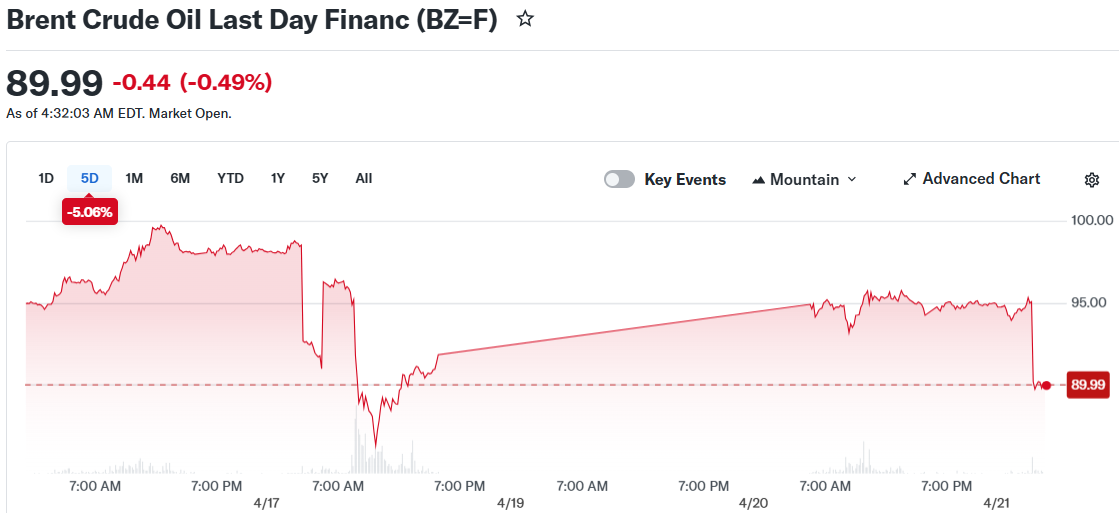
- Brent crude fell over 1% to $94.44 after Monday’s 5.6% gain, as Iran agreed to send a delegation to talks in Pakistan
- The US ceasefire with Iran expires Wednesday, and Trump says an extension is “highly unlikely”
- Hormuz shipping remains near a standstill, cutting off roughly a fifth of global crude supply
- Saudi Arabia and UAE are rerouting oil through alternative terminals, with combined loading rising to 6.5 million barrels per day
- Citigroup warns oil could hit $110 a barrel if Hormuz disruption continues for another month
Oil prices slipped on Tuesday after Iran indicated it would send a team to peace talks with the US in Islamabad, Pakistan. The move came despite Iranian officials publicly opposing further negotiations.
Brent crude dropped as much as 1.1% to $94.44 a barrel, pulling back after a 5.6% gain on Monday. West Texas Intermediate fell 0.9% to $86.68 a barrel in Asian trade.
Iran’s parliament speaker Mohammad Bagher Ghalibaf said the country would not negotiate “under the shadow of threats” from Washington. But a Wall Street Journal report said Iran had privately told regional mediators it would send a delegation to Pakistan this week.
⚡️JUST IN: IRAN WILLING TO NEGOTIATE A DEAL
Iran will send negotiators to Pakistan on Tuesday for second-round US talks led by Vice President JD Vance, per WSJ. pic.twitter.com/9QvNkAf3cO
— Coin Bureau (@coinbureau) April 20, 2026
It remains unclear who will lead the Iranian delegation.
Vice President JD Vance is traveling to resume talks, expected either Tuesday night or Wednesday morning. Trump said Sunday it is “highly unlikely” he would extend the ceasefire, which expires Wednesday evening Washington time.
Trump also confirmed that a US naval blockade against Iran will stay in place until a peace deal is reached. The US Navy seized an Iranian vessel over the weekend, which prompted Tehran to reimpose controls on the Strait of Hormuz.

Hormuz Shipping Remains Stalled
The Strait of Hormuz has been effectively blocked since the war began in late February. Iran briefly reopened the channel over the weekend before closing it again.
Only three vessels attempted to transit the strait early Tuesday. The waterway normally handles about a fifth of the world’s crude oil supplies.
ANZ analysts noted that the “ongoing uncertainty continues to overshadow any peace agreement” as Iran remains reluctant to return to talks.
Saudi Arabia and the UAE have started rerouting shipments to avoid Hormuz. They are using the Yanbu terminal in the Red Sea and the Fujairah terminal in the Gulf of Oman. Combined loading at these two facilities has risen to 6.5 million barrels per day, up from 5.0 million before the war.
What Analysts Are Saying
Citigroup said oil prices could rise to $110 a barrel if Hormuz remains disrupted for another month.
The International Energy Agency’s executive director Fatih Birol warned that global energy markets could stay volatile for up to two years due to the conflict.
Pepperstone research strategist Dilin Wu said markets will be “super sensitive to any headline updates in the next 24 hours.”
Chinese President Xi Jinping called for an immediate ceasefire and the restoration of normal Hormuz transit on Monday, in a phone call with Saudi Crown Prince Mohammed bin Salman.
As of Tuesday morning, no confirmed second round of US-Iran talks had been scheduled, and the ceasefire deadline remains Wednesday evening.
Stop guessing and start investing with confidence. KnockoutStocks gives you the AI insights, market intelligence, and stock research you need to spot opportunities, cut through the noise, and make smarter investment decisions — all in one powerful platform.
Sign up today and get 50% OFF full access to our premium stock picks.
Simply use coupon code SPECIAL50 at checkout to claim your exclusive discount.
Get 3 Free Stock Ebooks
Discover top-performing stocks in AI, Crypto, and Technology with expert analysis.
- Top 10 AI Stocks - Leading AI companies
- Top 10 Crypto Stocks - Blockchain leaders
- Top 10 Tech Stocks - Tech giants



