






TLDR
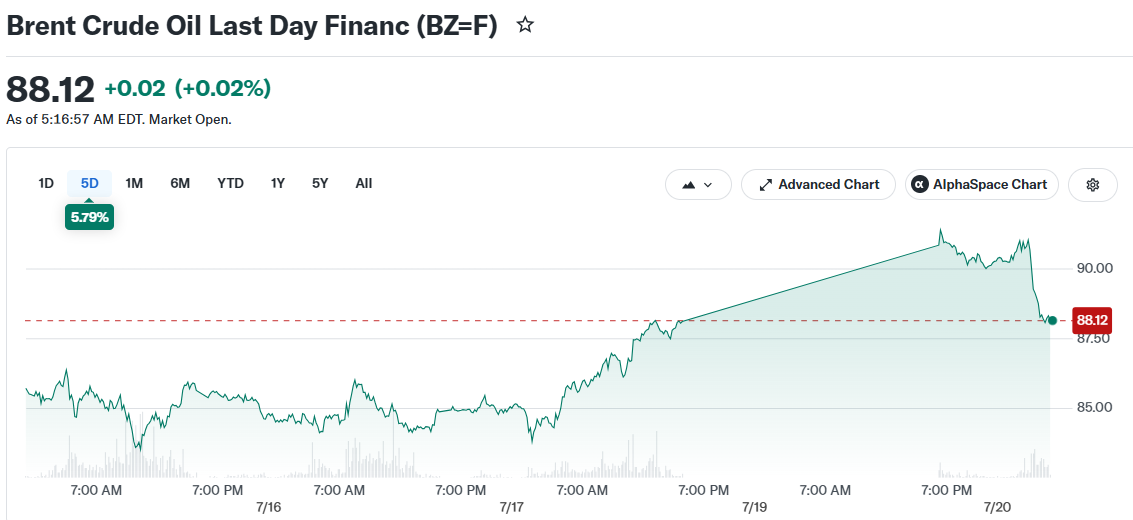
- Brent crude hit a five-week high of $90.75 before easing back to around $88-$89 a barrel on Monday
- The U.S. conducted its ninth straight day of military strikes against Iran
- Strait of Hormuz transit volumes dropped to single digits, with just four vessels passing on Sunday
- Two oil tankers were struck and immobilized attempting to transit the strait
- ANZ analysts said the anticipated shipping recovery has “effectively stalled”
Oil prices surged to their highest level in over a month on Monday before pulling back, as the escalating conflict between the U.S. and Iran continued to choke off crude shipments through the Strait of Hormuz.
Brent crude hit an intraday high of $90.75 a barrel — a five-week peak — before easing to around $88.26 after an Iranian foreign ministry spokesperson said negotiations with the U.S. could be pursued based on national interests.
West Texas Intermediate also slipped, falling 0.4% to $82.18 a barrel after earlier trading above $83.
Strait of Hormuz Traffic Falls to Single Digits
The drop in oil shipments through the strait has been sharp. Just four vessels made the transit on Sunday, down from eight the day before, according to LSEG data.
BREAKING: Iran's IRGC announces that two oil tankers attempting to transit the Strait of Hormuz overnight detonated and blew up in the Iranian minefield and were prevented from proceeding, per Tasnim.
The IRGC declares "this is our land" and warns "as long as America's mischief…
— The Hormuz Letter (@HormuzLetter) July 20, 2026
ANZ analysts said transit volumes had fallen to single digits, adding that “the anticipated recovery in shipping has effectively stalled.”
Before the Iran war began in late February, roughly 20% of global oil supplies moved through the waterway.

The Islamic Revolutionary Guard Corps said two oil tankers were struck and immobilized after explosions as they tried to transit the strait. Tehran alleged the vessels had been encouraged by U.S. military to use what it called an unsafe southern route.
Reuters said it could not immediately verify those claims.
U.S. forces have carried out strikes against Iran for nine consecutive days. Iranian forces responded with strikes on U.S. aircraft at a Jordan airport, and at American military assets in Kuwait and Syria.
Bahrain also reported sirens sounding Monday morning.
Oil Market Tightens as Global Inventories Shrink
UBS analyst Giovanni Staunovo said the oil market is “again tightening,” with repeated strikes on vessels crossing the strait resulting in a drop in tankers exiting the Gulf.
ANZ analysts noted that while U.S. production has increased, it has not materially changed the broader market balance. Global inventories continue to shrink, keeping crude and refined products markets tight.
Brent posted its biggest weekly gain since April last week, rising 15.9%. West Texas Intermediate climbed 15.5% over the same period, its largest weekly rise since early March.
Brent crude had spiked above $110 a barrel earlier in the conflict before falling back to around $70 after a ceasefire deal was signed in June. That truce has since collapsed.
Gulf countries did boost crude and condensate exports in early July to their highest levels since before the war started. However, flows through the Strait of Hormuz are now slowing again as fighting picks up.
Iran has also pressed the Houthis to close the Red Sea route if the U.S. attacks Iranian power infrastructure, raising the prospect of further supply disruptions.
Stop guessing and start investing with confidence. KnockoutStocks gives you the AI insights, market intelligence, and stock research you need to spot opportunities, cut through the noise, and make smarter investment decisions — all in one powerful platform.
Sign up today and get 50% OFF full access to our premium stock picks.
Simply use coupon code SPECIAL50 at checkout to claim your exclusive discount.
Get 3 Free Stock Ebooks
Discover top-performing stocks in AI, Crypto, and Technology with expert analysis.
- Top 10 AI Stocks - Leading AI companies
- Top 10 Crypto Stocks - Blockchain leaders
- Top 10 Tech Stocks - Tech giants



