





TLDR
- Oil briefly topped $105 a barrel Thursday as tensions in the Strait of Hormuz escalated
- Iran’s Revolutionary Guard attacked three ships in the strait Wednesday
- Brent crude settled above $100 for the first time since the ceasefire began
- The US extended its ceasefire but kept its naval blockade on Iranian ports in place
- Talks between the US and Iran have stalled, with no new meeting scheduled
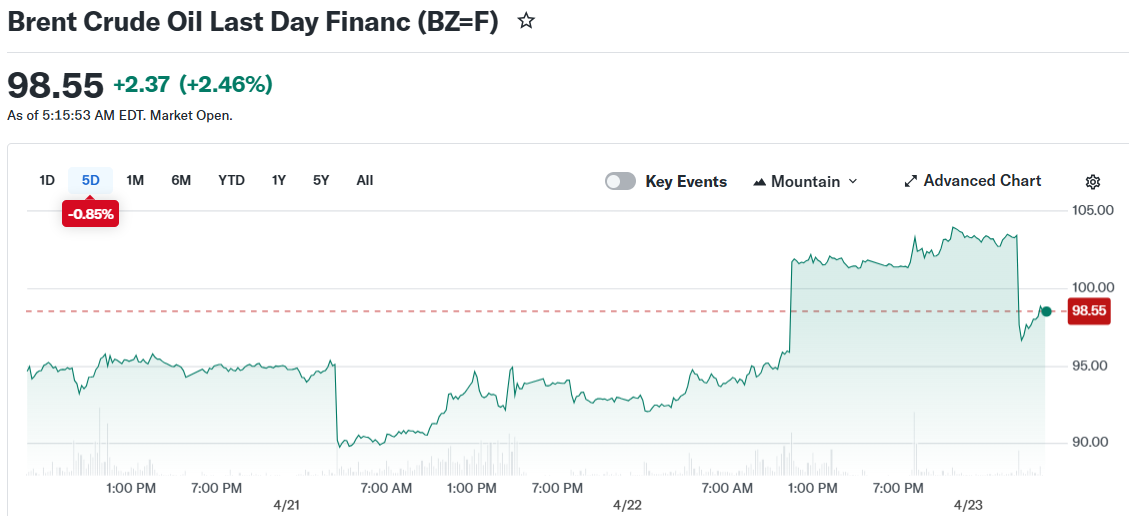
Oil prices jumped above $105 a barrel on Thursday as fighting resumed in the Strait of Hormuz, just hours after the US said it was extending a ceasefire with Iran.
Iran’s Islamic Revolutionary Guard Corps attacked three commercial ships in the strait on Wednesday. The attacks came shortly after President Donald Trump announced the truce agreed on April 7 would stay in place indefinitely.
Brent crude futures rose 1.4% to $103.36 a barrel early Thursday. West Texas Intermediate futures also rose 1.4%, reaching $92.96. Brent had jumped as much as 4.2% earlier in the session before pulling back on unconfirmed reports of explosions inside Iran.
🚨JUST IN: Iran has reportedly attacked multiple commercial ships in the Strait of Hormuz, hours after President Trump announced a ceasefire extension, per NBC.
The IRGC reportedly fired on at least 3 vessels today.
One container ship sustained heavy damage.
Iran claims it… pic.twitter.com/jnND8aoQVs
— Coin Bureau (@coinbureau) April 23, 2026
The Strait of Hormuz handles around 20% of the world’s oil supply. Since fighting began in late February, the near-closure of the strait has sharply cut oil flows from major Gulf producers.
The US has maintained a naval blockade on ships going to and from Iranian ports. Iran’s Foreign Minister Abbas Araghchi called the blockade a violation of the ceasefire agreement.
Traffic through the strait effectively stopped on Thursday. Only one bulk carrier was seen moving through the waterway.

Talks at a Standstill
Washington and Tehran are deadlocked on several issues, including Iran’s nuclear program and Israel’s invasion of Lebanon.
Iranian President Masoud Pezeshkian said he welcomes talks but called the “blockade and threats” the main obstacles to diplomacy. Tehran says it has no plans to join negotiations in the near term.
Mediators are reportedly still pushing for peace talks as early as Friday, according to the Wall Street Journal. But no meeting has been confirmed.
“Tensions are remaining high, and with the US and Iran currently at a stalemate, until somebody flinches, the path of least resistance for prices still looks higher,” said Dennis Kissler, senior vice president at BOK Financial Securities.
Supply Disruption Weighing on Markets
Brent has risen almost 13% over the last three sessions alone. Analysts say the market is beginning to price in a longer disruption rather than a quick resolution.
“The lack of progress in peace talks means that hopes the oil market had for a resolution will fade,” said Warren Patterson, head of commodities strategy at ING. “The market will gradually become numb to these headlines if they turn out to be just headlines.”
US oil inventory data published Wednesday by the Energy Information Administration showed declines across all major refined product categories.
The world has been leaning on US supplies to offset Middle East disruptions. That rising demand pushed total US oil and fuel exports to a fresh record, according to the agency.
On Thursday, just one vessel was seen transiting the Strait of Hormuz, with none observed entering the waterway.
Stop guessing and start investing with confidence. KnockoutStocks gives you the AI insights, market intelligence, and stock research you need to spot opportunities, cut through the noise, and make smarter investment decisions — all in one powerful platform.
Sign up today and get 50% OFF full access to our premium stock picks.
Simply use coupon code SPECIAL50 at checkout to claim your exclusive discount.
Get 3 Free Stock Ebooks
Discover top-performing stocks in AI, Crypto, and Technology with expert analysis.
- Top 10 AI Stocks - Leading AI companies
- Top 10 Crypto Stocks - Blockchain leaders
- Top 10 Tech Stocks - Tech giants



