



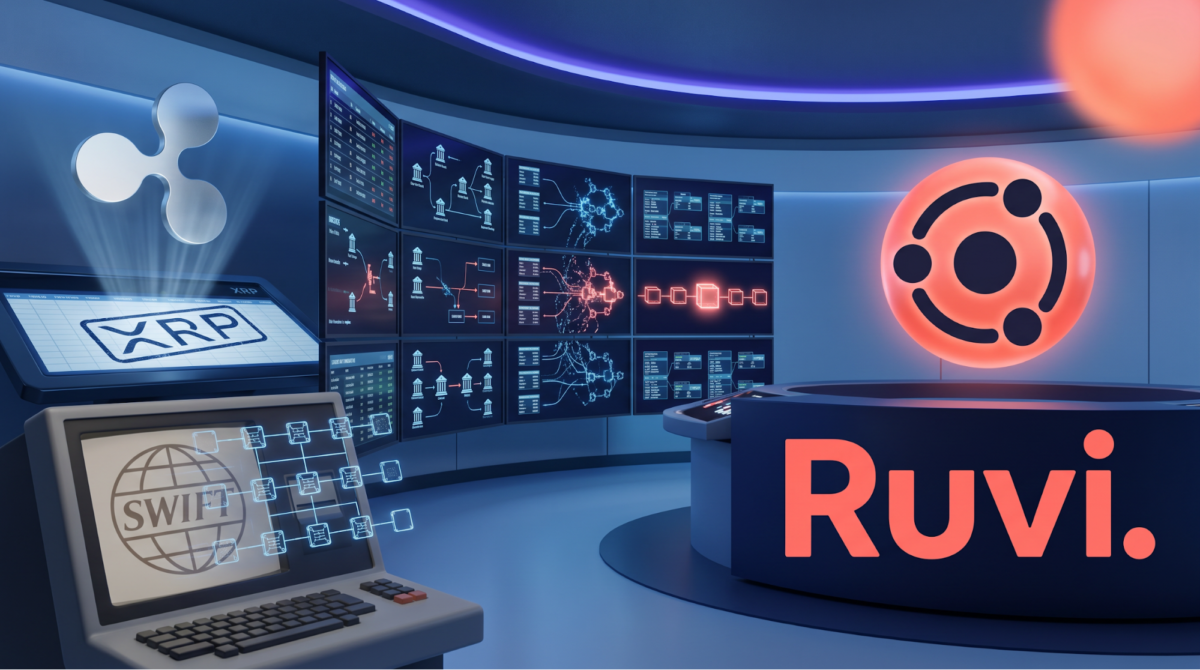


SWIFT recently named more than 50 institutions in its new payment framework, and at least 30 of them already hold ties to Ripple, including Deutsche Bank, Santander, HSBC, Standard Chartered, and JPMorgan. XRP trades near $1.42 after ETF inflows topped $1.44 billion, with a cup-and-handle pattern pointing analysts toward $1.70. The token still sits far below its $3.65 peak from last year.
While traders track each XRP price prediction, some investors are also turning toward the Ruvi AI (RUVI) decentralized AI superapp, which integrates 20+ AI models and is rolling out a public token sale across seven phases priced from $0.020.
XRP Price Prediction Hinges on Bank Rails It Cannot Capture
Analysts remain split on the XRP price prediction. Standard Chartered has floated multi-dollar targets, while a panel of AI models polled this year returned a 2026 range from $1.40 to $14. Yet a sharp nuance shadows the optimism: most of the 2026 Ripple corridors run on stablecoins like RLUSD, not XRP directly, and SWIFT’s framework does not require XRP at any step.

South Korea’s Kbank signed Ripple in April to test Korea-UAE remittances, but the messaging layer rarely touches the token. XRP holders watch banks adopt the rails while the asset captures little of the fee flow moving across them.
Why XRP Holders Are Studying the Ruvi Token Sale

That structural gap is the rotation story. XRP holders capture none of the settlement revenue flowing through RippleNet, because fees go to network operators, not the token. That is exactly what Ruvi was built to solve.
Every contributor who corrects, ranks, or refines outputs inside the AI superapp earns $RUVI, funded by a 1.25 billion token Ecosystem and Rewards allocation. Platform revenue feeds an on-chain buyback that permanently burns supply as usage grows. Staking activates at the end of the presale. XRP offers exposure to bank rails it does not own. Ruvi pays the people building its network.
What a $500 Ruvi Position Looks Like Across Seven Phases
Ruvi runs a seven-phase token presale on a fixed 5 billion supply, non-mintable, with no inflation. Phase 3 is priced at $0.020. The final phase lands at $0.070, a 3.5x climb from there, with a $0.10 listing target representing a 5x move from Phase 3. A $500 position at Phase 3’s $0.020 buys 25,000 $RUVI. At the $0.070 final phase that allocation is worth $1,750. At the $0.10 listing target that is $2,500.

At a $1 token price that is $25,000. VIP buyers stack bonuses up to plus 100% at VIP 5 on a 500,000 $RUVI commitment, which is 500,000 free tokens before listing. Presale buyers unlock 100% at launch, with no cliff or vesting. While XRP holders wait for banks to route value past their token, Ruvi is shipping product to 3,000+ holders, and each phase that fills raises the price permanently.
Conclusion
XRP news is a cycle of banks adopting rails the token does not capture, leaving the asset near $1.42 while holders search for real revenue capture. Ruvi at $0.020 with 3,000+ holders, 20+ AI models live, a fixed 5 billion supply, and contributor payouts in $RUVI is not waiting on anyone. Make a move before Phase 3 closes and today’s entry becomes the floor.
FAQs
What is the XRP price prediction for 2026? XRP trades near $1.42 after $1.44 billion in ETF inflows, with analyst targets ranging from $1.40 to $14. The token remains below its $3.65 peak as bank adoption favors stablecoins over XRP.
Why are XRP holders buying Ruvi? XRP holders capture none of the settlement revenue moving through RippleNet. Ruvi flips that by paying contributors in $RUVI for user-training value and burning supply through on-chain buybacks tied to real platform revenue.
Is Ruvi better than XRP? Ruvi is live with 20+ AI models, 3,000+ holders, a fixed 5 billion supply, and a Phase 3 price of $0.020 across a 1.5 billion token sale. The contrast in execution speaks for itself.
Useful Links
Website/Buy $RUVI: Ruvi.io
Whitepaper: Docs
X/Twitter: @RuviAiOfficial
Telegram: @Ruviofficial


