





TLDR
- Samsung projected Q1 operating profit of ~57.2 trillion won ($39B), an eightfold year-on-year jump, beating market expectations.
- The results were driven by soaring demand for high-bandwidth memory (HBM) and AI data centre chips.
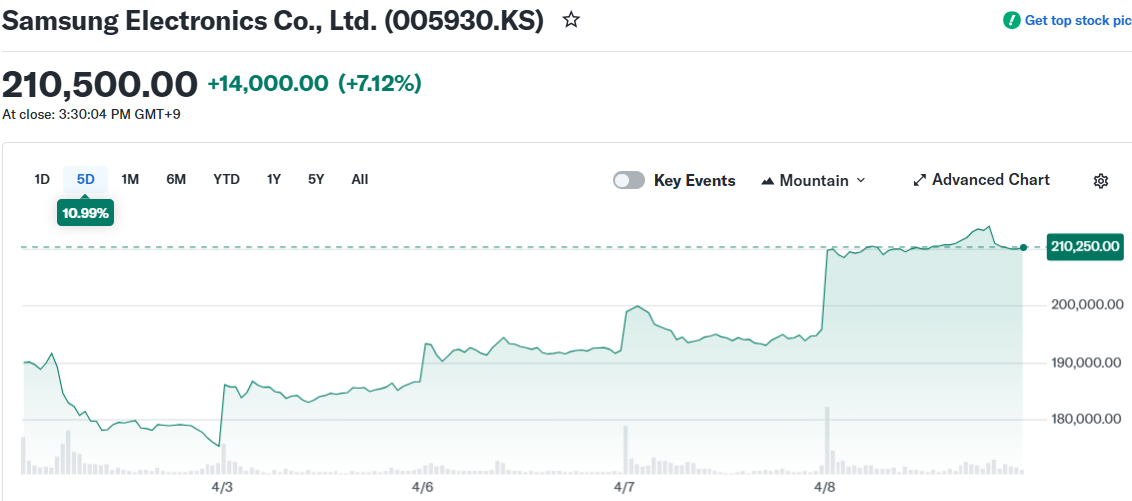
- Samsung stock jumped more than 7% to 210,500 won on Wednesday.
- SK Hynix surged as much as 15% to 1,050,000 won, outperforming Samsung and the broader market.
- Korea Investment & Securities raised its SK Hynix full-year operating profit estimate by 28% to 216 trillion won, more than four times the 2025 figure.
Samsung Electronics (005930) stock rose more than 7% to 210,500 won on Wednesday, while SK Hynix (000660) surged as much as 15% to 1,050,000 won after Samsung posted a blowout Q1 earnings preview.
Samsung’s preliminary results showed an operating profit of around 57.2 trillion won ($39 billion) for the January-March quarter. That was an eightfold increase from the same period a year earlier and came in well above what analysts had expected.
The strong numbers were fuelled by tight supply and surging prices for high-bandwidth memory chips and other AI data centre components. Samsung’s revenue guidance also pointed to growth of around 68%, underlining the scale of the sector’s turnaround after last year’s memory downturn.
The result would mark a record quarterly profit for Samsung if confirmed when full results are released.
SK Hynix, the world’s second-largest memory chipmaker, did not release its own Q1 figures on Wednesday. Its earnings are due later this month. But Samsung’s beat was enough to send SK Hynix stock sharply higher, with investors expecting similar tailwinds to show up in its numbers.
SK Hynix shares hit 1,050,000 won at their peak, up 15% on the day — outpacing Samsung’s 8.7% gain and the broader KOSPI index, which itself rose around 7%.
Analyst Estimates Jump
Korea Investment & Securities moved quickly on the news. The firm raised its full-year operating profit estimate for SK Hynix by 28%, now forecasting 216 trillion won ($146.55 billion). That would be more than four times what SK Hynix reported in 2025, and reflects stronger-than-expected price increases in both DRAM and NAND chips.

The upgrade captures how quickly sentiment has shifted in the memory sector. Earlier concerns about oversupply have given way to a period where chip prices are rising, supply is constrained, and demand from AI infrastructure projects shows no sign of slowing.
Both Samsung and SK Hynix benefit from the same underlying driver: the rapid build-out of AI data centres by major technology companies, which requires large volumes of high-bandwidth memory and advanced logic chips.
HBM Demand at the Centre
High-bandwidth memory has become the key battleground in the AI chip market. HBM is used in AI accelerators — like those made by Nvidia — and supply has struggled to keep pace with the sharp increase in orders since late 2023.
Samsung’s Q1 figures suggest it has gained meaningful ground in this market. The company had previously faced questions about its HBM yields, but a record quarterly profit points to stronger execution.
SK Hynix has long held a leading position in HBM and is widely seen as the primary supplier to Nvidia. Its stock reaction on Wednesday reflected confidence that its own Q1 results, when released, will tell a similar story.
The KOSPI index’s 7% gain on the day also showed that the earnings beat lifted broader market sentiment in South Korea, not just the two chipmakers directly involved.
SK Hynix is expected to report its January-March results later in April.
Considering a new stock? You may want to see what’s on our watchlist first.
Our team at Knockout Stocks follows top-performing analysts and market-moving trends to spot potential winners early. We’ve identified five stocks gaining quiet attention that could be worth watching now. Create your free account to unlock the full report and get ongoing stock insights.Get 3 Free Stock Ebooks
Discover top-performing stocks in AI, Crypto, and Technology with expert analysis.
- Top 10 AI Stocks - Leading AI companies
- Top 10 Crypto Stocks - Blockchain leaders
- Top 10 Tech Stocks - Tech giants



