





TLDR
- Solana is targeting September 9 for its Transaction v1 upgrade, raising max transaction size from 1,232 bytes to 4,096 bytes.
- The upgrade is optional — legacy and v0 formats continue working under existing limits.
- Infrastructure providers like RPC nodes, indexers and explorers must update software or risk showing incorrect data.
- SOL is trading around $105, with a liquidation heatmap showing dense liquidity between $145–$150.
- Open interest in Solana derivatives has climbed back toward $6–7 billion, up from the $4–5 billion range.
Solana is preparing to roll out Transaction v1 on September 9, a format upgrade that raises the maximum transaction size from 1,232 bytes to 4,096 bytes — roughly 3.3 times more space per transaction.
JUST IN: Solana triples its transaction size limit on Monday, Sept 9, giving apps room for complex proofs and large multisig operations.
Transaction v1 lets these larger operations fit into a single transaction instead of being split.@solana pic.twitter.com/pGzbBEHqqC
— MSB Intel (@MSBIntel) September 7, 2026
The upgrade comes from two proposals: SIMD-0296, which defines the size increase, and SIMD-0385, which defines the v1 format itself. Both were co-authored by Jacob Creech and Andrew Fitzgerald.
The larger transaction size allows developers to include more instructions, signatures and account data in a single operation. Use cases include zero-knowledge proofs, large multisignature setups and cross-chain operations.
Previously, complex operations had to be split across multiple transactions, which created risk. One step could succeed while another failed. Transaction v1 allows all instructions to succeed or fail together as one atomic operation.
What Changes for Developers and Infrastructure
Transaction v1 removes Address Lookup Tables, which v0 uses to compress account addresses into one-byte indexes. V1 stores full 32-byte addresses directly in the transaction, which uses more space per account but fits within the new larger envelope.
The 64-account-per-transaction limit remains unchanged. Developers must also explicitly set compute-unit and loaded-data limits in v1, as both default to zero.

Infrastructure providers face the biggest compatibility risk. RPC providers, indexers, block explorers and analytics services must update their software to support version one. If they don’t, they could fail on v1 transactions or display wrong information — such as showing a zero priority fee when one was actually paid.
Solana Foundation VP of Technology Jacob Creech confirmed September 9 as the target. However, the official roadmap still labels mainnet activation as pending, and Anza’s release schedule is listed as tentative.
SOL Price and Market Positioning
SOL was trading around $105.56 at time of writing, up roughly 0.8% over 24 hours. The weekly RSI has climbed to around 60, above the neutral 50 level and not yet in overbought territory above 70.
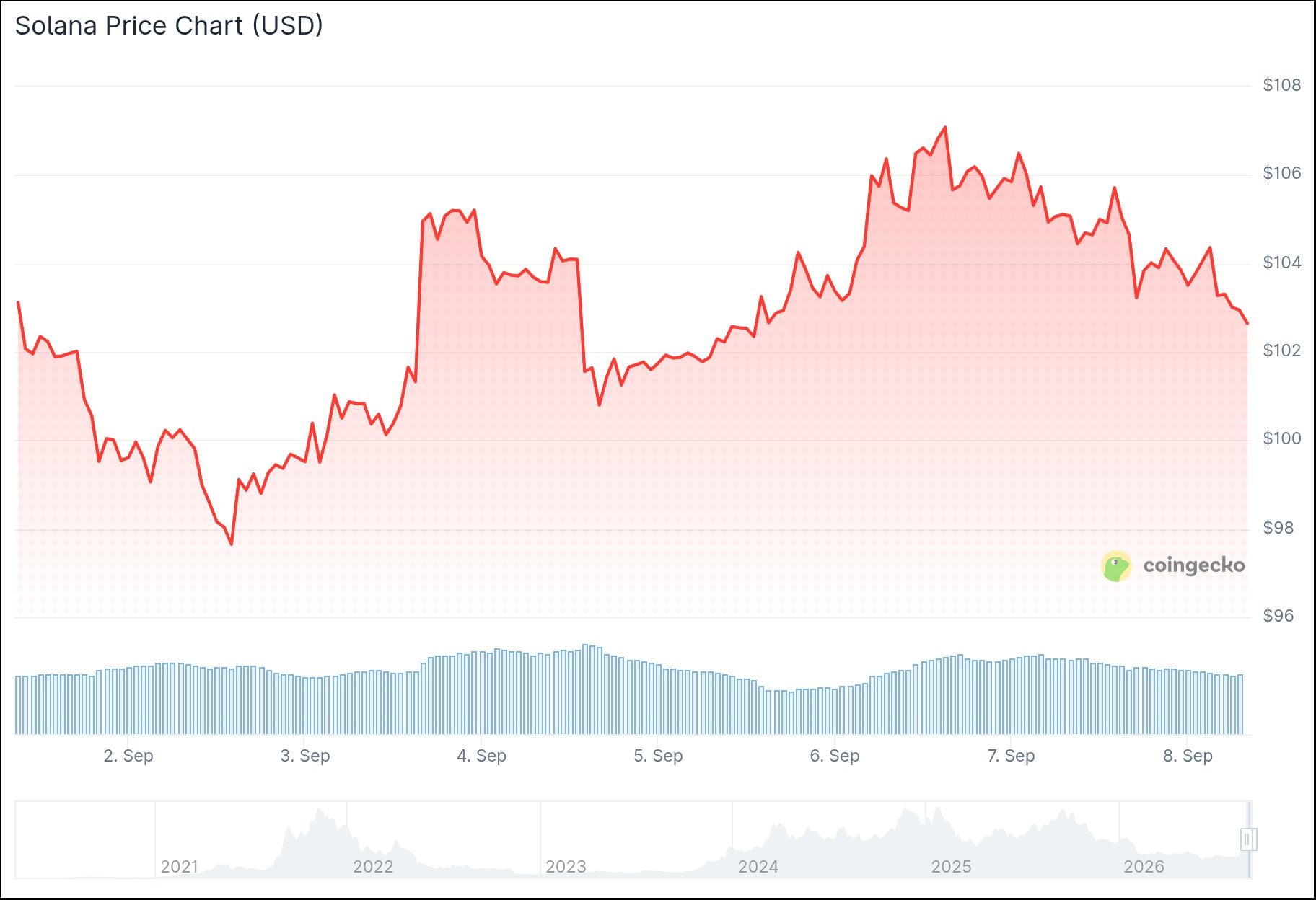
Crypto analyst SatoshiOwl posted on X that SOL could be close to a breakout, targeting $115–$116 in the near term. He added that if SOL reaches $116 and sentiment turns extremely bullish, he would watch for a sharp reversal rather than continued upside.
My $SOL game plan from here. 👀
I think we’re getting very close to a breakout.
Wouldn’t surprise me to see SOL break this structure and push towards $115–$116 next. 📈
And that’s where things could get interesting…
If we reach $116 and CT suddenly turns MAX bullish, I’ll… pic.twitter.com/5BG0TfApxJ
— SatoshiOwl (@SatoshiOwl) September 7, 2026
A liquidation heatmap from CoinGlass shows dense leveraged positions between $145–$150, with further clusters near $180–$200 and $240–$250. On the downside, liquidity sits around $60–$70.
Solana derivatives open interest has risen back to roughly $6–7 billion, up from the $4–5 billion range seen earlier in the cycle, though still well below the previous peak near $17 billion.
Testnet and devnet have already activated the Transaction v1 feature, according to the latest Solana Foundation status page.


