





TLDR
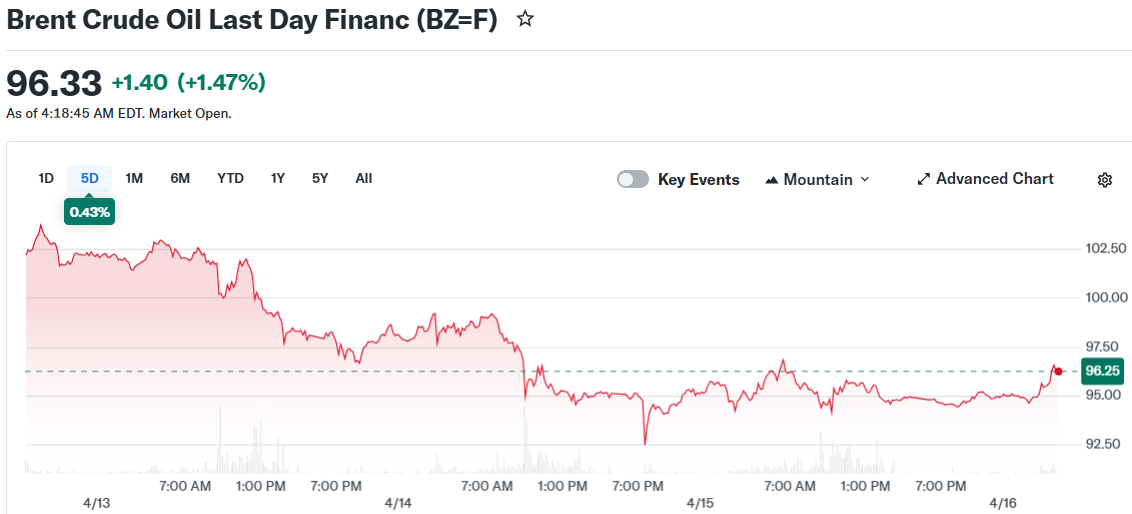
- Brent crude is trading near $95 a barrel, with West Texas Intermediate around $88–$91
- The US and Iran are considering a two-week ceasefire extension ahead of the April 21 expiration
- The Strait of Hormuz remains largely blocked, putting 3.8 million barrels of daily flow at risk
- China’s Q1 GDP grew 5% year-on-year, offering some support to oil demand expectations
- Both the IEA and OPEC have warned of softer oil demand due to war-related disruptions
Oil prices have steadied this week as the US and Iran weigh a two-week extension to their ceasefire, buying more time for peace negotiations that so far have not produced a deal.
Brent crude is holding near $95 a barrel. West Texas Intermediate is trading around $88 to $91. Both benchmarks remain roughly a third higher than before the conflict began in late February, though well below the $120 peak seen in the early weeks of the war.
The ceasefire between Washington and Tehran is set to expire on April 21. Talks held in Pakistan last weekend did not yield an agreement. Mediators are now working to arrange technical discussions on the most disputed issues, including the reopening of the Strait of Hormuz and Iran’s nuclear enrichment program.
JUST IN: 🇺🇸🇮🇷 United States military says it redirected & turned around 10 ships attempting to evade US blockade in Strait of Hormuz.
"Zero ships have broken through since the start of the US blockade on Monday."
— BRICS News (@BRICSinfo) April 15, 2026
Iran’s joint military headquarters commander Ali Abdollahi warned that if the US blockade continues, Iran will not allow any exports or imports through the Persian Gulf, the Sea of Oman, or the Red Sea.
The US has enforced a naval blockade to cut off Iranian traffic. Iran has kept the strait largely closed to other vessels. The Strait of Hormuz connects the Persian Gulf to global oil markets.
Commonwealth Bank of Australia analyst Vivek Dhar said the blockade puts at risk the roughly 3.8 million barrels of crude and products that passed through the waterway last month.

Why the Futures Market May Be Misleading
Diamondback Energy chief executive Kaes Van’t Hof said the oil futures market does not fully reflect what is happening in the physical market. He said futures are increasingly pricing in de-escalation rather than the reality on the ground.
ING Groep commodities strategist Warren Patterson echoed that view, saying any ceasefire is likely to be fragile and that US and Iranian demands remain far apart, leaving clear upside price risks ahead.
Both the IEA and OPEC have warned this week that the war is weighing on global oil demand.
China GDP Offers Partial Offset
China’s economy grew 5% year-on-year in the first quarter of 2026, meeting the upper end of Beijing’s annual target. The result was stronger than expected and helped lift sentiment around oil demand in the world’s largest crude importer.
However, economic momentum slowed toward the end of the quarter. China imports much of its crude from Iran, adding uncertainty to its outlook.
Elsewhere, Thailand is negotiating emergency oil and fertilizer supplies through Oman. In Australia, a fire at Viva Energy’s Geelong refinery is cutting into domestic fuel production. India has warned the war’s economic shockwaves could be as disruptive as the pandemic.
US President Donald Trump said this week that an end to the war is close and that further talks could take place within days.
Stop guessing and start investing with confidence. KnockoutStocks gives you the AI insights, market intelligence, and stock research you need to spot opportunities, cut through the noise, and make smarter investment decisions — all in one powerful platform.
Sign up today and get 50% OFF full access to our premium stock picks.
Simply use coupon code SPECIAL50 at checkout to claim your exclusive discount.
Get 3 Free Stock Ebooks
Discover top-performing stocks in AI, Crypto, and Technology with expert analysis.
- Top 10 AI Stocks - Leading AI companies
- Top 10 Crypto Stocks - Blockchain leaders
- Top 10 Tech Stocks - Tech giants



