



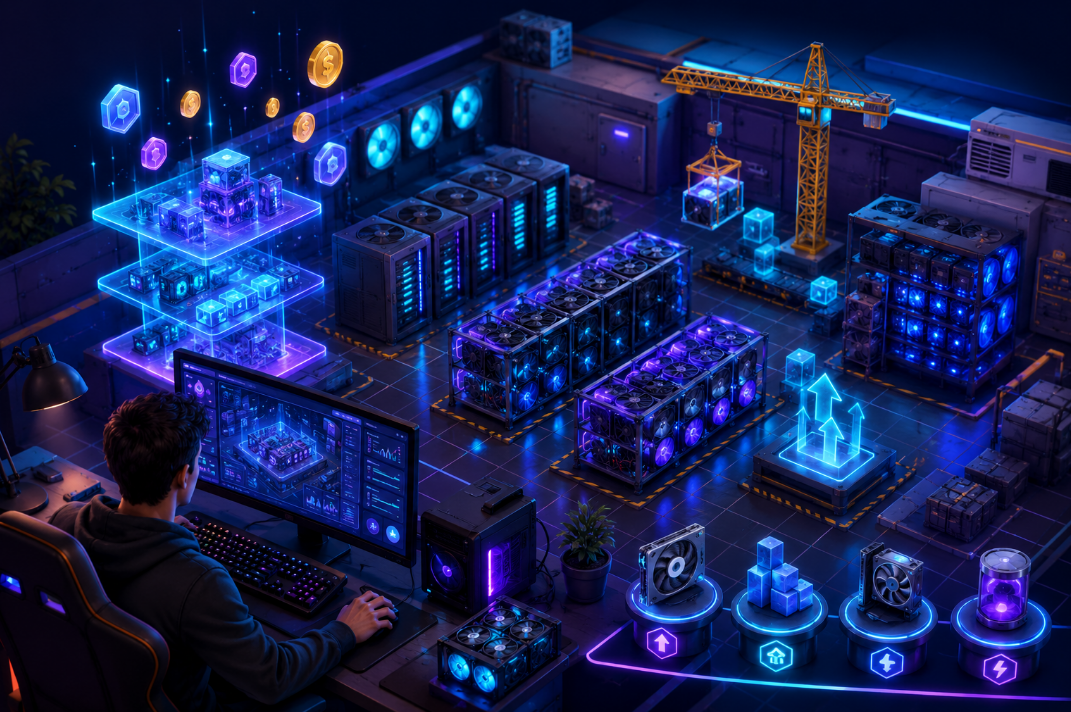


For many people, crypto mining first sounds like a modern gold rush. You buy equipment, let computers run, and somehow digital coins appear. Then reality shows up: specialized machines, heat, noise, setup costs, and electricity bills that can make the whole idea far less romantic than it sounds. In real proof-of-work networks, miners compete with processing power to validate transactions and add new blocks, and that process can consume serious energy at scale.
That gap between the fantasy and the reality helps explain why crypto mining simulators found an audience. They let people explore the idea of building a mining operation without buying ASIC hardware, wiring a cooling system, or worrying about whether the power bill will swallow the rewards. For some players, these simulators are entertainment. For others, they are a low-pressure way to understand the language and logic of mining before touching real crypto tools.
A crypto mining simulator is usually a game or gamified platform that imitates the structure of cryptocurrency mining without performing real blockchain mining on the user’s device. Instead of contributing computing power to a proof-of-work network, the player interacts with a virtual system that represents mining.
Think of it like a flight simulator compared with a commercial airplane. The cockpit may look convincing. The controls may teach you what pilots pay attention to. But you are not actually flying passengers across the Atlantic.
In the same way, a mining simulator often lets players build a virtual room, add digital miners, increase “hash power,” manage upgrades, and watch a reward meter grow over time. The experience borrows the language of real crypto mining, but the underlying activity is game logic, not industrial-grade transaction validation.
Why Mining Simulators Became Popular
Mining simulators grew in popularity for a few practical reasons.
First, interest in cryptocurrency expanded much faster than people’s willingness to spend thousands of dollars on hardware. Real mining at home can require ASIC machines, dedicated power supplies, cooling, networking gear, and enough ventilation to deal with loud, heat-heavy equipment. Ledger notes that a home setup can cost thousands of dollars, while power consumption alone can become a major barrier to profitability.

Second, the idea of passive crypto rewards is naturally attractive. A simulator turns that idea into a game loop: complete tasks, gain virtual power, collect rewards, upgrade, repeat. That formula feels familiar to anyone who has played idle games, tycoon games, or management sims.
Third, these platforms arrived at the right cultural moment. In the late 2010s and early 2020s, crypto was moving from a niche hobby into mainstream conversation. Many people were curious about mining but did not want the cost, risk, or technical complexity. A browser-based simulator offered a softer entry point.
Finally, mining simulators fit the broader trend of “learn by playing.” They can make abstract concepts such as hash power, block rewards, competition, and network share easier to picture than a technical white paper ever could.
Crypto Mining Simulators vs Real Cryptocurrency Mining
The clearest way to understand the category is to compare it directly with real mining.
| Aspect | Crypto Mining Simulator | Real Cryptocurrency Mining |
| Core activity | Playing a game or interacting with a virtual economy | Running hardware that performs computational work |
| Equipment | Virtual miners and upgrades | ASICs, GPUs in some cases, PSUs, cooling, internet, space |
| Energy use | Minimal on the user side | Can be high; crypto mining accounts for a measurable share of electricity use in the U.S. according to the EIA |
| Rewards | Distributed by platform rules | Earned from real network block rewards and fees |
| Risk level | Usually time-based and low-cost to start | High capital cost, energy cost, market risk, hardware obsolescence |
| Technical purpose | Entertainment, education, gamification | Securing a blockchain and validating transactions |
Real proof-of-work mining depends on miners racing to solve mathematical puzzles, with the winner adding verified transactions to the blockchain and receiving a network reward. It is a security process tied to the blockchain itself.
By contrast, a simulator does not turn your laptop into a Bitcoin mine. It creates a model of mining economics and wraps it in game mechanics. That difference matters. A simulator may use the vocabulary of crypto, but it is not replacing mining software, mining hardware, or a wallet strategy.
How Players Earn Rewards in These Games and Simulators
Players do not usually earn rewards by contributing real computational work to a blockchain. Instead, they earn rewards through gameplay systems designed by the platform.
The most common reward model works like this:
- The player completes actions such as mini-games, quests, missions, or daily tasks.
- Those actions increase virtual mining power or unlock better in-game equipment.
- The platform tracks each player’s share of total in-game power.
- Rewards are distributed from a platform-managed pool according to that share.
So the player is not “mining” in the technical blockchain sense. The player is earning a place in an internal reward system.
A useful comparison is a fantasy stock market game. You may learn how investing works and even receive prizes, but you are not trading on the New York Stock Exchange. Crypto mining simulators operate in a similar way: they recreate the logic and excitement of mining without performing the underlying network function.
Common Features and Mechanics
Although different platforms package the idea differently, this category tends to repeat a familiar set of features:
- Virtual hash power that represents your mining strength
- Mini-games or tasks that increase output
- Upgradeable miners and rooms for long-term progression
- Daily quests and seasonal events to keep players active
- Leaderboards that add competition
- Marketplace systems for buying, selling, or trading in-game items
- Reward pools split among users according to their in-game performance
- Referral or community features that encourage growth and retention
These mechanics are not random. They solve a design problem. If a mining simulator only showed a number rising on a screen, most users would leave. The game layer creates goals, habits, and a reason to come back tomorrow.
A Real Example: Mining Through a Game
One of the oldest and most recognized examples in this category is RollerCoin, which presents itself as a free-to-play crypto mining game and says it has been operating since 2018. As a crypto mining simulator, its structure reflects many of the patterns that define the genre: players complete games and quests, improve their virtual mining farm, use a marketplace, and compete for rewards from a platform-managed pool.
RollerCoin is useful as an example because it shows how these simulators blend idle-game design with crypto themes. You are not setting up an ASIC in your garage. You are managing a game economy that borrows the logic, language, and visual identity of mining culture.
That makes it a category example, not proof that simulators are “real mining” in another form. The distinction is still the same: the platform creates the reward structure, while real mining depends on participation in an actual blockchain network.
Pros and Cons
Pros
- Beginner-friendly: easier to understand than real mining software or hardware setup
- Low barrier to entry: often free or inexpensive to start
- Educational value: helps users learn terms such as hash power, rewards, upgrades, and competition
- Entertainment factor: more engaging than reading technical documentation
- Lower financial exposure: no need to buy expensive mining machines
Cons
- Not real mining: users are not validating blockchain transactions on their own hardware
- Platform-dependent rewards: earnings depend on the game’s rules, economics, and sustainability
- Can create false expectations: some newcomers may assume the experience mirrors real mining profitability
- Time-heavy progression: “free” progress may require consistent play
- Limited technical depth: you learn the broad idea, not the full engineering reality
FAQ
1. Are crypto mining simulators real mining software?
No. They imitate the structure and language of mining, but they do not usually use your hardware to secure a proof-of-work blockchain in the way real mining software does.
2. Can you earn real cryptocurrency in a mining simulator?
Some platforms distribute rewards in real crypto or crypto-linked payouts, but those rewards come from the platform’s internal system, not from your computer directly mining blockchain blocks.
3. Why do people play them if they are not real mining tools?
People use them for entertainment, curiosity, low-risk experimentation, and to get comfortable with basic crypto concepts before exploring more advanced tools.
4. Do mining simulators teach anything useful?
Yes, at a conceptual level. They can help users understand ideas like competition, reward sharing, upgrading equipment, and why scale matters. They do not replace technical study of blockchain mining.
5. Are mining simulators the same as cloud mining?
No. Cloud mining claims to give users access to remote mining hardware. A mining simulator is usually a game environment built around virtual progress and platform-defined rewards.


