






TLDR
- Oil prices fell over 1% on Monday as US-Iran nuclear talks eased conflict fears
- Trump raised global tariffs from 10% to 15% after the Supreme Court struck down his previous tariff plan
- A third round of US-Iran nuclear talks is set for Thursday in Geneva
- Goldman Sachs raised its Q4 2026 Brent forecast by $6 to $60 a barrel, citing lower OECD inventories
- Goldman expects a global oil surplus of 2.3 million barrels per day in 2026, with downside risks if Iran or Russia sanctions ease
Oil prices fell on Monday as two major developments hit the market at the same time: new US tariffs and progress on Iran nuclear talks.
Brent crude dropped 73 cents to $71.03 a barrel. US West Texas Intermediate fell 75 cents to $65.73.
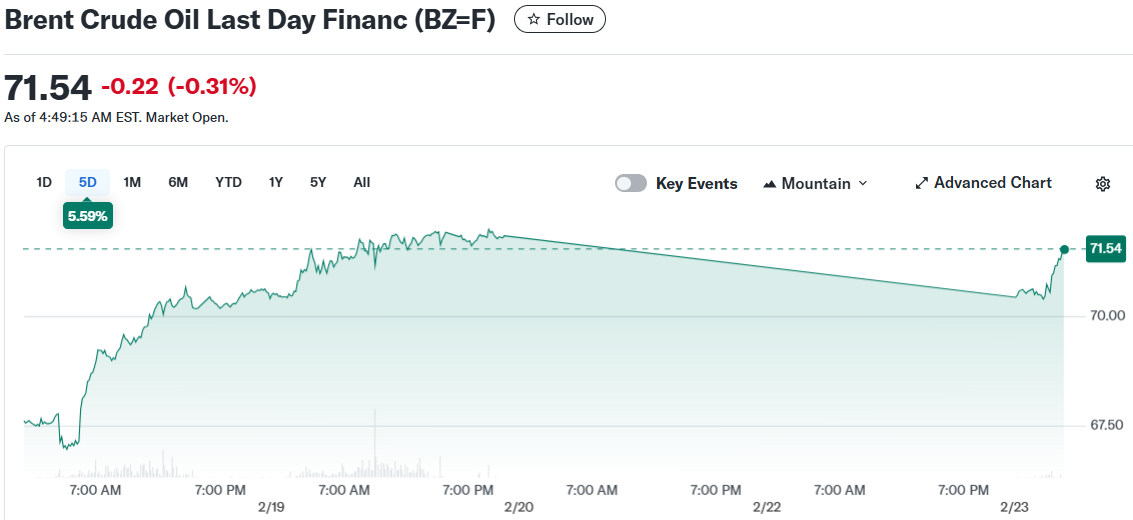
The moves came after President Trump announced he would raise tariffs on all US imports from 10% to 15%. The US Supreme Court had struck down his previous tariff programme, and this was his response under the International Emergency Economic Powers Act.
The higher tariffs raised worries about slower global growth and weaker fuel demand. Analysts said the news triggered risk-aversion across markets, hitting oil alongside US equity futures and gold.
Iran Nuclear Talks Add Pressure
Iran and the US are set to meet Thursday in Geneva for a third round of nuclear talks. Oman’s Foreign Minister confirmed the meeting on Sunday.
The talks helped ease fears of military conflict in the region. Brent and WTI had risen more than 5% last week on those fears.
A senior Iranian official told Reuters that Tehran is ready to make concessions on its nuclear programme. In return, Iran wants sanctions lifted and its right to enrich uranium recognised.

This easing of tension pulled prices back down. Analysts noted that with a potential deal on the table, the risk premium built into oil prices started to unwind.
Goldman Sachs Raises Oil Forecasts
Goldman Sachs raised its Q4 2026 oil price forecasts on Sunday. It now sees Brent at $60 and WTI at $56 for that period, up $6 from earlier estimates.
The bank cited lower OECD inventories as the main reason for the upgrade. For the full year 2026, Goldman now expects Brent to average $64, up from $56, and WTI to average $60, up from $52.
Goldman kept its 2026 surplus forecast at 2.3 million barrels per day. That assumes no major supply disruption and no Russia-Ukraine peace deal.
The bank downgraded supply outlooks for Kazakhstan, Venezuela, Iran, and Iraq due to missed production targets. It upgraded supply expectations for the Americas and core OPEC countries.
Goldman expects OPEC+ to start raising output gradually in Q2 2026, as OECD inventories have not built up as expected.
The bank flagged downside risks of $5 for Brent and $8 for WTI if sanctions relief for Iran or Russia speeds up supply growth.
Goldman sees Brent and WTI averaging $65 and $61 in 2027, rising to $70 and $66 by December 2027.
Stop guessing and start investing with confidence. KnockoutStocks gives you the AI insights, market intelligence, and stock research you need to spot opportunities, cut through the noise, and make smarter investment decisions — all in one powerful platform.
Sign up today and get 50% OFF full access to our premium stock picks.
Simply use coupon code SPECIAL50 at checkout to claim your exclusive discount.
Get 3 Free Stock Ebooks
Discover top-performing stocks in AI, Crypto, and Technology with expert analysis.
- Top 10 AI Stocks - Leading AI companies
- Top 10 Crypto Stocks - Blockchain leaders
- Top 10 Tech Stocks - Tech giants



