





TLDR
- Mt. Gox’s former CEO Mark Karpelès has proposed a Bitcoin hard fork to recover ~80,000 BTC stolen in a 2011 hack, now worth over $5.2 billion.
- The proposal would allow the funds to be moved without the original private key, using a new consensus rule tied to a single wallet address.
- Karpelès submitted the draft to GitHub as a discussion starter, not a formal improvement proposal.
- Critics argue it sets a dangerous precedent, threatening Bitcoin’s core principle of immutability.
- The hacked coins are separate from the ~200,000 BTC already being distributed to Mt. Gox creditors, with repayments running until October 2026.
Mark Karpelès, the former CEO of collapsed Bitcoin exchange Mt. Gox, has published a draft proposal calling for a Bitcoin hard fork. The goal is to recover roughly 79,956 BTC stolen in a hack more than 15 years ago.
🚨CRYPTO: FORMER MT GOX CEO PROPOSES HARD FORK TO RECOVER $5.2B IN $BTC
Mark Karpelès, the former CEO of defunct crypto exchange Mt. Gox, has published a proposal calling for a Bitcoin hard fork that would allow roughly 79,956 BTC, worth more than $5.2 billion at current… pic.twitter.com/HA24SPDbH8
— BSCN (@BSCNews) February 27, 2026
The coins, currently sitting in a single wallet address, are worth more than $5.2 billion at today’s prices. They have not moved since being taken in June 2011.
Under current Bitcoin rules, funds can only be spent using the original private key. That key has never been recovered.
Karpelès submitted the proposal on GitHub on Friday. He wants to introduce a new consensus rule that would allow the funds to be moved to a recovery address without that key.
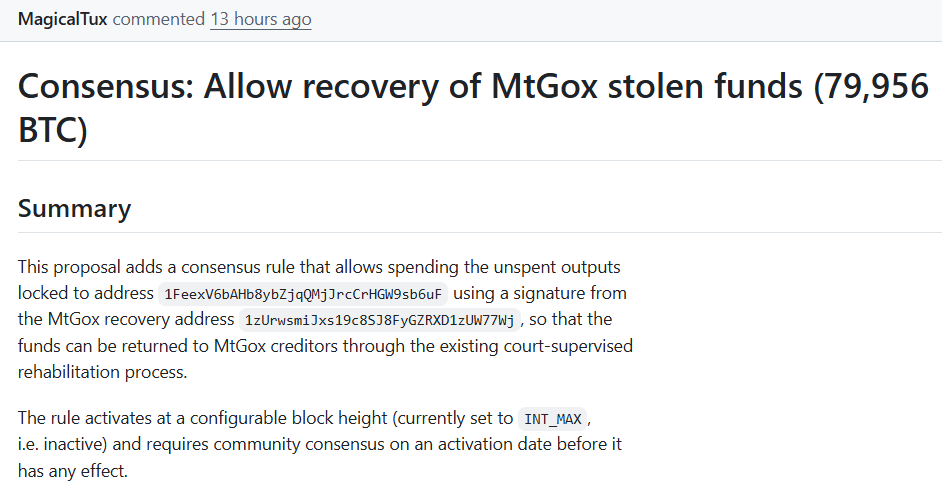
The rule would apply only to that single wallet address. It would activate at a future block height if the network agrees to adopt it.
Karpelès was direct about what the proposal involves. “I want to be upfront: this is a hard fork,” he wrote.
He framed the submission as a way to break a deadlock. The Mt. Gox trustee, Nobuaki Kobayashi, has declined to pursue on-chain recovery without certainty that the community would back a protocol change.

Why Critics Are Pushing Back
The proposal has drawn sharp criticism, mostly centered on Bitcoin’s immutability. Bitcoin is designed so that transactions are final and irreversible.
Many in the Bitcoin community argue that changing ownership rules for one address, even in a clear-cut theft case, sets a bad precedent. Forum users on Bitcointalk warned that it could open the door to similar demands after future hacks.
The proposal itself acknowledges the risk. It states: “If it can be done once, the argument goes, it can be done again.”
There is also a governance question. No clear process exists for deciding which historical thefts justify rewriting Bitcoin’s protocol rules.
For a hard fork to succeed, it would need broad support from miners, node operators, and exchanges. Historically, Bitcoin consensus on contentious changes has been very hard to achieve.
How This Fits Into Broader Mt. Gox Repayments
The 80,000 BTC in the hacked wallet are not part of the funds currently being paid out to creditors. Those repayments come from a separate pool of around 200,000 BTC recovered after the exchange’s 2014 collapse.
Creditor repayments began in mid-2024 and the deadline has been extended to October 2026. The hacked coins remain outside trustee control entirely.
Mt. Gox filed for bankruptcy in Tokyo on February 28, 2014, after losing around 750,000 customer bitcoins. The exchange had handled 70% of all global Bitcoin transactions at its peak.
Some creditors have voiced support for the proposal. One self-identified creditor said they received about 15% of their Bitcoin back through the bankruptcy and would support a court order to claim the remaining hacked coins.
The proposal remains a discussion draft with no formal backing or timeline.


