






TLDR
- US stock futures (Dow, S&P 500, Nasdaq) rose Friday after Thursday’s steep sell-off, as oil prices pulled back slightly.
- Brent crude briefly crossed $100 a barrel for the first time since August 2022, before retreating to around $99.
- The Iran conflict, now in its second week, has caused the biggest oil supply disruption in history, according to analysts, with the Strait of Hormuz still closed.
- Bitcoin surged past $70,000, with a Trump social media post cited as a possible factor in the crypto rally.
- Traders now see a 47% chance the Fed won’t cut rates at all in 2026, up from just 3% a month ago, as inflation fears grow.
US stock futures climbed on Friday morning after a rough Thursday that sent all three major indexes to their lowest closing levels of 2026. The Dow Jones Industrial Average, S&P 500, and Nasdaq 100 futures were each up around 0.3% to 0.4% in premarket trading.
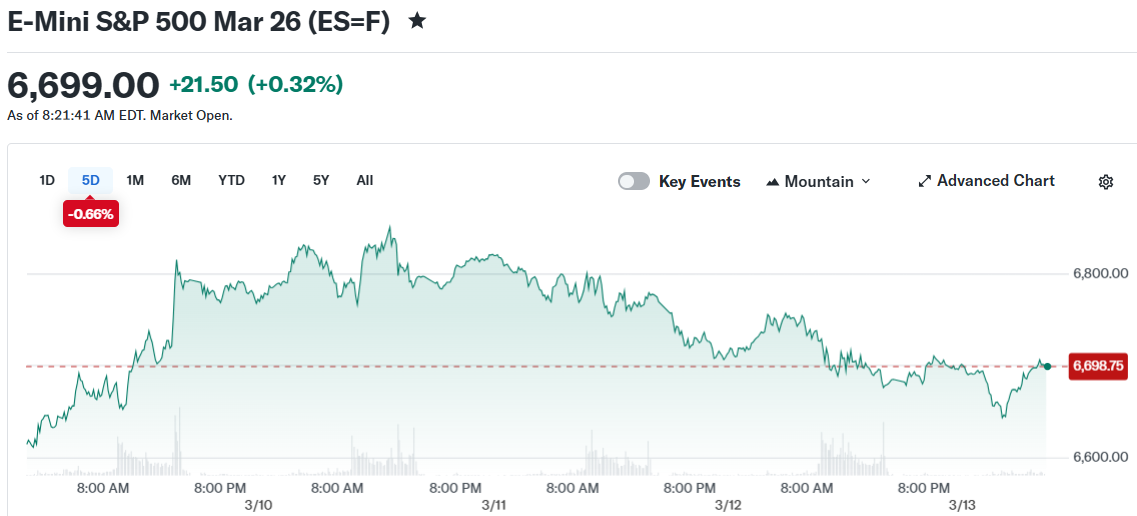
The gains followed a brief bounce tied to a report from Axios. It said President Donald Trump told other world leaders in a virtual meeting on Wednesday that Iran is “about to surrender.” The White House has not officially confirmed those remarks.
JUST IN: 🇺🇸🇮🇷 President Trump tells G7 leaders Iran is "about to surrender." pic.twitter.com/GQnwy53ege
— BRICS News (@BRICSinfo) March 13, 2026
Despite that optimism, Iran’s new supreme leader, Mojtaba Khamenei, on Thursday vowed to keep fighting. He also said Iran will keep the Strait of Hormuz closed. The strait is one of the world’s most critical oil shipping routes.
The conflict between Iran and Israel entered its second week on Friday. Israel launched fresh attacks on Tehran, while Iran is believed to be connected to missile strikes on Dubai and Turkey. The US military also confirmed that four crew members were killed when a refueling aircraft crashed.
Oil Pulls Back But Stays Elevated
Oil prices fell slightly on Friday after a volatile week. West Texas Intermediate crude dropped around 2% to below $94 a barrel. Brent crude, the international benchmark, fell back under $100 after settling above that level on Thursday for the first time since August 2022.
Analysts have described the ongoing oil supply disruption as the largest in history. In response, the US issued a second waiver allowing purchases of sanctioned Russian crude in an effort to ease supply pressure.

India is in active talks with Iran to allow at least 23 oil tankers through the Strait of Hormuz, according to The Wall Street Journal, citing Indian officials. The first crossings could happen by the weekend.
Fed Rate Cut Bets Fall Sharply
The oil-driven inflation concern is reshaping expectations for Federal Reserve policy. Traders now see a 47% chance the Fed will not cut interest rates at all in 2026, according to CME FedWatch data. That’s up from just 3% a month ago.
The 10-year Treasury yield was at 4.28% on Friday morning. The US dollar index was up 0.3%, sitting at a 3.5-month high.
All eyes were on the Personal Consumption Expenditures price index, the Fed’s preferred inflation gauge, due for release Friday morning. Fourth quarter GDP data and the January JOLTS job openings report were also scheduled.
Bitcoin surged past $70,000 early Friday. A post on social media by former President Trump was cited by some analysts as a possible factor in the move. Gold was on track for a weekly loss, weighed down by a stronger dollar.
Brent crude’s largest single-day gain since May 2020 came on Thursday, underlining just how quickly the market moved this week.
Stop guessing and start investing with confidence. KnockoutStocks gives you the AI insights, market intelligence, and stock research you need to spot opportunities, cut through the noise, and make smarter investment decisions — all in one powerful platform.
Sign up today and get 50% OFF full access to our premium stock picks.
Simply use coupon code SPECIAL50 at checkout to claim your exclusive discount.
Get 3 Free Stock Ebooks
Discover top-performing stocks in AI, Crypto, and Technology with expert analysis.
- Top 10 AI Stocks - Leading AI companies
- Top 10 Crypto Stocks - Blockchain leaders
- Top 10 Tech Stocks - Tech giants



