





TLDR
- Brent crude fell toward $98 a barrel, WTI near $93, both down over 3% for the week
- Trump announced a 10-day Israel-Lebanon ceasefire and claimed Iran agreed to key terms
- Iran has not publicly confirmed any concessions, including opening the Strait of Hormuz
- The IEA warned oil and gas production recovery could take up to two years
- Both the IEA and OPEC forecast weaker global oil demand in coming months
Oil prices dropped on Friday as diplomatic signals from the White House pointed toward a possible end to the US-Iran conflict, now approaching its 50-day mark.
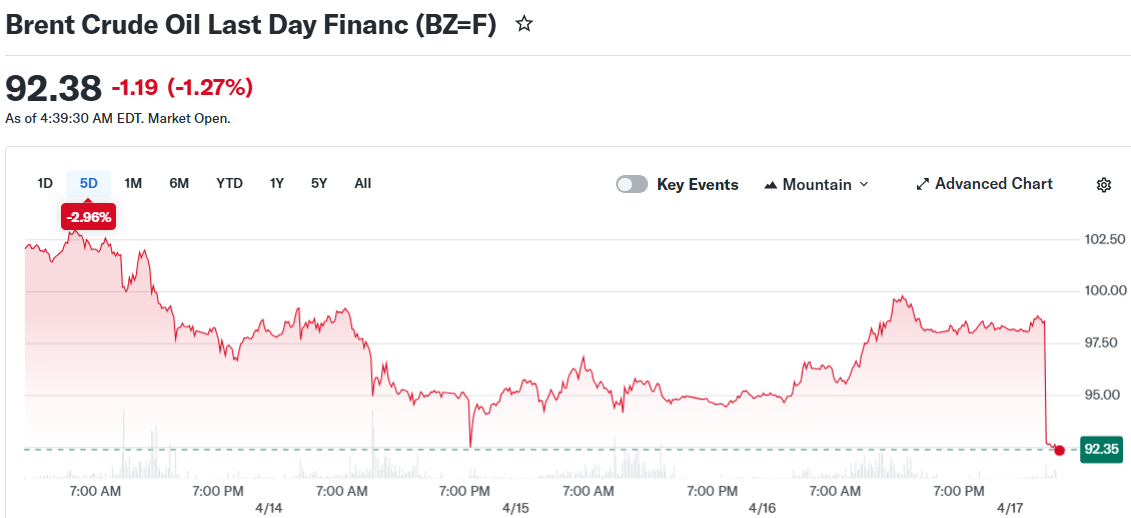
Brent crude fell 1.1% to around $98.32 a barrel, while West Texas Intermediate dropped 1.3% to $89.95. Both contracts were down more than 3% for the week.
The conflict began in February after the US and Israel attacked Iran. Since then, Tehran halted most traffic through the Strait of Hormuz, disrupting roughly 20% of global oil flows. The US later added its own naval blockade.
President Donald Trump struck an optimistic tone on Thursday, claiming Iran had agreed to terms it had long resisted, including opening the Strait of Hormuz. Iran has not publicly confirmed this.
Trump also announced a 10-day ceasefire between Israel and Lebanon. He invited Israeli Prime Minister Benjamin Netanyahu and Lebanese President Joseph Aoun to the White House for talks.
BREAKING: President Trump says a 10-day ceasefire between Lebanon and Israel will begin at 5 PM ET today. pic.twitter.com/coWBrqaL8k
— The Kobeissi Letter (@KobeissiLetter) April 16, 2026
Lebanon’s inclusion in a ceasefire was a key condition Iran had set for broader negotiations. The deal appeared to be holding through early Friday.

“The dominant theme now is not escalation, but stabilization,” said Priyanka Sachdeva, senior market analyst at Phillip Nova. “Fear drove the rally, diplomacy is driving the correction.”
Peace Talks Could Take Months
Some Gulf Arab and European leaders said a full US-Iran deal could take around six months. They urged both sides to extend the current ceasefire to cover that period.
OCBC analysts noted the US naval blockade entered its fourth day, keeping Hormuz traffic at near-standstill levels. Oil flows through the strait remain a fraction of pre-war levels.
Trump said he didn’t expect he would need to extend the ceasefire to reach a deal, predicting a resolution “fairly soon.” He also said he might travel to Pakistan, which hosted the first round of talks, if a deal is reached.
After weeks of extreme volatility, price swings have calmed. Brent traded in a range of about $10 a barrel this week, compared to a record $38 swing in mid-March.
Supply Damage Could Last Years
IEA Executive Director Fatih Birol warned that recovering a large share of disrupted oil and gas production could take up to two years. Any recovery would be gradual, he said.
The IEA and OPEC both flagged weaker global oil demand forecasts for coming months, adding further downward pressure on prices.
“While there’s been some positive geopolitical progress, it hasn’t translated into real movement on flows,” said Rebecca Babin, senior energy trader at CIBC Private Wealth Group.
Control of the Strait of Hormuz remains unresolved. Iran has said it plans to charge ships for transit even after the conflict ends.
The current US-Iran ceasefire is set to expire on April 21.
Stop guessing and start investing with confidence. KnockoutStocks gives you the AI insights, market intelligence, and stock research you need to spot opportunities, cut through the noise, and make smarter investment decisions — all in one powerful platform.
Sign up today and get 50% OFF full access to our premium stock picks.
Simply use coupon code SPECIAL50 at checkout to claim your exclusive discount.
Get 3 Free Stock Ebooks
Discover top-performing stocks in AI, Crypto, and Technology with expert analysis.
- Top 10 AI Stocks - Leading AI companies
- Top 10 Crypto Stocks - Blockchain leaders
- Top 10 Tech Stocks - Tech giants



