





TLDR
- Goldman Sachs CEO David Solomon says oil could reach $80–$100 per barrel within three to six months
- Solomon warned a highly escalated conflict with Iran could push oil to $170 per barrel
- Brent crude fell 0.5% to $94.95 and WTI dropped 1.8% to $88.04 on Tuesday
- Iran has kept the Strait of Hormuz largely closed since the war began in late February
- Saudi Arabia and UAE are rerouting oil shipments, with combined loading rising to 6.5 million barrels per day
Goldman Sachs CEO David Solomon said Tuesday that oil prices could reach $80 to $100 per barrel in the next three to six months. He made the comments at the Paley Center.
Solomon added that if conflict with Iran escalates sharply, oil could climb as high as $170 per barrel. He said U.S. recession risk is not materially elevated right now, but warned the situation is “only one tweet away” from changing.
Oil prices moved lower on Tuesday as markets tracked mixed signals around U.S.-Iran talks. A temporary ceasefire is set to expire later this week, and the exact deadline has not been made public.
Brent crude futures fell 0.5% to $94.95 a barrel. U.S. West Texas Intermediate dropped 1.8% to $88.04 a barrel.
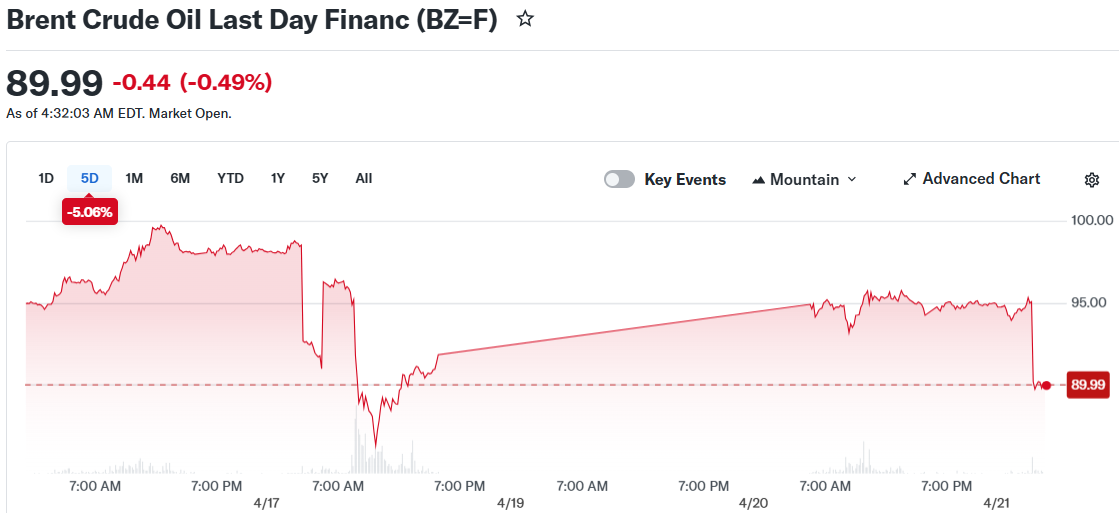
Prices had risen sharply the session before, after tensions spiked over the weekend. The U.S. seized an Iranian-flagged cargo ship, and Iran responded with threats of retaliation.
Iran also shut the Strait of Hormuz again, despite having reopened it on Friday. The country cited an ongoing U.S. blockade of Iranian ports and coastline.
Ceasefire Talks in Doubt
President Trump said Monday the naval blockade will stay in place until a peace deal is reached. He also said new talks with Iran were expected this week, with a delegation heading to Pakistan on Tuesday or Wednesday.

But Iranian officials have publicly pushed back on more talks. Iran’s Parliamentary Speaker and top negotiator Mohammad Bagher Ghalibaf said Iran would not negotiate “under the shadow of threats” from Washington.
Several Iranian state media reports backed that position. However, separate reports said Iran privately told regional mediators it would send a delegation to Pakistan this week.
ANZ analysts wrote that “ongoing uncertainty continues to overshadow any peace agreement, as Iran remains reluctant to attend a second round of talks in Pakistan.”
Trump announced the two-week ceasefire on April 7 at 6:32 p.m. ET.
Hormuz Disruptions Continue
The Strait of Hormuz carries roughly one fifth of the world’s oil supply. It has remained largely closed since the war began in late February.
While the initial price spike has eased somewhat, crude remains well above pre-war levels.
Saudi Arabia and the UAE have been rerouting shipments to avoid Hormuz. They are using the Yanbu terminal in the Red Sea and the Fujairah terminal in the Gulf of Oman.
ANZ said combined loading at those two facilities has risen to 6.5 million barrels per day, up from 5.0 million barrels per day before the war started.
Iran’s ceasefire deadline is approaching with no confirmed deal in place.
Stop guessing and start investing with confidence. KnockoutStocks gives you the AI insights, market intelligence, and stock research you need to spot opportunities, cut through the noise, and make smarter investment decisions — all in one powerful platform.
Sign up today and get 50% OFF full access to our premium stock picks.
Simply use coupon code SPECIAL50 at checkout to claim your exclusive discount.
Get 3 Free Stock Ebooks
Discover top-performing stocks in AI, Crypto, and Technology with expert analysis.
- Top 10 AI Stocks - Leading AI companies
- Top 10 Crypto Stocks - Blockchain leaders
- Top 10 Tech Stocks - Tech giants



