





TLDR
- The Senate Banking Committee released the full text of the Clarity Act, a crypto market structure bill, ahead of a May 14 committee vote.
- The bill includes restrictions on stablecoin yield payments and legal protections for DeFi developers.
- Banks are pushing to close what they call a stablecoin “loophole,” warning it could pull deposits away from traditional banks.
- A conflict-of-interest provision targeting crypto profits by government officials is not yet in the bill — Democrats say it must be included.
- Polymarket puts the odds of Trump signing the Clarity Act into law this year at 64%.
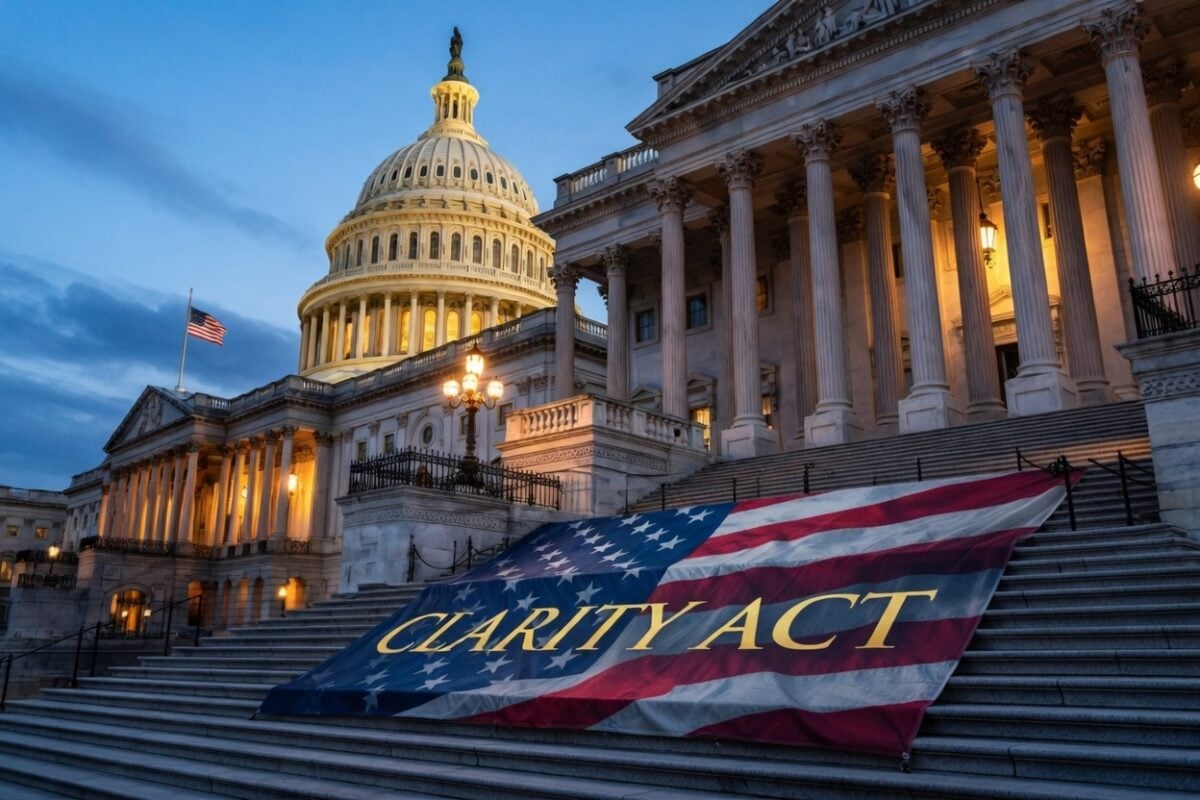
The Senate Banking Committee released the full text of the Clarity Act late Monday, just hours before a scheduled markup hearing set for May 14. The bill is one of the most wide-ranging attempts to bring the U.S. crypto industry under a formal regulatory framework.
🚨 BREAKING: The Senate just released new CLARITY Act draft with a stablecoin compromise allowing activity-based rewards.
Members now have until tomorrow to file amendments before Thursday’s markup. pic.twitter.com/wDLC4oNMjC
— Coin Bureau (@coinbureau) May 12, 2026
Committee Chairman Tim Scott said the bill “puts consumers first, combats illicit finance, cracks down on criminals and foreign adversaries and keeps the future of finance here in the United States.”
The 309-page document had already been circulating privately within the industry, so few surprises were expected. Industry groups spent the night reviewing the language to confirm their priorities made it into the final draft.
The bill covers three main areas: stablecoin yield rules, DeFi developer protections, and law enforcement tools for prosecutors pursuing crypto-related money laundering.
Stablecoin Yield Rules Divide Banks and Crypto Firms
One of the most contested sections deals with stablecoin rewards. The current text blocks crypto firms from paying interest on idle stablecoin balances. Only activity-based rewards are permitted.
Coinbase CEO Brian Armstrong said Monday that “not everyone got everything they wanted, but they got the must-haves.” He added that Coinbase is working with at least five major global banks to integrate crypto services.
But the banking industry is not satisfied. American Bankers Association CEO Rob Nichols sent a letter to bank CEOs urging them to call their senators before the vote.
Nichols warned that the current language would “unnecessarily incentivize the flight of bank deposits into payment stablecoins, putting both economic growth and financial stability at risk.”

Banking trade groups also sent a separate letter to Senate Banking Committee members asking for tighter restrictions on stablecoin rewards.
Research from Galaxy pushed back on those concerns, arguing that most stablecoin growth will come from offshore capital flowing into U.S. banking infrastructure, not from domestic deposit migration.
Ethics Provision Remains a Sticking Point
The bill does not yet include a conflict-of-interest section that would limit government officials from profiting from crypto. That provision falls outside the banking committee’s jurisdiction and must be added later.
Democrats have made the ethics clause a condition for their support. Senator Elizabeth Warren said the bill “turbocharges Donald Trump’s crypto corruption,” pointing to at least $1.4 billion in crypto gains by the president and his family since taking office.
White House crypto adviser Patrick Witt said the administration supports rules that apply to everyone in government, but rejects anything that singles out a specific officeholder.
Senate Republicans are expected to advance the bill along party lines at the May 14 markup. After that, it would need to be merged with a version passed by the Senate Agriculture Committee before a full Senate vote.
Sixty votes will be needed on the Senate floor, meaning some Democratic support is required. The White House is targeting a July 4 completion. Senator Kirsten Gillibrand predicted passage by early August.
Polymarket currently gives a 64% chance that Trump signs the Clarity Act into law this year.


