






Key Takeaways
Automated trading bots now operate around the clock across major crypto markets and asset classes, fundamentally changing how traders approach Bitcoin, Ethereum, and altcoins. Here’s what matters most:
- Auto trading bot is a software that executes predefined automated trading strategies in markets like Bitcoin, Ethereum, and major altcoins without constant human supervision.
- Many traders now use automated trading bots to automate your trading and improve discipline, leveraging these tools to reduce emotional errors and enhance their trading strategies.
- Algo bots help maintain discipline and consistency in trading execution by removing emotional biases that often lead to poor decision-making.
- Profitability depends more on strategy quality, data, and risk controls than on the crypto trading bot platform itself.
- Effective crypto bots are always backtested on several years of historical data and across different market conditions, including high market volatility periods like March 2020 and November 2022.
- Traders should start with small position sizes, use features like stop loss and DCA bots, and regularly monitor performance instead of relying on “set and forget” automation.
What Is an Automated Trading Bot?
An automated trading bot is software that places and manages orders automatically on exchanges like Binance, Coinbase, and Bybit based on rules, signals, or algorithms. Automated trading systems encompass a range of software platforms that execute trading strategies automatically, offering advanced tools for different markets. Algorithmic trading bots are designed to execute predefined strategies based on specific market conditions, indicators, or price movements, allowing for faster and more disciplined trading compared to manual methods.
Automated trading and crypto trading bots are used across asset classes including crypto, stocks, forex, and futures. A bot might trade BTC/USDT on Binance, ETH perpetual futures on Bybit, or large-cap tech stocks through a traditional broker. The best automated trading bots vary by market and strategy, with some optimized for crypto markets and others for futures or forex trading. Traders can also create their own automated trading bot by designing, testing, and deploying strategies tailored to their needs.
Bots connect to exchanges via API keys and can run on cloud servers or local machines. Bots can operate 24/7, capturing opportunities in markets like cryptocurrency even when you’re asleep. They support traders’ decision making by automating execution, but may lack the nuanced judgment found in discretionary trading, where human intuition and experience play a larger role.
Crypto traders can choose between fully automated bots, semi-automated alert-based systems, and copy-trading style automation depending on their experience level. Trading algo bots are designed to automate execution based on predefined rules, such as price movements or technical indicators, and help remove emotional biases from trading decisions. This contrasts with discretionary trading, where human judgment and emotions can influence outcomes.
How Automated Trading Bots Work in Crypto Markets
Understanding the full workflow—data input, signal generation, order execution, and monitoring—is essential before deploying any bot in live crypto markets. Advanced auto trading bots process large datasets to improve the accuracy and speed of their trading decisions.
Bots continuously read live order books, price feeds, and technical indicators like RSI, MACD, and moving averages to decide when to buy or sell. Execution quality plays a major role in algorithmic trading performance, as even a well-designed strategy can underperform if it operates on delayed or incomplete market data. Automated trading bots can react faster than manual traders to capitalize on market opportunities, making execution speed a key advantage.

Automated trading strategies are encoded as rule sets, scripts, or algorithmic models. For example: “buy BTC when the 50-day MA crosses above the 200-day MA and volume is above the 20-day average.” Automated trading bots use algorithms and machine learning to analyze market data and execute trades at speeds and frequencies that are impossible for humans.
Bots use exchange APIs to submit limit, market, and conditional orders while managing stop loss and take-profit levels automatically. Many modern bots combine indicator-based logic with risk modules covering max leverage, per-trade risk caps, and portfolio rules like maximum exposure per coin.
Some advanced bots adapt to market conditions by adjusting position size or trading frequency when market volatility spikes, rather than using fixed parameters throughout all market regimes. Additionally, some bots integrate advanced analysis tools to provide insights into market liquidity and trading activity, helping traders refine their strategies.
Core Automated Trading Strategies Used by Crypto Bots
This section outlines the most common automated trading strategies used in crypto markets. Automated trading strategies can include various approaches such as trend following, grid trading, arbitrage, and market making, each tailored to specific market conditions and trader preferences. Some auto trading bots also offer portfolio management features, such as automated rebalancing and strategy testing, which help long-term investors optimize asset allocation across multiple exchanges.
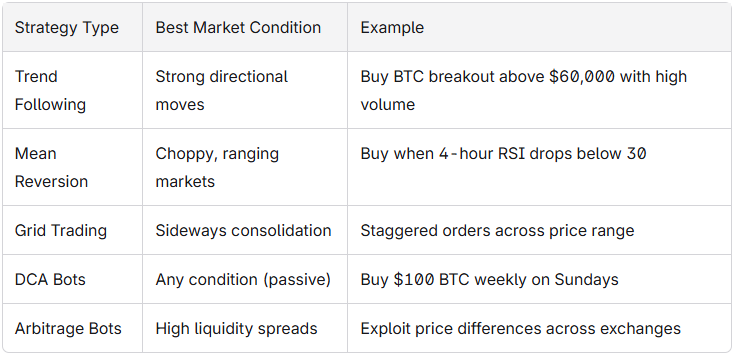
Trend-following strategies buy when price breaks above resistance or moving averages and sell on trend reversals. Mean reversion strategies fade short-term extremes—buying when BTC’s 4-hour RSI drops below 30 and selling when RSI returns to neutral.
Arbitrage bots and market-making strategies exploit small price differences between exchanges or within order books, focusing on liquid pairs like BTC/USDT and ETH/USDT. Grid bots place multiple staggered buy and sell orders around a price range to capture sideways volatility.
DCA bots automatically buy fixed amounts of assets like BTC or ETH at regular intervals regardless of short-term price swings. Traders should match strategy type to market conditions—trend-following in strong trends, grid and mean reversion in choppy, sideways markets. Many bots also integrate risk control modules to enhance trading safety and manage potential losses as part of their automated strategies.
Choosing the Right Automated Trading Bot Platform
Selecting the right platform requires evaluating reliability, transparency, and fit with your specific trading goals. In 2025, traders evaluate automated trading bots based on execution speed, customization, data access, and compatibility with algorithmic finance workflows. Having control and flexibility over your trading bot platform is crucial, as it allows you to tailor strategies and risk management to your unique needs.
Key evaluation criteria:
- Exchange support: Ensure the bot supports key crypto markets like BTC, ETH, SOL, and major stablecoin pairs on exchanges you already use
- Strategy customization: Can you build your own automated trading strategies, adjust parameters like timeframes and indicators, and maintain full control over your trading algorithms—including risk management and parameter adjustments—or are you limited to preset templates?
- Backtesting capabilities: Robust backtesting on high-quality historical data including bull runs (2020-2021), bear markets (2022), and high volatility events
- Security practices: API key permissions with no withdrawal rights, IP whitelisting, 2FA, and transparent logging of every order
Security vulnerabilities make bots targets for hacking or API breaches, necessitating secure infrastructure. Prioritize platforms offering clear documentation, educational content, and a responsive support team instead of only marketing claims or “guaranteed profit” promises.
Backtesting and Optimizing Automated Trading Strategies
Backtesting allows users to test strategies against historical data to assess performance before risking real capital. This step is non-negotiable before deploying any strategy with real money.
Traders load historical candles and order-book snapshots to simulate how a strategy would have performed under different market conditions and market volatility regimes. Use realistic assumptions for fees, slippage, and spreads on specific exchanges—approximately 0.1% maker/taker on Binance spot, higher on smaller exchanges.
Best practices for backtesting:
- Test strategies on multiple coins and timeframes (BTC 1-hour, ETH 4-hour, SOL 15-minute) instead of optimizing on a single pair
- Include stress-test periods: March 2020 crash, November 2022 market disruption
- Fine tune parameters like stop loss distance, take-profit targets, and indicator thresholds
- Avoid extreme over-optimization
Over-optimization may cause a strategy to fail in live markets because it was tuned too specifically to historical conditions. Out-of-sample testing and paper trading in demo mode are essential to validate performance before switching a crypto trading bot to real capital.
Risk Management for Automated Crypto Trading
Risk management is more important than raw performance for long-term survival in algorithmic and automated trading. Traders tend to see the most consistent results when bots are paired with real-time data and clear rules for risk management.
Position sizing rules:
- Risk only 0.5-2% of account equity per trade
- Cap total exposure to any single coin at 5-10% of portfolio
- Diversify across different asset classes and sectors
Bots can enforce protective orders like stop loss, trailing stop loss, and take-profit even when you’re offline, reducing catastrophic loss risk. Portfolio diversification across large-cap coins, DeFi tokens, and stablecoins beats concentrating all capital in one volatile asset.
Automated trading can potentially lead to significant losses in extreme market volatility. During macro news, regulatory announcements, or exchange incidents, consider lowering leverage or pausing aggressive strategies. Set daily or weekly loss limits where the bot stops trading if losses exceed a predefined percentage of equity.
Pros and Cons of Using Automated Trading Bots
Automated trading bots are powerful tools but not guaranteed money machines. Here’s a balanced view:
Advantages:
- 24/7 operation in global crypto markets
- Freedom from emotional biases in trading decisions
- Consistent execution of rules across multiple markets
- Automated trading bots can execute trades much faster than human traders, making them particularly beneficial in high-frequency trading environments
- Algo bots help maintain discipline and consistency in trading execution by removing emotional biases
- Bots can simultaneously manage multiple strategies and assets across different exchanges, facilitating diversification
Disadvantages:
- Dependence on stable internet and API connections
- Connectivity issues, software glitches, or insufficient hardware can lead to mechanical failures
- The effectiveness of automated trading strategies can vary significantly based on market conditions; they tend to perform best in stable, liquid environments and may struggle during periods of high volatility or regime shifts
- While trading bots can enhance efficiency and productivity, they may struggle in volatile markets where they cannot adapt quickly to sudden market changes
Bots can amplify losses quickly if the underlying strategy is flawed or doesn’t adapt to changing market conditions like sudden regime shifts from trending to ranging markets. The best use of crypto bots is as disciplined execution tools for vetted strategies, not as “set and forget” income generators.
Getting Started With Your First Crypto Trading Bot
Here’s a practical, step-by-step path for beginners launching their first automated trading bot.
Step 1: Start with paper trading or a small test account on a major exchange. Limit initial capital to an amount you can comfortably afford to lose—$50-$500 is reasonable for learning.
Step 2: Choose one simple, well-documented strategy. A basic DCA bot or straightforward trend-following bot on BTC or ETH beats multiple complex setups for beginners.
Step 3: Connect your exchange account via API keys with trading-only permissions. Legitimate auto trading bots connect to existing exchanges via API rather than requesting direct custody of funds. Verify that orders appear correctly in your exchange history.
Step 4: Monitor the bot daily at first, review trade logs, and adjust parameters slowly. Don’t react emotionally to a few losing trades—variance is normal.
Step 5: Keep a trading journal documenting strategy rules, parameter changes, and performance over weeks and months. To optimize the effectiveness of algo bots, traders can integrate them with advanced market analysis tools to gain insights into market liquidity and activity.
FAQ
Is an automated trading bot suitable for complete beginners in 2026?
Beginners can use automated trading bots if they start with very simple strategies like DCA bots or basic trend-following and spend time understanding how orders are placed. Avoid high-leverage futures bots, complex arbitrage, or unverified third-party strategies until you have at least several months of experience with manual or low-risk automated trading. Combine educational resources with small live experiments to learn gradually rather than expecting instant profits.
How much money do I need to start using a crypto trading bot?
There’s no fixed minimum, but many exchanges require at least $50-$100 per trading pair to cover fees and maintain order sizes above exchange minimums. Start with the smallest amount that allows your specific trading strategy to function properly—and that you’re fully prepared to lose. As performance improves over several months of tracked results, scale position sizes gradually rather than depositing large sums at once.
Can automated trading bots guarantee profits in crypto markets?
No automated trading system, crypto bot, or algorithm can guarantee profits, especially in highly volatile markets like Bitcoin and altcoins. Returns depend on strategy design, execution quality, and future market conditions, which can differ significantly from historical periods used in backtesting. Be skeptical of marketing promising fixed daily returns, “risk-free” profits, or fully passive income without drawdowns.
How do I know if my automated trading strategy is overfitted?
Strategies are likely overfitted if they show near-perfect backtest performance on one dataset but perform poorly in live trading or on different time periods and symbols. Test on multiple coins and time ranges, use out-of-sample data, and keep the number of strategy parameters minimal. Monitor live performance for at least several dozen trades before making strong conclusions about profitability or scaling up capital.
Can I use one automated trading bot across different asset classes?
Many platforms support multiple asset classes, but strategies usually need adaptation to each market’s liquidity, trading hours, and volatility profile. A strategy designed for 24/7 crypto markets may require modifications to handle gaps and session-based trading in stocks or forex. Test separately on each asset class and avoid assuming a profitable crypto strategy will automatically transfer to other markets without adjustment.


