






TLDR
- Sui’s mainnet went down three times over Thursday and Friday due to bugs in its v1.72 software upgrade.
- The first two halts were caused by a gas-charging bug tied to a new “address balances” feature.
- The Sui Foundation admitted it knowingly deployed a fix with a risk of causing another halt — and it did.
- A third, separate bug in the network’s randomness system caused a final freeze lasting around six hours.
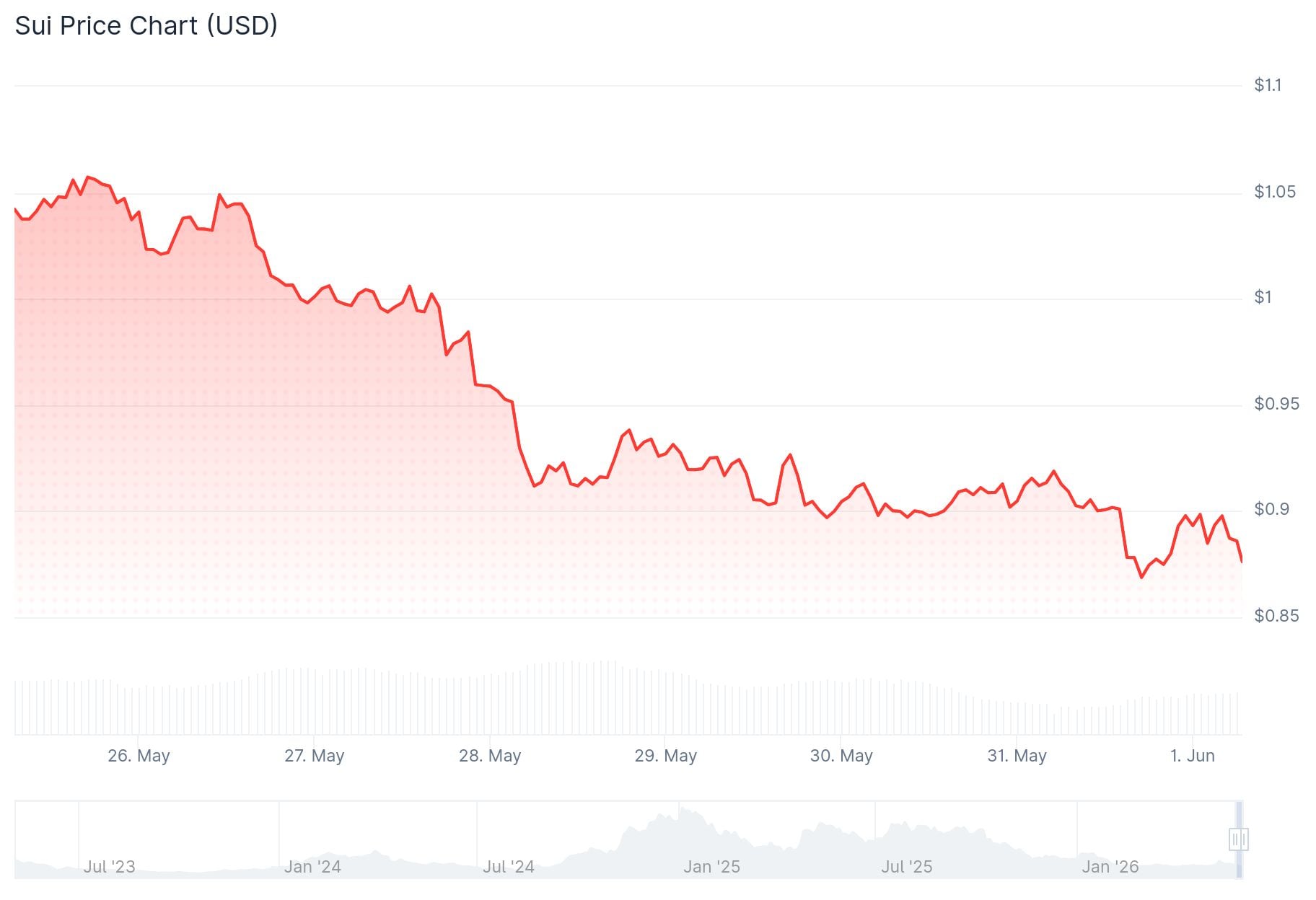
- SUI is currently trading around $0.87, down roughly 13% from $1.04 one week ago.
Sui’s blockchain suffered three mainnet outages in under 48 hours last week, marking its most disruptive period since launching. The Layer 1 network, built by Mysten Labs, was offline for a total of more than 18 hours across Thursday, May 28 and Friday, May 29. All three halts were traced back to its v1.72 software release.
Following last week’s outages related to the 1.72 release, the Sui Core Team has completed an investigation and incident review, detailing what happened and the steps taken by validators to restart the network.
— Sui (@SuiNetwork) May 31, 2026
The first outage began around 10 a.m. ET on Thursday and lasted until roughly 4:30 p.m. It was caused by a bug in how the network handles gas fees tied to a new feature called “address balances.” A transaction could be cancelled for insufficient funds, but the system still tried to charge gas on those same funds. That produced a negative balance that crashed the validator settlement process.
The Sui Foundation deployed a fix by early afternoon. But in its own post-mortem published Sunday, the Foundation confirmed that the team knew the patch carried a risk of causing another halt. They accepted that risk to restore service quickly.
Known Risk Deployed, Second Halt Follows
That decision led directly to the second outage. On Friday morning, around 5 a.m. ET, the network went down again when the exact flaw the team had flagged actually triggered. The same underflow crash happened because a different error code had masked the one the fix was designed to catch. A more complete fix was deployed by around 8:30 a.m. ET.
A third halt hit later that Friday afternoon and had a completely separate cause. When validators restarted to install the Friday morning patch, not enough of them were ready for a distributed key generation process the network uses to power its random number generator. That process switched itself off as designed, but a bug meant the failure status was never saved to disk. Validators kept restarting without knowing DKG had already failed, causing transactions requiring randomness to queue up indefinitely and the current epoch to stall. The network was frozen from around 4:30 p.m. to 10:20 p.m. ET.
The Sui Foundation said AI agents with access to validator logs helped speed up diagnosis across all three incidents.

SUI Price Slides as Outages Stack Up
SUI was trading around $0.87 at time of writing, down about 13% from $1.04 recorded one week earlier. Its market cap sits at approximately $3.49 billion. The token hit an all-time high of $5.35 on January 6, 2025, meaning it now trades roughly 84% below that peak. Around $1.88 million in SUI positions were liquidated during the three halts, with long traders taking most of the losses.
Crypto analyst Crypto Patel noted on X that SUI is showing a quiet accumulation pattern with little retail attention, suggesting larger players may be positioning in the $0.60–$0.90 range. The RSI sits near 34.51, close to oversold territory. Open interest declined 4.17% to $705 million, while trading volume rose 28% to $740 million.
$SUI Is Being Bought Up Quietly And Nobody's Talking About It
No pump. No noise. Just steady buying day after day. That's how the big moves start.
Entry Zone: $0.60 – $0.90
Targets: $5 | $10 | $20Get in before the crowd wakes up. $10 is just a matter of time.
Save this and… pic.twitter.com/agbfUmukrM
— Crypto Patel (@CryptoPatel) May 31, 2026
This was not Sui’s first outage. The network experienced a six-hour stall in January 2026 and a validator crash in November 2024. The Foundation said it plans to improve failure containment so future bugs drop individual transactions rather than halt the entire network.


