





TLDR
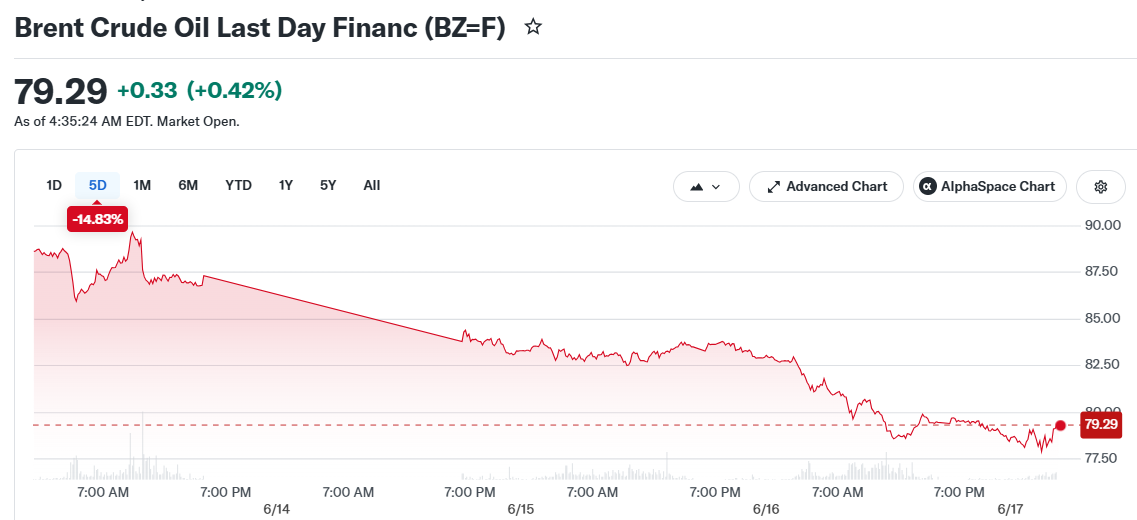
- Brent crude fell to near $78 a barrel, its lowest since early March
- A US-Iran peace deal, due to be signed Friday, would reopen the Strait of Hormuz
- Iran would be allowed to sell oil immediately upon signing
- US crude inventories dropped by 8.33 million barrels last week, more than double estimates
- Average US gasoline prices have pulled back toward $4 a gallon from a May peak above $4.56
Oil prices fell for a fifth straight session on Wednesday, hitting their lowest levels since early March, as traders priced in the possibility of more Iranian crude flowing into global markets following a US-Iran peace agreement.
Brent crude dropped to around $78.23 a barrel, while West Texas Intermediate slipped to $75.16. Both benchmarks have fallen roughly 10% over the past two sessions.
The Deal Driving the Selloff
The US and Iran have reached an interim agreement that is due to be signed on Friday. Under the deal, Iran will reopen the Strait of Hormuz to merchant shipping, and the US will lift its blockade of Iranian ports.
BLOOMBERG PUBLISHES REPORTED 14-POINT DRAFT US-IRAN MOU
1. The US, Iran, and their allies would declare an immediate and permanent end to the war on all fronts, including Lebanon, and agree not to launch hostile action or threaten force against each other.
2. Both sides would…
— Wall St Engine (@wallstengine) June 17, 2026
Tehran will also be permitted to sell its oil immediately after signing. The deal includes US waivers covering Iranian crude, petrochemicals, and related services such as banking and insurance.
A 14-point draft memorandum outlines the terms. It also kicks off 60 days of formal talks aimed at ending the war and placing limits on Iran’s nuclear program.
The Strait of Hormuz is a narrow waterway connecting the Persian Gulf to the Indian Ocean. In peacetime, it carried around one-fifth of the world’s oil supplies.

Supply and Shipping Outlook
Traders are now watching how quickly supply can actually return. Shipping companies are waiting for clarity on security arrangements before sending vessels through the strait.
Dennis Kissler, senior vice president for trading at BOK Financial Securities, said US naval vessels would likely escort ships for the first few weeks, and minesweeping operations would also slow traffic.
Parash Jain, global head of transport and logistics research at HSBC, said any resumption would be gradual. He pointed out that shipping lines spent months rerouting vessels and would not rush to reverse course until conditions were clear.
Two tankers that had been headed toward Africa have already turned around in the Indian Ocean and redirected toward the Middle East, according to vessel-tracking data.
Inventory Data Limits the Losses
Despite the bearish mood around supply, a large drop in US crude inventories gave the market some support.
The American Petroleum Institute reported that US crude stockpiles fell by 8.33 million barrels in the week ending June 12. That was more than double the estimated 4.5 million barrel draw.
The data pointed to firm demand in the US, the world’s largest oil consumer. Official government inventory figures were due later Wednesday.
Gasoline prices have also eased. The national average in the US has pulled back toward $4 a gallon after peaking above $4.56 in May, according to the American Automobile Association.
The Federal Reserve was also meeting Wednesday to decide on interest rates. No change was expected, though falling energy costs are a factor policymakers were considering.
Stop guessing and start investing with confidence. KnockoutStocks gives you the AI insights, market intelligence, and stock research you need to spot opportunities, cut through the noise, and make smarter investment decisions — all in one powerful platform.
Sign up today and get 50% OFF full access to our premium stock picks.
Simply use coupon code SPECIAL50 at checkout to claim your exclusive discount.
Get 3 Free Stock Ebooks
Discover top-performing stocks in AI, Crypto, and Technology with expert analysis.
- Top 10 AI Stocks - Leading AI companies
- Top 10 Crypto Stocks - Blockchain leaders
- Top 10 Tech Stocks - Tech giants



