





TLDR
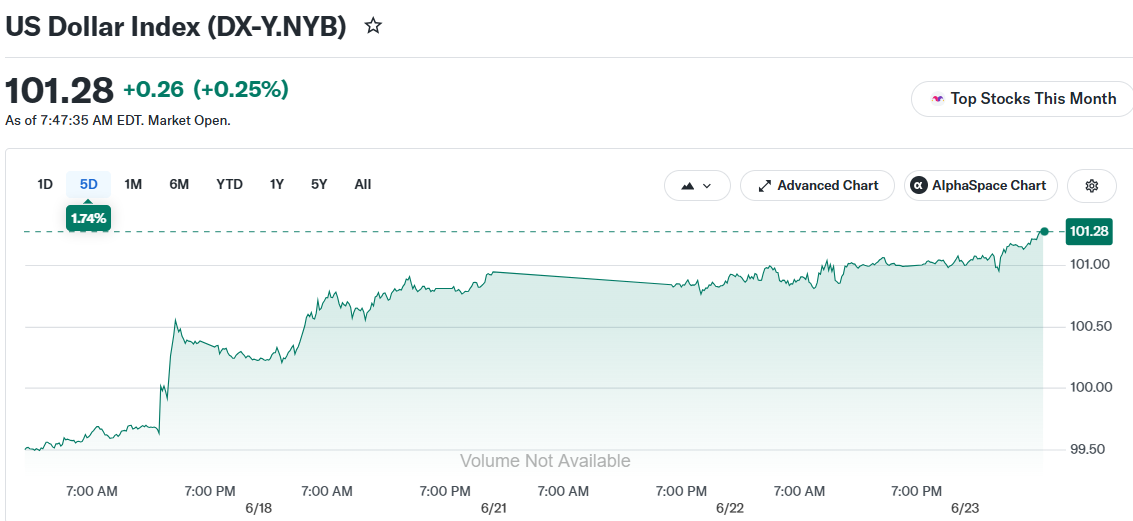
- The US Dollar Index climbed to its highest level in over a year, reaching 101.25
- Fed funds futures now price in an 80–85% chance of a rate hike by September or October
- The Japanese yen is close to its weakest level since 1986, raising intervention fears
- UK Prime Minister Keir Starmer resigned, adding pressure to the British pound
- The euro fell to its lowest since August 2025 after ECB’s Lagarde downplayed inflation risks
The US dollar climbed to a one-year high on Tuesday as traders increasingly bet the Federal Reserve will raise interest rates before the end of the year. The Dollar Index hit 101.25, its highest point since May 2025.
Fed funds futures now price in roughly an 80 to 85% chance of a quarter-point rate hike by September or October. Both BofA Global Research and Deutsche Bank have revised their forecasts, dropping earlier calls for steady policy and now expecting a hike within the year.
“Right now, the dollar is pricing in higher rates and is gaining on that,” said Tommy von Bromsen, FX strategist at Handelsbanken.
Ongoing uncertainty from unresolved Middle East tensions is also adding support to the dollar, according to von Bromsen.
Yen Under Pressure Near 40-Year Low
The Japanese yen is hovering near dangerous territory. It briefly hit 161.93 per dollar on Monday, and a move above 161.96 would push it to its weakest level since 1986.
Markets are on edge for potential intervention by Japanese authorities. Japan’s government spent tens of billions of dollars in late April and early May to prop up the yen, but those efforts had limited effect.
The Bank of Japan raised interest rates last week and signaled more tightening ahead. Even so, the yen continued to weaken, pressured by the wide gap between US and Japanese rates.
Japanese Finance Minister Satsuki Katayama held talks with US Treasury Secretary Scott Bessent on Monday. The meeting focused on policy responses to the yen’s decline, including possible currency intervention.

Political Uncertainty Hits Pound, Euro Slips
The British pound fell 0.2 to 0.3% on Tuesday after UK Prime Minister Keir Starmer resigned, adding political uncertainty to British markets. Health Minister Wes Streeting backed Andy Burnham as a replacement, which analysts said could reduce uncertainty around the leadership transition.
“With Streeting’s willingness to back Burnham, this uncertainty is now likely to be a thing of the past,” said Commerzbank FX analyst Michael Pfister.
The euro also slipped, falling to $1.1395, its lowest since August 2025. ECB President Christine Lagarde downplayed second-round inflation risks on Monday, while data showed eurozone private sector activity shrank for a third straight month in June.
The Australian dollar fell 0.7 to 0.8%, hitting its weakest level since April.
Markets are now watching upcoming US data closely. The May PCE price index, due Wednesday, is the Fed’s preferred inflation gauge. June PMI readings and a revised first-quarter GDP print are also expected this week. These releases could determine whether the dollar’s rally has further room to run.
Stop guessing and start investing with confidence. KnockoutStocks gives you the AI insights, market intelligence, and stock research you need to spot opportunities, cut through the noise, and make smarter investment decisions — all in one powerful platform.
Sign up today and get 50% OFF full access to our premium stock picks.
Simply use coupon code SPECIAL50 at checkout to claim your exclusive discount.
Get 3 Free Stock Ebooks
Discover top-performing stocks in AI, Crypto, and Technology with expert analysis.
- Top 10 AI Stocks - Leading AI companies
- Top 10 Crypto Stocks - Blockchain leaders
- Top 10 Tech Stocks - Tech giants



