





TLDR
- Chainlink has joined Project Pangea, a coalition of 47 European and South Korean banks with over $10 trillion in assets under management.
- The project aims to move FX settlement from a 48-hour process to near real-time using stablecoins.
- The Europe-South Korea trade corridor handles over $150 billion in goods and services annually.
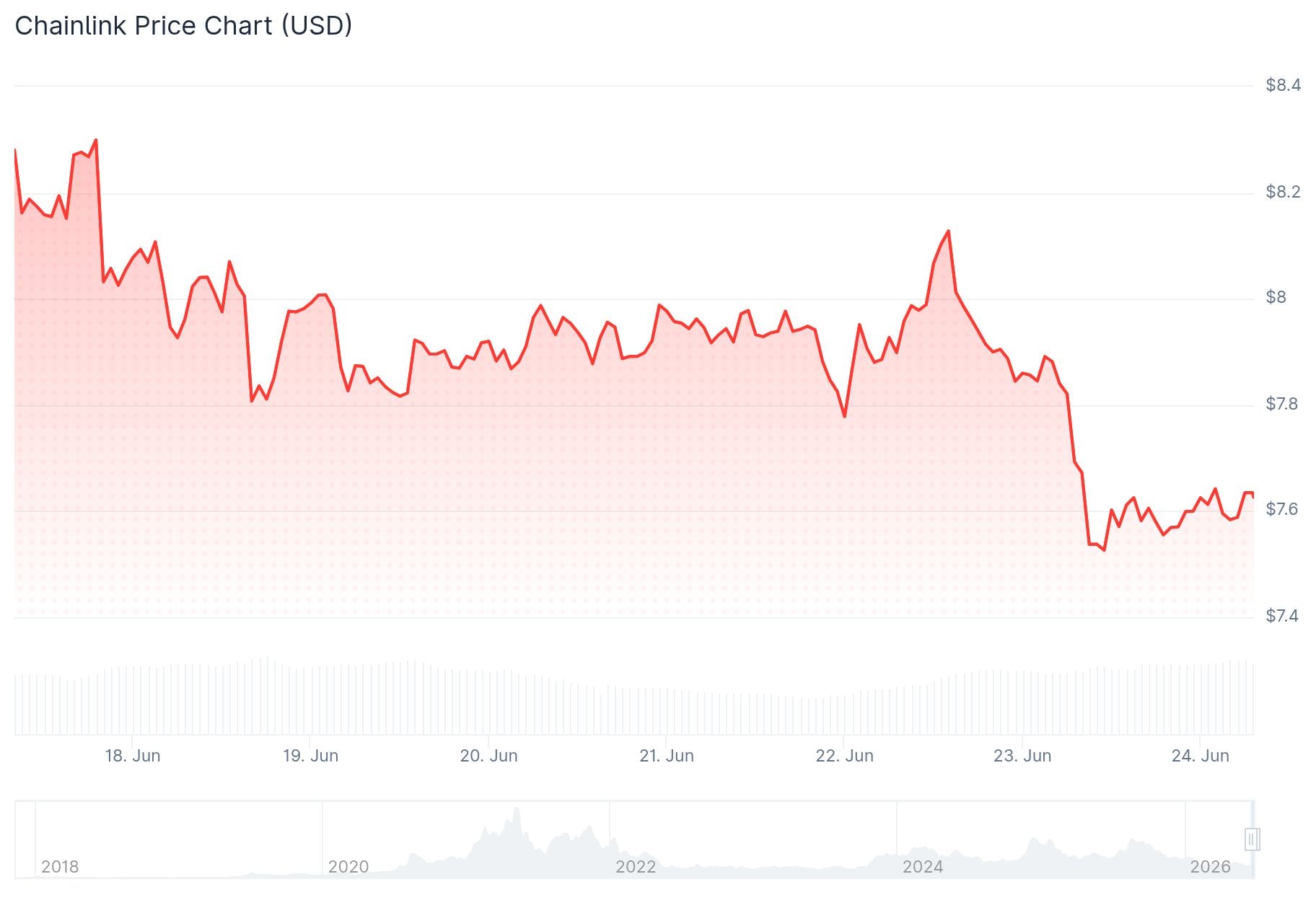
- LINK is currently trading in the $7–$8 range, near a key accumulation zone analysts have flagged.
- Long-term price targets from analysts range from $21 to $100, with the $100 level projected for 2028–2029.
Chainlink has joined a major new banking coalition designed to speed up cross-border payments using stablecoin technology. At the same time, market analysts are pointing to the LINK token as potentially sitting at a long-term accumulation bottom.
The coalition, called Project Pangea, brings together Chainlink, Qivalis (a euro stablecoin group backed by 37 European banks), and UniKA (a Korean banking alliance of more than 10 commercial banks). Together, the participating institutions manage over $10 trillion in assets.
Chainlink Joins 47 European and South Korean Banks Managing Over $10 Trillion to Enable Near Real-Time (T+0) Cross-Border Settlement
Chainlink has joined 47 European and South Korean banks with more than $10 trillion in combined assets under management as part of Project Pangea,… pic.twitter.com/S1evBZdGTV
— Wu Blockchain (@WuBlockchain) June 23, 2026
The goal is to reduce FX settlement times from the current standard of 48 hours (T+2) to near-instant (T+0). They plan to do this using euro- and South Korean won-pegged stablecoins.
The project will test atomic payment-versus-payment (PvP) settlement. This means both sides of a currency trade settle at the same time, or not at all, cutting counterparty risk.
Chainlink’s VP of Asia-Pacific and the Middle East, Niki Ariyasinghe, was direct about the timeline. “The target is live transactions within a legal, regulatory compliance framework within the next 12 months,” he said.
A $150 Billion Trade Corridor
The project is focused on Europe and South Korea, a trade route that processes over $150 billion in goods and services each year, making it one of the world’s 15 largest.

Banks involved will continue using Swift to trigger transactions. Chainlink’s infrastructure will then translate those commands into instant atomic swaps on a neutral ledger called the Pangea L1 Network. This approach means banks don’t need to replace their existing systems.
Ariyasinghe noted that 60% of all global stablecoin payments are currently happening in Asia, pointing to real demand in the region.
LINK Price Near Key Accumulation Zone
On the price side, analyst Crypto Patel posted a weekly chart analysis on X showing LINK has been consolidating in a downward channel since its 2021 high of around $50. According to Patel, LINK has re-entered a strong buying region between $4.75 and $7.85 after falling 86–87% from recent highs. His analysis identifies the nearest target at $21.35, with the previous cycle high of $52.22 as the next level after that. The most optimistic projection puts LINK at $100 between 2028 and 2029.
Did You Know: $LINK Already Got Classified As A Commodity And It's Still -87% From ATH 😏
That's Like Buying Bitcoin When Everyone Called It A Scam… Except This Time The Government Already Said It's Legit 😂
$100+ LINK Is Not A Question… It's Just A Matter Of Time. pic.twitter.com/gQHLxNNArF
— Crypto Patel (@CryptoPatel) June 19, 2026
Separately, analyst Gann Wyck pointed to a GannWyck Model 1 Accumulation forming on higher timeframes, suggesting LINK may be nearing the end of a multi-year downtrend.
LINK is currently trading in the $7–$8 range. Analysts flag the $6.50–$7.50 zone as a key support area. A move above $10 would be an early signal that the downtrend is reversing.
Chainlink’s growing use in DeFi data infrastructure, along with a Grayscale ETF application and purchases from Caliber Investments, are among the institutional factors being cited alongside the Project Pangea announcement.


