






TLDR
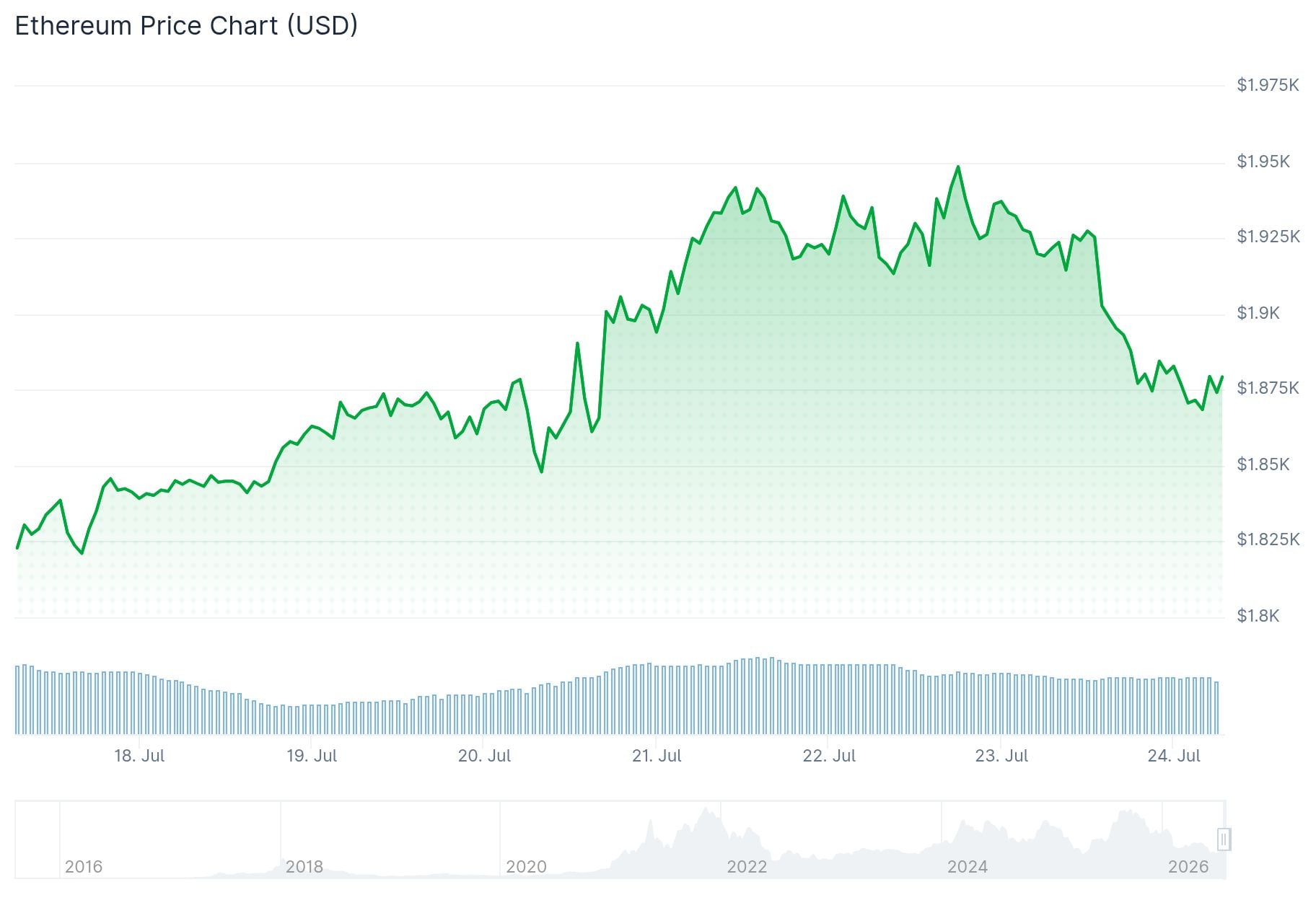
- ETH is trading near $1,927, failing to break the key $2,000 level despite a 27% recovery from June lows
- Rising oil prices are pushing up inflation fears, increasing the chance of a September Fed rate hike to 79%
- U.S. spot Ethereum ETFs saw $72.64 million in net inflows on July 22, led by BlackRock’s $53.47 million
- BitMEX is shutting down on Sept. 23, adding uncertainty around leverage and liquidity in ETH markets
- CryptoQuant data shows ETH is trading 17% below its realized price of ~$2,300, historically linked to undervaluation
Ethereum is stuck in a familiar spot — below $2,000. The token traded near $1,927 on July 23, after hitting an intraday high of $1,941. That puts ETH up more than 27% from its June low around $1,514, but repeated failures near $1,955 have kept the $2,000 level out of reach.
The main pressure right now is coming from oil markets. Middle East tensions have pushed crude prices higher for five straight sessions. West Texas Intermediate climbed above $90 a barrel after Houthi attacks on Saudi oil tankers raised supply concerns. Higher energy prices could feed inflation and limit the Federal Reserve’s ability to hold rates steady.
Rate traders have already shifted their outlook. The probability of a September Fed rate hike has risen from 68% to 79%, according to CME FedWatch data. That kind of rate environment tends to weigh on risk assets like crypto.
ETF Inflows Offer Some Support
Despite the macro headwinds, institutional money has kept flowing in. U.S. spot Ethereum ETFs recorded $72.64 million in net inflows on July 22, per SoSoValue. BlackRock’s iShares Ethereum Trust alone accounted for $53.47 million of that total.
According to SoSoValue, U.S. spot Bitcoin ETFs recorded total net inflows of USD 68.99 million on July 23, led by BlackRock’s IBIT with USD 38.78 million. Spot Ethereum ETFs drew USD 72.64 million, with BlackRock’s ETHA posting the largest single-day inflow at USD 53.47 million.… pic.twitter.com/wHHDMkqnLj
— Wu Blockchain (@WuBlockchain) July 23, 2026
Analyst Ted Pillows noted that spot demand has remained resilient. He said: “Spot demand is strong and the key support zone hasn’t been lost. IMO, Ethereum could begin its next move up in a few days.” Pillows identified $2,030 as the first upside target, with heavier resistance around $2,400.
Crypto analyst Daan Crypto Trades also pointed out that ETH has been moving well against Bitcoin. He noted that ETH/BTC dominance could shift if Ethereum keeps outperforming, though BTC dominance has not yet rolled over.

$ETH Moving pretty well against $BTC
This is the kind of rotation people have been waiting on for a while now. $BTC dominance is still not moving much though as not all alts are performing.
If $ETH keeps outperforming at this pace, that dominance number is usually the next… https://t.co/VeswBQoFyy pic.twitter.com/WKzFH8jKwr
— Daan Crypto Trades (@DaanCrypto) July 23, 2026
Onchain Data and Key Risks
CryptoQuant’s latest report shows ETH is trading roughly 17% below its realized price of around $2,300. Historically, that level has coincided with long-term bottoms. However, only two of CryptoQuant’s five bottoming indicators have been confirmed so far.
Meanwhile, BitMEX announced it will shut down on September 23. The exchange has served over 2 million traders since 2014. Customers have been told to close positions and withdraw funds before the deadline.
A record 34% of Ethereum’s circulating supply is now staked, according to Staking Rewards. Tom Lee’s Bitmine Immersion Technologies has added 325,000 ETH over one month and is targeting a 5% share of the total ETH supply.
ETH needs a 4-hour close above $1,955 to open the path toward $2,000–$2,030. Below $1,860, the current recovery structure weakens.


