





TLDR
- Brent crude fell 1.5% to $94.22 and WTI slipped 1.4% to $89.78 on Thursday after a three-day rally
- Trump said the renewed U.S. bombing campaign against Iran would not last long
- U.S. Energy Secretary said 17 million barrels passed through the Strait of Hormuz on Monday, the highest since the conflict reduced flows
- Shipping traffic remains volatile, with only four commodity vessels transiting the strait on Tuesday versus a 10-day average of 13
- U.S. commercial crude stocks fell by 4.5 million barrels last week, the first decline in five weeks
Oil prices pulled back on Thursday after three straight sessions of gains, as President Donald Trump suggested the latest U.S. strikes against Iran would be brief.
Brent crude futures fell 1.5% to $94.22 per barrel. West Texas Intermediate dropped 1.4% to $89.78 per barrel. Both contracts had hit five-week highs during the recent rally.
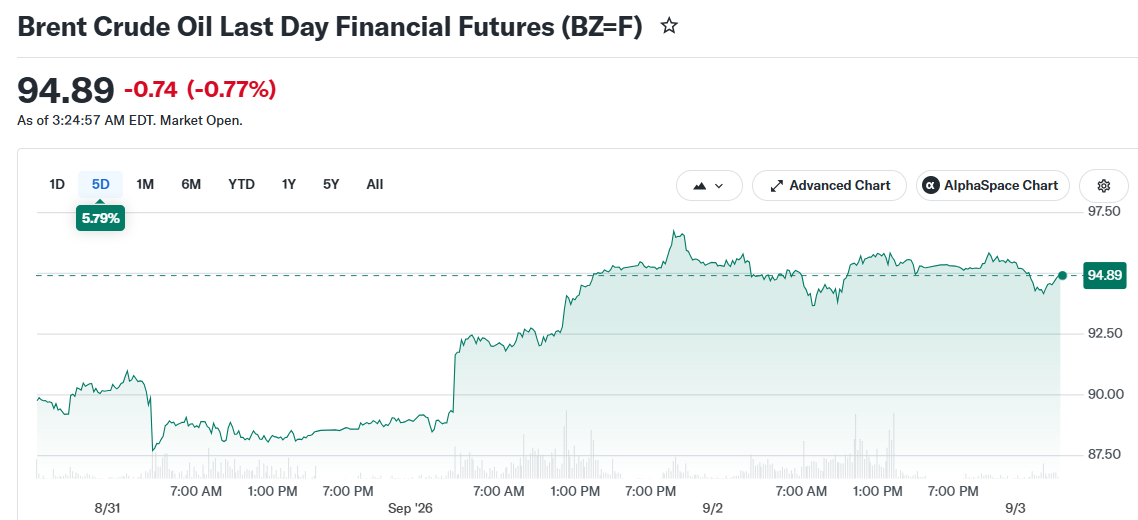
The gains had been driven by fears that renewed U.S.-Iran military clashes could disrupt oil flows from the Middle East. U.S. forces struck Iran’s southern coast on Wednesday, and Tehran fired back with drones and missiles at American bases across the region.
It was the most intense exchange between the two countries since July.
Trump’s Comments Cool the Market
When asked how long the U.S. campaign would last, Trump said “I don’t think too long,” though he added that “we’re prepared to do another one.” Those comments helped ease some of the immediate supply fears in the market.
BREAKING: President Trump is having private discussions with senior aides about potentially declaring the Iran War over, per WSJ.
Aides are reportedly advising President Trump that an escalation of the war beyond recent strikes could cost Republicans the midterm elections.
— The Kobeissi Letter (@KobeissiLetter) September 3, 2026
Trump also said the U.S. had targeted Iranian radar, missile systems and capabilities linked to laying mines near the Strait of Hormuz.

The Strait of Hormuz is one of the most important oil shipping routes in the world. U.S. Energy Secretary Chris Wright said 17 million barrels of crude passed through the waterway on Monday, the highest volume since conflict disrupted flows.
Despite that, shipping traffic is still unstable. Preliminary data showed only four commodity vessels transiting the strait on Tuesday, compared to a 10-day average of around 13.
Inventory Data and OPEC+
U.S. crude stockpiles fell by 4.5 million barrels last week. That was the first decline in five weeks and came in below analyst forecasts of a small rise.
Gasoline stocks dropped by 1.2 million barrels. Distillate inventories, which include diesel and heating oil, rose by around 800,000 barrels.
Oil prices are now more than 30% higher since the war between the U.S. and Iran started in late February. Refined products like diesel have risen even more sharply.
Traders are also watching OPEC+, which is expected to keep its October output policy unchanged at a meeting on Sunday. The group had already raised September output quotas by 188,000 barrels per day as part of a scheduled unwinding of earlier production cuts.
A peace deal agreed in June between the U.S. and Iran in Islamabad collapsed, and neither side has shown interest in returning to the negotiating table since.
Dennis Kissler of BOK Financial Securities said more peace talks could quickly bring prices down, but added that both sides appear to be looking for an exit from the conflict.
Stop guessing and start investing with confidence. KnockoutStocks gives you the AI insights, market intelligence, and stock research you need to spot opportunities, cut through the noise, and make smarter investment decisions — all in one powerful platform.
Sign up today and get 50% OFF full access to our premium stock picks.
Simply use coupon code SPECIAL50 at checkout to claim your exclusive discount.
Get 3 Free Stock Ebooks
Discover top-performing stocks in AI, Crypto, and Technology with expert analysis.
- Top 10 AI Stocks - Leading AI companies
- Top 10 Crypto Stocks - Blockchain leaders
- Top 10 Tech Stocks - Tech giants



