






Read our Advertising Guidelines Here
Most slot pages carry a single number, “96.21% RTP,” and most players read it as a promise: play long enough and you’ll get most of your money back. That’s not what the number means, and treating it as the whole picture is why players get blindsided by a “high RTP” game that burns through a bankroll in ten minutes. RTP tells you how much a slot pays back over its lifetime. It says nothing about how that payback arrives: steady and small, or rare and large. That second part has a name, volatility. Reading a slot’s odds means reading both.
What Is RTP?
RTP, short for return to player, is the percentage of everything staked on a slot that the game is mathematically designed to pay back to players over its full lifetime. That figure comes from millions of simulated spins run against the game’s math model, not from any single session or player. Flip it around and you get the house edge: a slot with 96% RTP keeps 4% of every dollar wagered, on average, over that same long run. Neither number tells you what happens in the one hour you actually play.
RTP is also not fixed to a game the way a title or a reel set is. Play’n GO’s Book of Dead, one of the most-played online slots, ships with an official RTP of 96.21%, but the studio also builds four lower-paying versions of the same game (94.25%, 91.25%, 87.25%, 84.18%). It’s the operator or the local regulator, not the player, who picks which configuration goes live in a given market. Two casinos can legally offer “Book of Dead” with a four-point RTP gap between them: same graphics, same bonus round, different math underneath.
Regulators set the floor for how low that math can go, and they don’t agree on where it should sit. The Malta Gaming Authority cut its minimum RTP requirement for slots from 92% to 85% in 2021, aligning online games with the lower bar long used in land-based casinos. The UK Gambling Commission takes a different approach: it doesn’t publish a single minimum RTP, but it requires every game to pass an independent, Commission-approved testing audit before launch, and operators must keep monitoring live performance to confirm each game still hits the RTP it was certified at. Curaçao’s regulatory overhaul, which replaced the old sub-license system with direct licensing at the end of 2024, requires certified random number generators and GLI-standard fairness testing across the board, tighter oversight than the sub-license system it replaced, though it stops short of a published RTP floor. None of that is consistent across jurisdictions, which is exactly why the RTP printed on a game’s info panel is worth checking rather than assuming.
What Is Slot Volatility?
Slot volatility, also called variance, describes how a slot’s payouts are distributed, not how much it pays back overall. It’s the difference between a game that returns small amounts often and one that returns large amounts rarely, even when both games carry a similar RTP.
A related figure, hit frequency, measures how often a spin produces any win at all, expressed as a percentage: a game with a 20% hit frequency pays out on roughly 1 in 5 spins. Lower hit frequency generally tracks with higher volatility, since wins are rarer but bigger when they land.
The two ends of the spectrum are easy to see in real games. NetEnt’s Blood Suckers pairs a 98% RTP with low volatility: the vampire-hunting slot has stayed popular since 2013 largely because it produces frequent, modest wins rather than long dry spells. Big Time Gaming’s White Rabbit Megaways sits at the other extreme, with an RTP around 97.24% (rising to 97.77% if a player buys into the bonus round outright), built around long droughts punctuated by potentially massive multiplier wins, the volatility profile the studio’s Megaways mechanic is known for. Then there’s Microgaming’s Mega Moolah, which complicates the picture further: its base game pays out at 88.12% RTP, rising to 93.42% once the four-tier progressive jackpot’s contribution is counted in, a structure that trades a lower everyday return for a shot at prizes that have paid out more than €1 billion combined since 2006, including an €18.9 million single win recognized by Guinness World Records as the largest jackpot payout in an online slot.

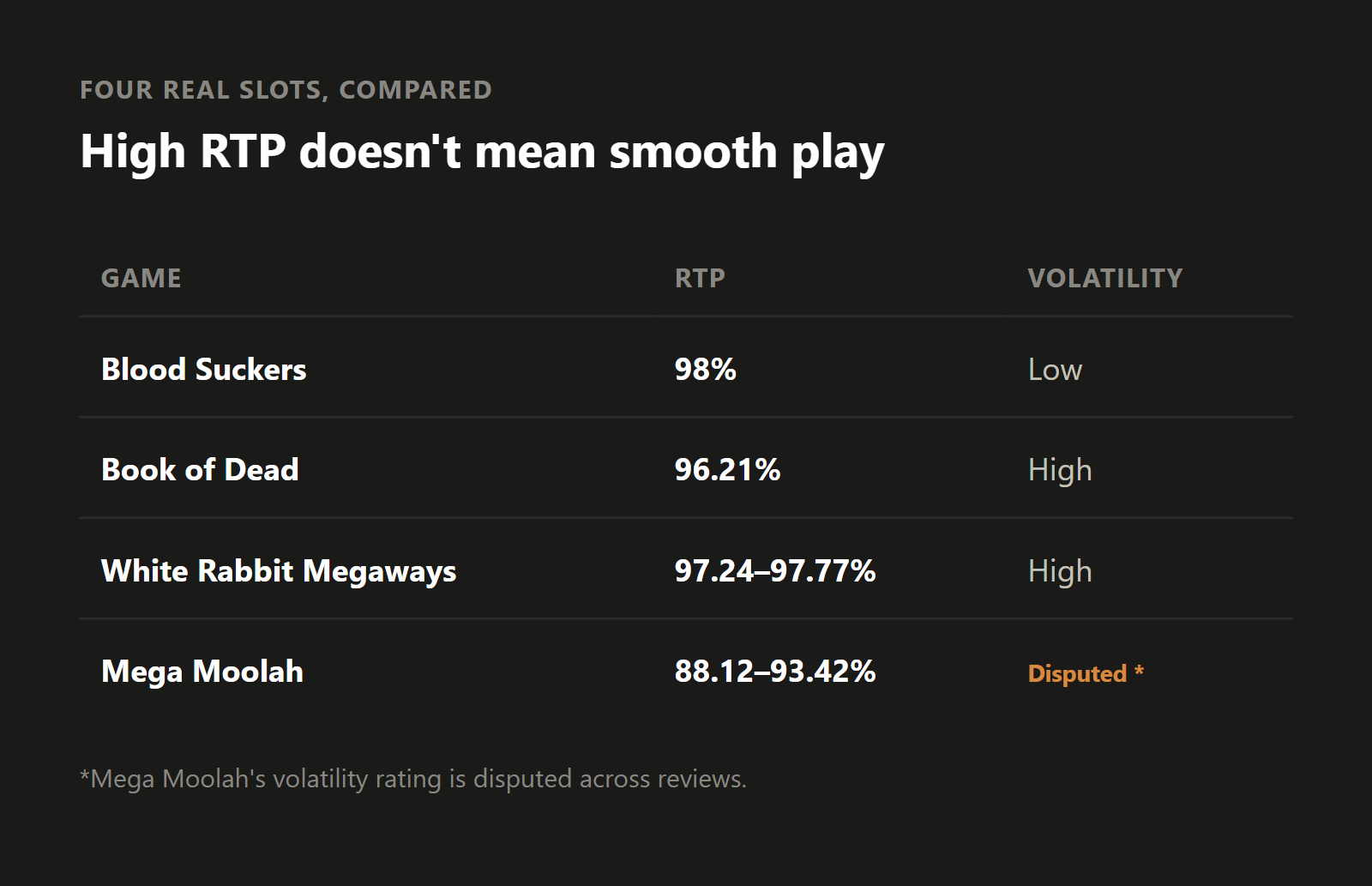
Providers increasingly label this directly. Pragmatic Play rates its slots on a 1-to-5 volatility scale, so players don’t have to reverse-engineer the risk profile from a paytable. Where that labeling exists, it’s worth reading alongside the RTP figure, not instead of it, whether you’re checking a traditional casino’s paytable or one of today’s crypto slots platforms.
Why Do RTP and Volatility Matter More Together Than Apart?
A high RTP with high volatility is a slow-burn, high-variance bet: expect long stretches with nothing, and occasional payouts big enough to offset them, if the timing works out. A high RTP with low volatility is closer to a grind: smaller, steadier returns, less likely to torch a bankroll in a bad session, also less likely to produce a headline-sized win. Neither is objectively better. They suit different bankrolls and different reasons for playing. What’s actually useful is knowing which one you’re looking at before you stake money on it, since the RTP figure alone can’t tell you.
How to Actually Check This Before You Play
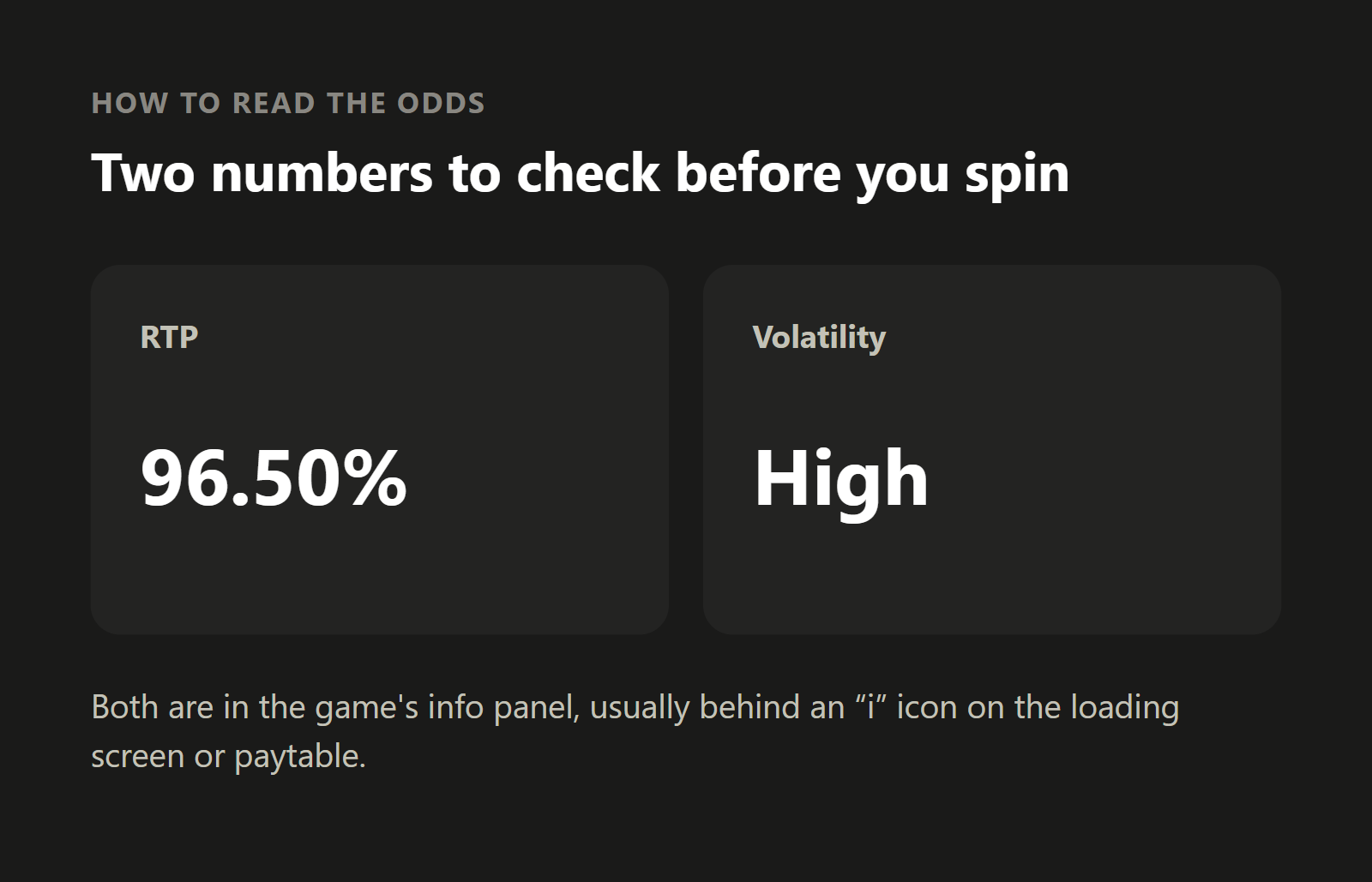
The practical fix is simple: open the game’s info panel (usually an “i” icon on the slot’s loading screen or paytable) before spinning, not after. That panel is where the studio discloses the specific RTP configuration live at that casino, and, on titles from providers that publish it, the volatility rating.
This matters for crypto slots too, where libraries run into the thousands and marketing tends to foreground bonus terms over game math. jack.com is a Curaçao-licensed crypto casino and sportsbook with a slot library sourced from multiple providers, and it’s a useful example here. Independent reviews report that RTP figures are disclosed inside each game’s own info panel, but there’s no lobby-level filter that sorts the library by RTP or volatility the way some competitors’ interfaces do. That’s not unusual for the category: most crypto slot libraries prioritize breadth of titles over analytical tools. It also points to what actually makes a platform worth calling the best crypto casino for slots: whether the RTP and volatility data are there to check before the player commits any money, not the size of the library or the bonus copy around it.
Whichever casino a player uses, the same two questions settle what a slot’s odds actually mean: what does the info panel say the RTP is at this specific casino right now, and does the volatility label (or the paytable, if there isn’t one) point to frequent small wins or rare large ones. Answer both before the first spin, and the number on the loading screen stops being a marketing line and starts being useful information.
Jack’s own 2026 casino review walks through RTP and volatility across its slot library in more detail.
Disclaimer: This media platform provides the content of this article on an "as-is" basis, without any warranties or representations of any kind, express or implied. We assume no responsibility for any inaccuracies, errors, or omissions. We do not assume any responsibility or liability for the accuracy, content, images, videos, licenses, completeness, legality, or reliability of the information presented herein. Any concerns, complaints, or copyright issues related to this article should be directed to the content provider mentioned above. Read our Advertising Guidelines Here.

Michelle is an editor at CoinCentral & Blockonomi, covering the latest trends in crypto, blockchain, and digital finance. With a sharp eye for detail and a passion for emerging technologies, Michelle ensures every story delivers clarity, accuracy, and insight to our readers.


