





TLDR
- Brent crude rose 1.3% to $101.59 per barrel on Tuesday after four straight days of losses
- WTI crude gained 0.7% to $96.45 per barrel, recovering from Monday’s 4.5% drop
- President Trump signaled openness to meeting Iranian President Pezeshkian at the UN General Assembly
- Saudi Arabia increased crude shipments through the Strait of Hormuz after pipeline disruptions
- Libya’s Sharara oil field output fell from 340,000 to 127,000 barrels per day after an armed group blocked a pipeline
Oil prices bounced back on Tuesday after four consecutive sessions of losses. Brent crude futures rose 1.3% to $101.59 per barrel, while West Texas Intermediate gained 0.7% to $96.45 per barrel.
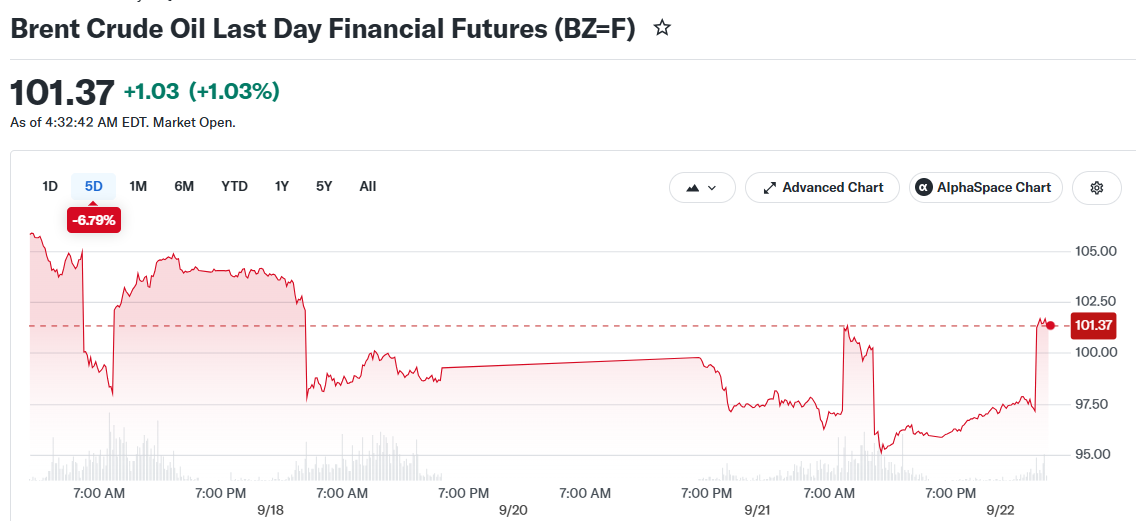
The rebound came after a rough Monday. Brent settled 3.4% lower and WTI fell 4.5%, both hitting their lowest closing levels since September 9.
Investors are watching potential diplomatic talks between the U.S. and Iran. President Donald Trump said he would be open to meeting Iranian President Masoud Pezeshkian, who is attending the UN General Assembly in New York this week.
Iran has also reportedly passed conditions for re-entering negotiations through mediators. That raised hopes that diplomacy could ease tensions and reduce the war’s impact on global energy markets.
Oil has rallied more than 60% this year. The ongoing conflict in the Middle East has disrupted energy flows through the Strait of Hormuz, a critical chokepoint for global oil supply.
Saudi Arabia Shifts Exports Through Hormuz
Saudi Arabia recently suffered disruptions to its key east-west pipeline. In response, the kingdom shifted crude exports back toward the Strait of Hormuz.
Crude Oil has now declined for 5 consecutive days, its longest losing streak since August 2025 📉 pic.twitter.com/hJmu68uB9e
— Barchart (@Barchart) September 22, 2026

Satellite data shows Saudi observed loadings from inside the Persian Gulf jumped over the weekend. Flows through the Strait of Hormuz averaged about 2.9 million barrels per day over the past six days, up sharply from August levels.
Analysts at ING noted that Middle East tensions continued to support risk premiums in the market. Crude prices clawed back some losses Tuesday morning on the back of those concerns.
The Houthis in Yemen have also been fighting for control of areas near the Bab el-Mandeb Strait. That narrow waterway links the Red Sea with the Gulf of Aden and is another key route for Saudi crude exports.
Libya Output Slumps, Russia Eyes Diesel Export Ban
Supply disruptions are not limited to the Gulf. Libya’s Sharara oil field, the country’s largest, has seen output fall sharply.
Production dropped from roughly 340,000 barrels per day to about 127,000 barrels per day. An armed group blocked a pipeline connecting the field to the Zawiya export terminal.
Russia is also weighing an extension of its ban on most diesel exports. Ukrainian attacks on Russian energy infrastructure have reduced refinery output, pushing diesel prices to record highs in the U.S. and Europe.
The combination of disruptions across multiple regions has kept oil markets on edge. Traders are watching diplomatic developments at the UN closely for any sign of a de-escalation that could ease supply concerns.
Stop guessing and start investing with confidence. KnockoutStocks gives you the AI insights, market intelligence, and stock research you need to spot opportunities, cut through the noise, and make smarter investment decisions — all in one powerful platform.
Sign up today and get 50% OFF full access to our premium stock picks.
Simply use coupon code SPECIAL50 at checkout to claim your exclusive discount.
Get 3 Free Stock Ebooks
Discover top-performing stocks in AI, Crypto, and Technology with expert analysis.
- Top 10 AI Stocks - Leading AI companies
- Top 10 Crypto Stocks - Blockchain leaders
- Top 10 Tech Stocks - Tech giants



