





TLDR
- European natural gas prices rose around 1.6% on Tuesday after falling over 7% on Monday
- The sell-off was triggered by news that President Trump expressed openness to talks with Iran’s President Pezeshkian at the UN General Assembly
- Hope that U.S.-Iran diplomacy could ease Middle East tensions briefly reduced energy supply risk premiums
- Energy markets pulled back some of that optimism on Tuesday as a deal remains far from certain
- Germany’s low gas storage levels and slow tender volumes add to concerns ahead of winter
European natural gas prices bounced back on Tuesday after suffering their worst single-day drop in nearly two months the day before.
The Dutch TTF front-month contract, the European benchmark, rose 1.6% to around 78.80 euros per megawatt-hour. The British NBP contract rose by the same amount, trading near 195.40 pence per therm.
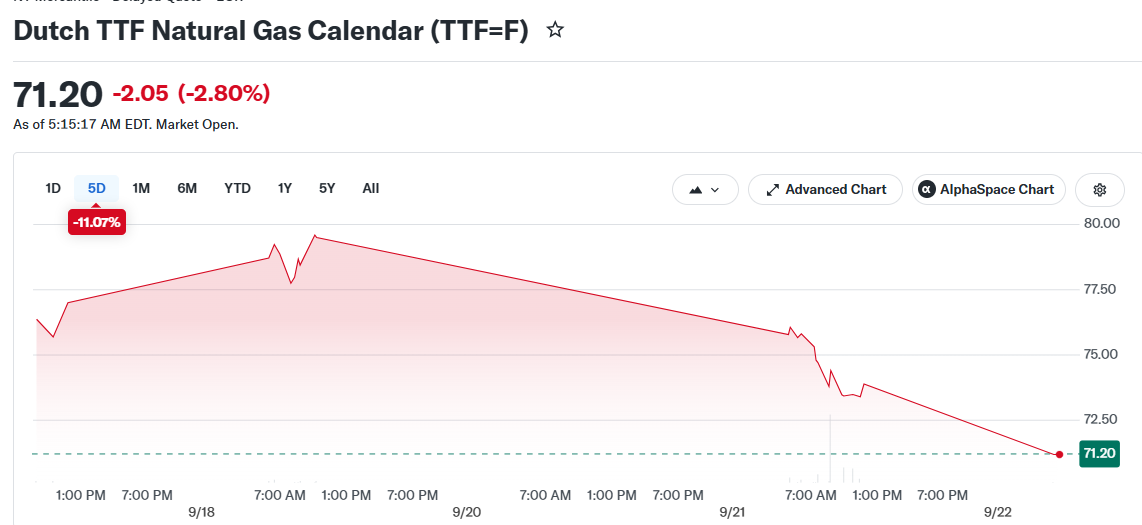
Both contracts had fallen more than 7% on Monday. That was their steepest one-day decline in close to two months.
The sell-off came after reports that U.S. President Donald Trump said he was open to direct talks with Iranian President Masoud Pezeshkian. Pezeshkian is attending the UN General Assembly in New York this week.
The news sparked hope that diplomacy could bring an end to the seven-month conflict in the Middle East. Markets reacted quickly, pricing out some of the risk premium tied to potential disruptions through the Strait of Hormuz.
The Strait of Hormuz is a key chokepoint for global energy flows. Any threat to shipping there tends to push energy prices higher.
Markets Walk Back Early Optimism
By Tuesday morning, that optimism had cooled. Traders recognized that a diplomatic breakthrough is far from certain, and physical supply through the Persian Gulf remains constrained.

Brent crude futures also edged lower on Tuesday, following a 3% drop in the previous session. Reports suggest energy companies and shipping operators are using overland pipelines and alternate loading routes off the coast of Oman to work around Gulf transit issues.
These alternative routes are helping ease some supply concerns, which is adding to the downward pressure on prices alongside the diplomatic developments.
Germany’s Storage Levels Add to Supply Concerns
Germany’s latest gas-storage tenders came in below expectations in terms of volumes sought. That added some downward pressure to prices.
However, Germany’s overall storage levels remain historically low. That raises concerns about energy supply heading into the winter heating season, when demand typically rises.
The European Central Bank has also flagged a concern. It noted in a recent Economic Bulletin that wholesale gas price spikes now feed through to retail inflation within one to three months across more than half of eurozone economies. That means consumers could feel the effects of any sustained price rise fairly quickly.
For now, markets are in a wait-and-see mode. All eyes are on New York, where any update on U.S.-Iran talks this week could move prices sharply in either direction.
Germany’s low storage levels remain a key risk factor as the region heads toward the colder months.
Stop guessing and start investing with confidence. KnockoutStocks gives you the AI insights, market intelligence, and stock research you need to spot opportunities, cut through the noise, and make smarter investment decisions — all in one powerful platform.
Sign up today and get 50% OFF full access to our premium stock picks.
Simply use coupon code SPECIAL50 at checkout to claim your exclusive discount.
Get 3 Free Stock Ebooks
Discover top-performing stocks in AI, Crypto, and Technology with expert analysis.
- Top 10 AI Stocks - Leading AI companies
- Top 10 Crypto Stocks - Blockchain leaders
- Top 10 Tech Stocks - Tech giants



