






TLDR
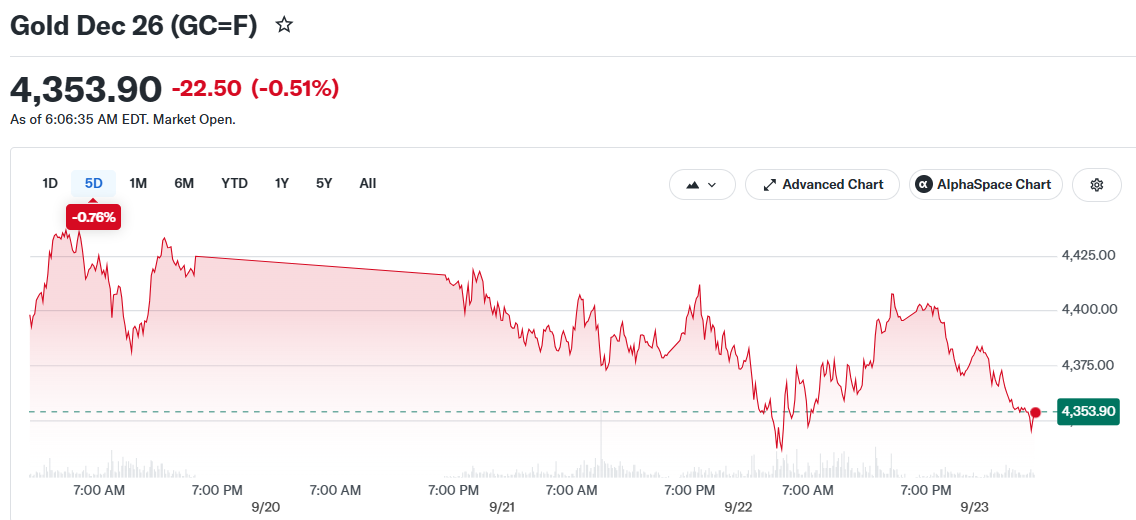
- Gold fell about 0.9% to around $4,318 an ounce as the U.S. dollar strengthened.
- The dollar index climbed to its highest level since late July, making gold more expensive for overseas buyers.
- The Federal Reserve raised rates by 25 basis points last week to 3.75%-4.00%, and markets are pricing further tightening.
- Lower oil prices are easing some inflation pressure, but crude remains sharply higher for the year.
- Strong Chinese demand and central-bank buying are helping limit deeper losses.
Gold prices fell Wednesday as a stronger U.S. dollar and expectations that interest rates could remain high for longer reduced demand for the non-yielding metal.
Spot gold dropped about 0.9% to $4,318 an ounce, while U.S. gold futures fell around 0.5%. The dollar index climbed to around 100.71, its strongest level since July 30.
Higher Rates Pressure Gold
The Federal Reserve raised its benchmark rate by 25 basis points last week to a range of 3.75%-4.00%, its first increase in more than three years. Policymakers also indicated that another rate rise could come before the end of 2026.
Higher interest rates tend to weigh on gold because the metal does not pay interest. Investors can instead earn higher returns from bonds and other yield-bearing assets.
Fed officials have continued to highlight inflation risks. Boston Fed President Susan Collins said a somewhat more restrictive policy rate could be needed to return inflation sustainably toward the central bank’s 2% target.
The stronger dollar is adding further pressure. Gold is priced in dollars, so a rising U.S. currency makes bullion more expensive for buyers using euros, yen and other currencies.
Falling Oil Offers Some Relief
Oil prices have declined as hopes increase for improved Middle East supply. Iran has indicated that the Strait of Hormuz could reopen under certain conditions, while Saudi Arabia has restarted its East-West pipeline.

JUST IN 🚨: Crude Oil going for 7 consecutive red days, which would be its longest losing streak since August 2021 📉 🤯 👀 pic.twitter.com/iNglD7iTMi
— Barchart (@Barchart) September 23, 2026
Brent crude has fallen below $100 per barrel, helping ease some fears that energy prices will keep driving inflation higher. However, oil remains substantially above levels seen at the beginning of the year.
Lower energy costs could eventually reduce pressure on central banks to keep raising rates. For gold, that creates a counterweight to the stronger dollar and current expectations for tighter monetary policy.
Chinese Demand Supports Gold
Physical and investment demand also continues to provide support. ANZ said Chinese gold imports reached roughly 1,000 tonnes during the first eight months of 2026, while Chinese gold ETFs added around 44 tonnes in August.
The People’s Bank of China also reportedly accelerated gold purchases to about 20 tonnes in August. Central-bank buying has been one of the important longer-term sources of demand for bullion.
Gold has nevertheless struggled as investors focus on real yields and the dollar. Reuters reported Tuesday that bullion had fallen more than 22% from its January record of $5,594.82 an ounce as higher rates reduced its relative appeal.
For now, the main drivers remain the dollar, Treasury yields and expectations for the next Fed move.
Stop guessing and start investing with confidence. KnockoutStocks gives you the AI insights, market intelligence, and stock research you need to spot opportunities, cut through the noise, and make smarter investment decisions — all in one powerful platform.
Sign up today and get 50% OFF full access to our premium stock picks.
Simply use coupon code SPECIAL50 at checkout to claim your exclusive discount.
Get 3 Free Stock Ebooks
Discover top-performing stocks in AI, Crypto, and Technology with expert analysis.
- Top 10 AI Stocks - Leading AI companies
- Top 10 Crypto Stocks - Blockchain leaders
- Top 10 Tech Stocks - Tech giants



