






TLDR
- Brent crude fell 0.7% to $101.61 per barrel and WTI dropped 0.8% to $92.17 on Friday.
- Both benchmarks had jumped sharply on Thursday after a Wall Street Journal report on possible U.S. military buildup near Iran.
- The Pentagon may send another aircraft carrier group and up to 10,000 troops to the Persian Gulf.
- Saudi Arabia restarted its East-West Pipeline and resumed tanker loadings from Yanbu.
- China’s refiners have suspended fuel exports outside Hong Kong and Macau for October, tightening diesel and jet fuel supplies.
Oil prices dipped on Friday after a sharp rally the day before. Traders are weighing the risk of a wider U.S.-Iran conflict against signs that Middle East oil supply is recovering.
Brent Oil Futures for December delivery fell 0.7% to $101.61 per barrel. West Texas Intermediate crude slipped 0.8% to $92.17 per barrel.
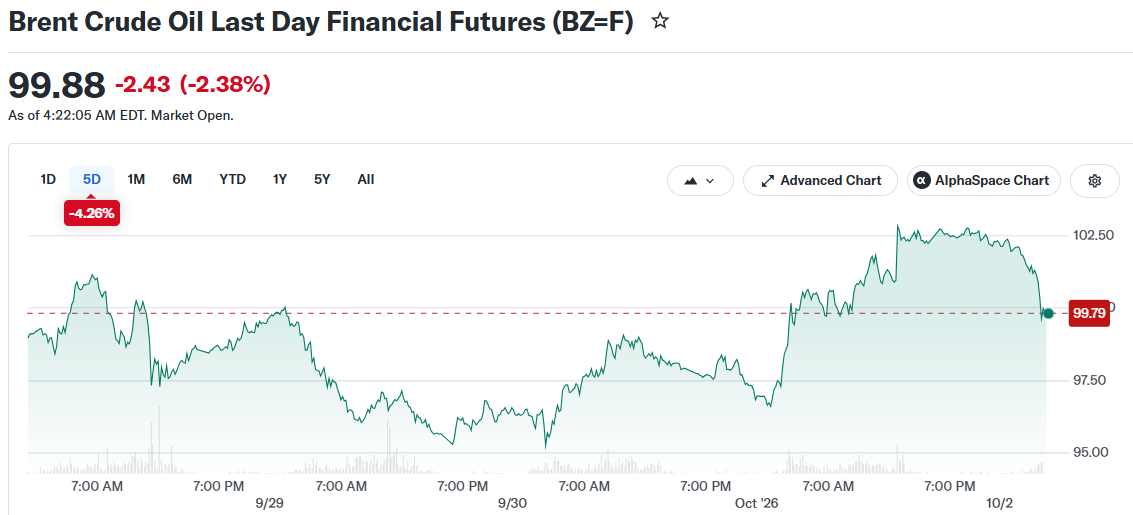
On Thursday, both benchmarks jumped. Brent rose more than $4 and WTI gained over $2 in a single session.
Why Oil Jumped Thursday
The gains followed a Wall Street Journal report. It said Washington was considering sending another aircraft carrier group and more troops to the Middle East.
BREAKING: Brent crude oil prices extend gains to +5% on the day after Chinese refiners suspend oil exports “until further notice.”
Brent crude oil is back up to $103/barrel. pic.twitter.com/OLnEGAxgdQ
— The Kobeissi Letter (@KobeissiLetter) October 1, 2026
This raised concerns that fresh military action against Iran could disrupt oil flows from the region. Markets have been closely watching the Strait of Hormuz, a key shipping route for global energy supplies.
A U.S. official said the Pentagon may deploy an added carrier along with 10,000 sailors and Marines to the Persian Gulf. This would give President Trump more options if he chooses to escalate attacks on Iran.

The tension arrived just as supply worries had started easing. Analysts said earlier this week that oil flows from the region were nearing pre-war levels.
Fuel supplies, however, have not recovered as quickly as crude oil flows. Iran appeared to load no crude onto tankers in September. That suggests the U.S. naval blockade continues to limit Iran’s access to energy markets.
Supply Signs and Fuel Market Pressure
Despite the standoff, some supply routes are recovering. Saudi Arabia restarted operations on its East-West Pipeline. It also resumed tanker loadings from Yanbu after earlier disruptions.
China’s refiners added a new wrinkle. Reports show they have suspended fuel exports beyond Hong Kong and Macau for October. This move is expected to tighten global supplies of diesel, jet fuel and gasoline.
Diesel markets are already under pressure from reduced Russian exports. There are also concerns about possible restrictions on U.S. fuel shipments.
The U.S. has reportedly asked European countries to consider releasing emergency diesel reserves. This would help ease pressure on fuel markets while refinery output and inventory levels are monitored.
Analysts said recovering Middle East supply and soft global demand have limited how far prices can climb. Brent remains up 70% this year as the U.S.-Iran conflict stretches into an eighth month.
There has been little progress toward a diplomatic resolution. Investors are also watching how higher energy prices could affect inflation expectations.
A sustained rise in crude prices could complicate decisions for central banks. This includes the U.S. Federal Reserve, which is balancing growth concerns with inflation risks.
As of Friday morning, both benchmarks remained below Thursday’s peak levels, with traders awaiting further developments on the U.S. military posture in the Gulf.
Stop guessing and start investing with confidence. KnockoutStocks gives you the AI insights, market intelligence, and stock research you need to spot opportunities, cut through the noise, and make smarter investment decisions — all in one powerful platform.
Sign up today and get 50% OFF full access to our premium stock picks.
Simply use coupon code SPECIAL50 at checkout to claim your exclusive discount.
Get 3 Free Stock Ebooks
Discover top-performing stocks in AI, Crypto, and Technology with expert analysis.
- Top 10 AI Stocks - Leading AI companies
- Top 10 Crypto Stocks - Blockchain leaders
- Top 10 Tech Stocks - Tech giants



