





Stablecoins are digital tokens that track the value of a currency, usually the US dollar. In 2026 they move more money on blockchains than Visa and Mastercard move through their card networks, based on raw volume.
Artemis and Visa Onchain Analytics project $40 trillion to $46 trillion in stablecoin volume for 2026. Visa and Mastercard together processed about $23 trillion in fiscal 2024.
The headline numbers need context. A large share of raw volume comes from bots and exchange transfers. This article reviews the data, separates real payments from noise, and compares the two systems on cost, speed and reach.
Stablecoin Volume vs Visa and Mastercard
Sources report different totals, depending on the year and the method used. Standard Chartered said stablecoins settled $27.6 trillion in 2024. Forbes reported $33 trillion in on-chain volume for 2025, compared with $25.5 trillion for Visa and Mastercard combined.
Artemis and Visa Onchain Analytics project $40 trillion to $46 trillion for 2026. Eco’s analysis lists Visa’s fiscal 2024 payments volume at $13.2 trillion and Mastercard’s gross dollar volume at $9.76 trillion. Together, that is about $23 trillion.
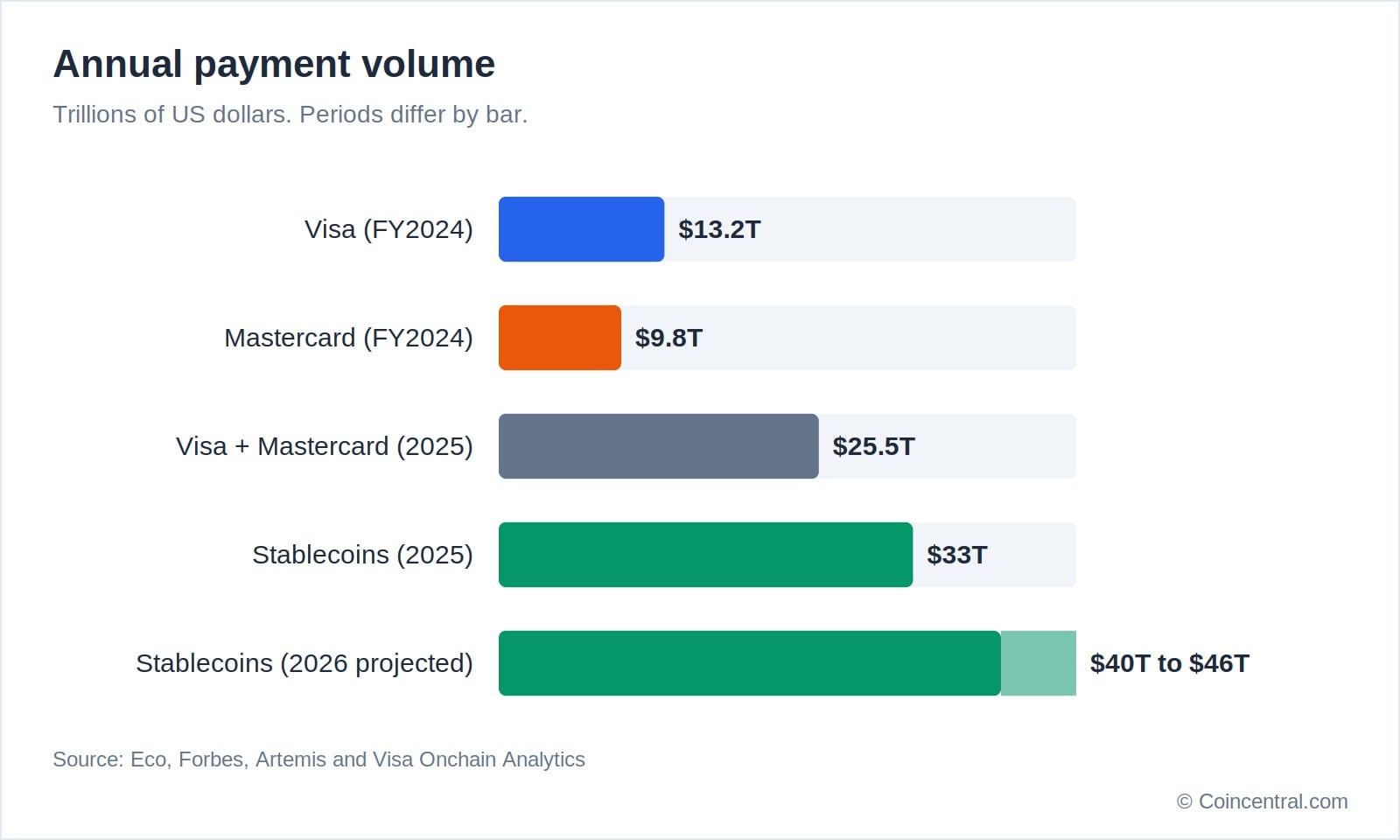
Another source in this set puts the combined card total near $16 trillion. The gap comes from different fiscal years and different definitions of volume. Readers should only compare figures that cover the same period.
Forbes called the 2025 result a milestone for an asset class that barely registered a decade ago. It said the shift matters more for what it signals about payments than for the headline number.

Visa and Mastercard also report on different fiscal calendars. That is why the totals in this article should be read as ranges, not exact side-by-side comparisons.
| Source | Figure | Period |
|---|---|---|
| Standard Chartered | $27.6T stablecoin volume | 2024 |
| Forbes | $33T stablecoins; $25.5T Visa and Mastercard | 2025 |
| Eco | Visa $13.2T; Mastercard $9.76T | FY2024 |
| The Motley Fool | $7.1T Visa and Mastercard | Q1 2026 |
| Artemis, Visa Onchain Analytics | $40T to $46T stablecoins (projected) | 2026 |
Raw Volume vs Organic Volume
Raw on-chain volume counts every transfer on a blockchain. That includes bot trades, MEV activity and moves between exchange wallets. MEV stands for maximal extractable value, a form of automated trading.
Visa’s on-chain analytics tool removes those flows. It puts organic stablecoin volume at about $9 trillion to $11 trillion a year as of early 2026. That is roughly 25% to 30% of the raw total.
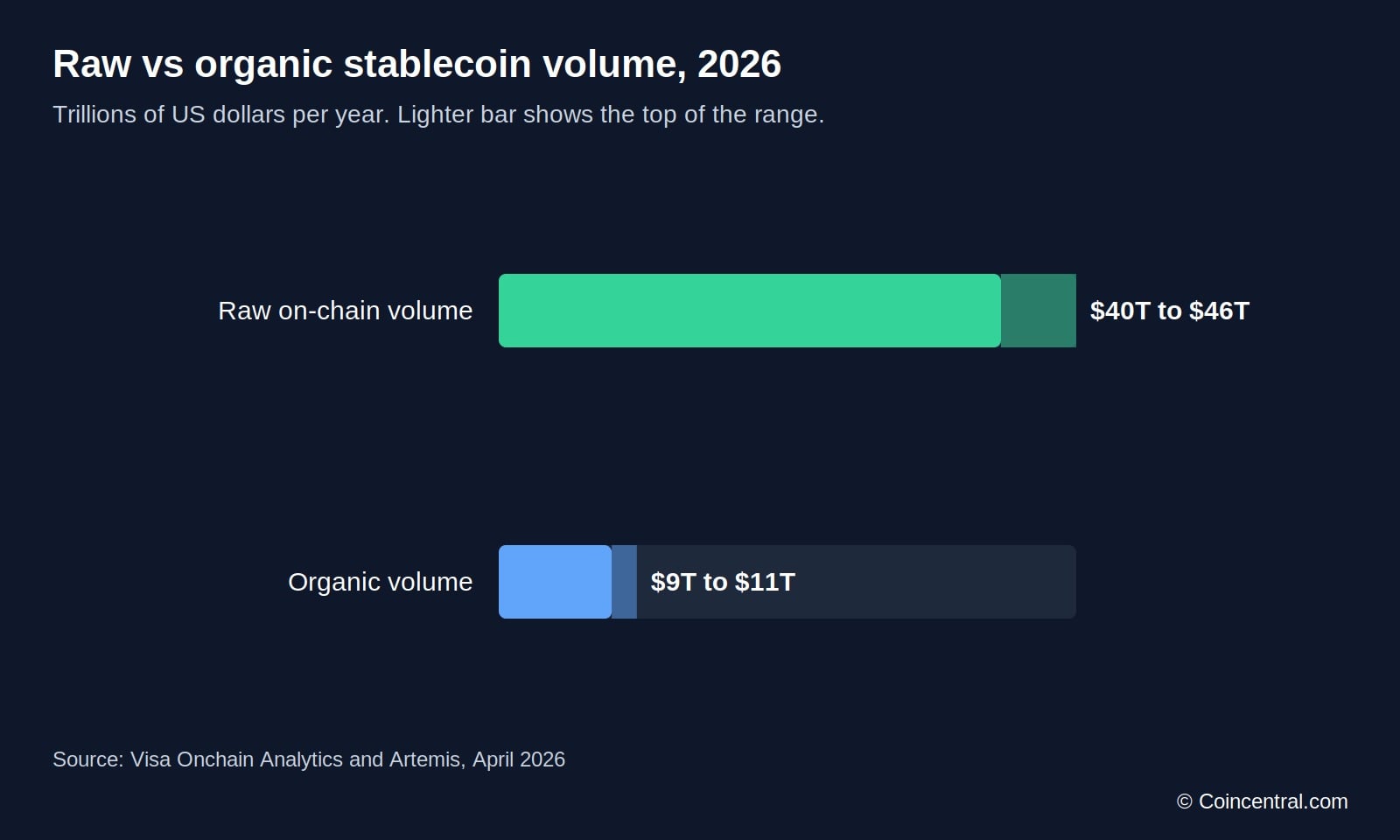
Even the adjusted figure is close to Mastercard’s full annual volume of about $10 trillion. Forbes also noted that part of stablecoin volume still runs through exchange systems. It added that use in cross-border payments, treasury work and brokerage funding is rising.
Forbes reported that B2B stablecoin payments grew from under $100 million a month in 2023 to more than $6 billion by mid-2025. It said B2B makes up about 60% of real economic activity. It also noted that growth continued in 2025 even as speculative trading cooled.
Critics often dismiss stablecoin volume as artificial. The source data suggests the answer sits in the middle. After filtering, trillions of dollars in payment, remittance and settlement value still move each year.
Visa’s tool is one view, and other analysts may filter the data differently. The 25% to 30% share is an estimate, not a fixed rule.
Monthly Transfer Volume in Early 2026
Artemis data from April 2026 shows stablecoin transfers averaged $3.8 trillion a month in the first quarter. Visa processed about $1.3 trillion a month and Mastercard about $850 billion. The two card networks together handled about $2.15 trillion.
That makes raw stablecoin volume about 1.8 times the two card networks combined. The comparison changes when bots and exchange transfers are removed. Organic volume of $9 trillion to $11 trillion a year works out to $0.75 trillion to $0.92 trillion a month.
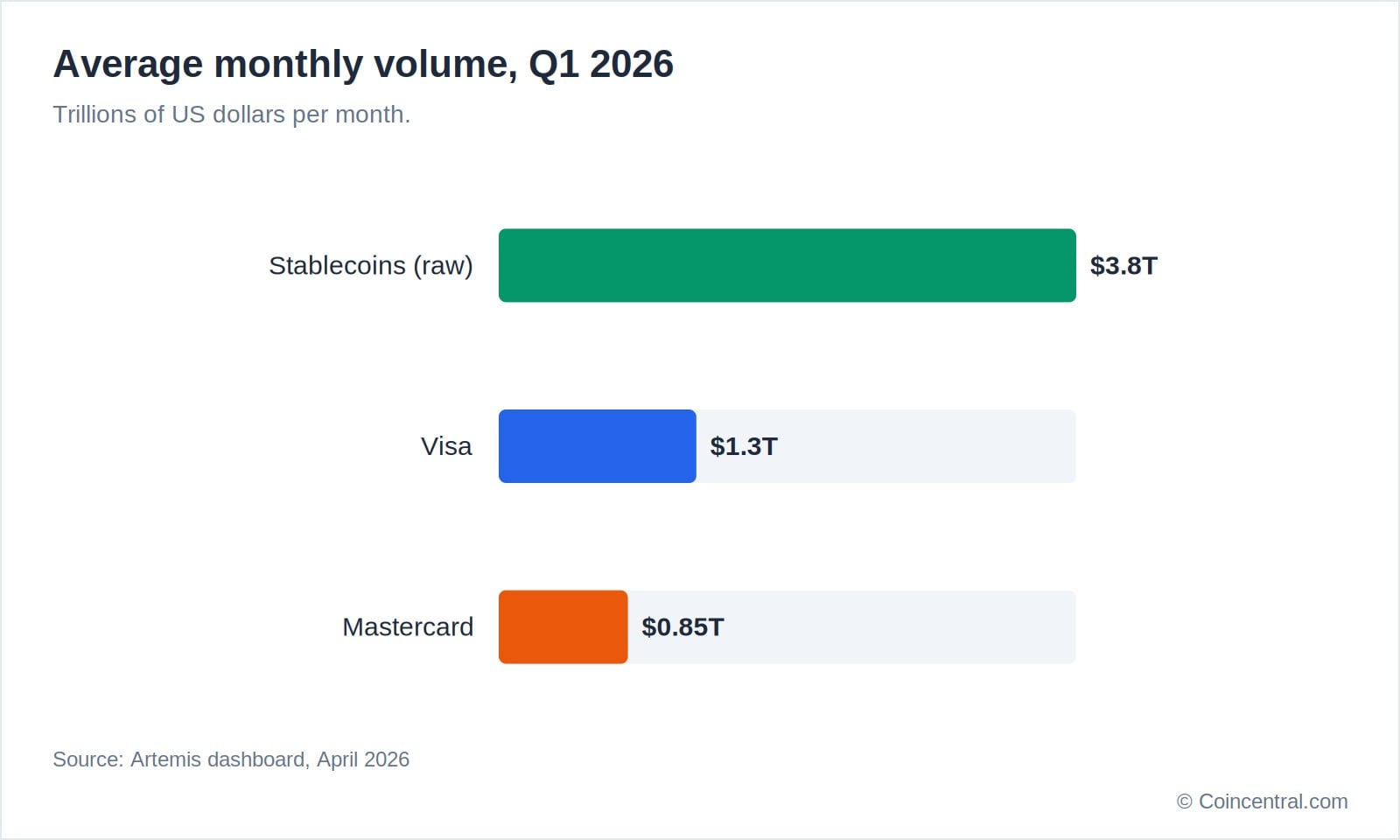
The Motley Fool gave a different card figure. It said Visa and Mastercard together processed $7.1 trillion in the first three months of 2026, or about $2.4 trillion a month. The sources use different measures, but both show stablecoins ahead on a raw basis.
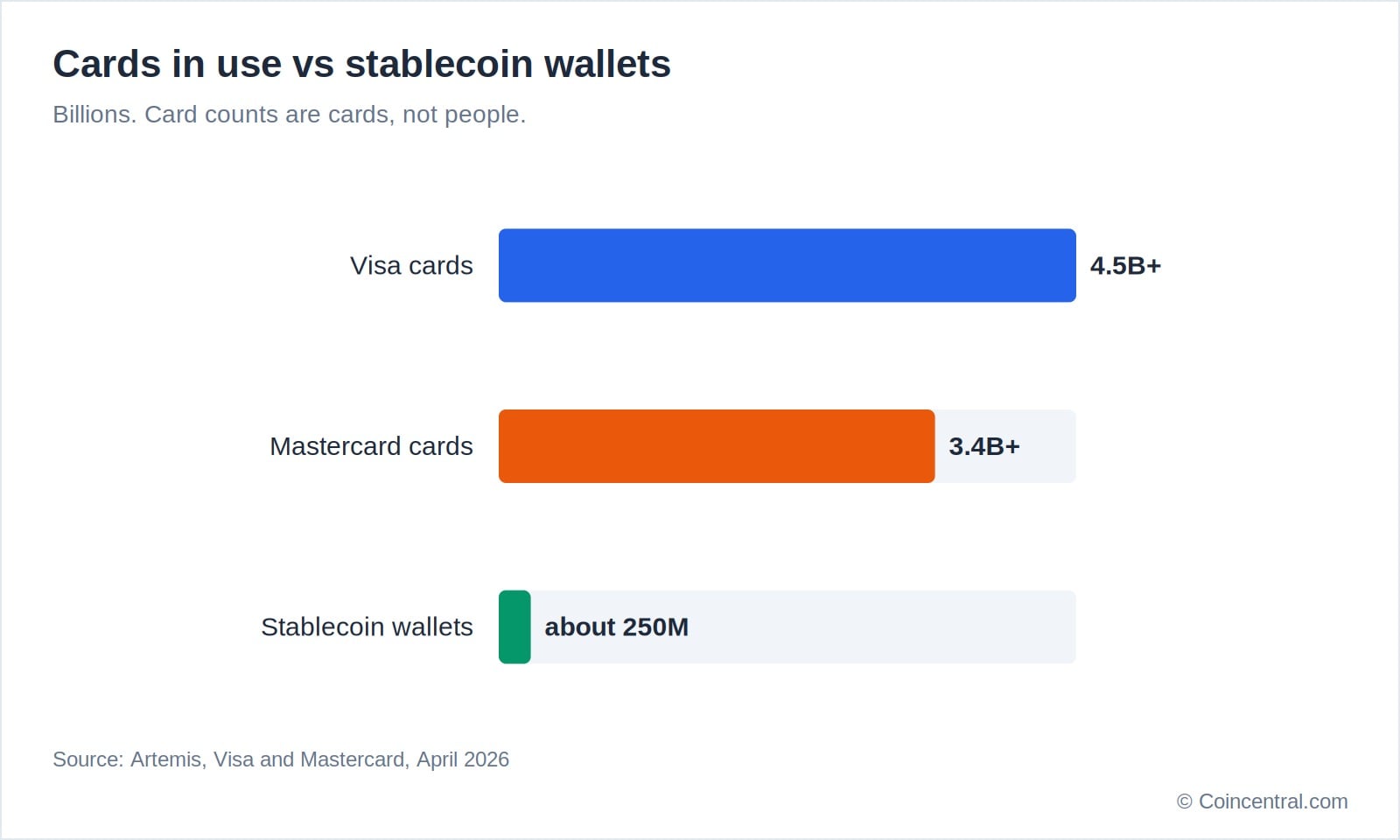
The volume also comes from far fewer accounts. Stablecoins have about 250 million wallets, compared with 8.4 billion cards in use worldwide, according to The Motley Fool.
| Network | Monthly volume, Q1 2026 | Share of the three |
|---|---|---|
| Stablecoins (raw) | $3.8 trillion | 64% |
| Visa | $1.3 trillion | 22% |
| Mastercard | $0.85 trillion | 14% |
Fees and Settlement Speed
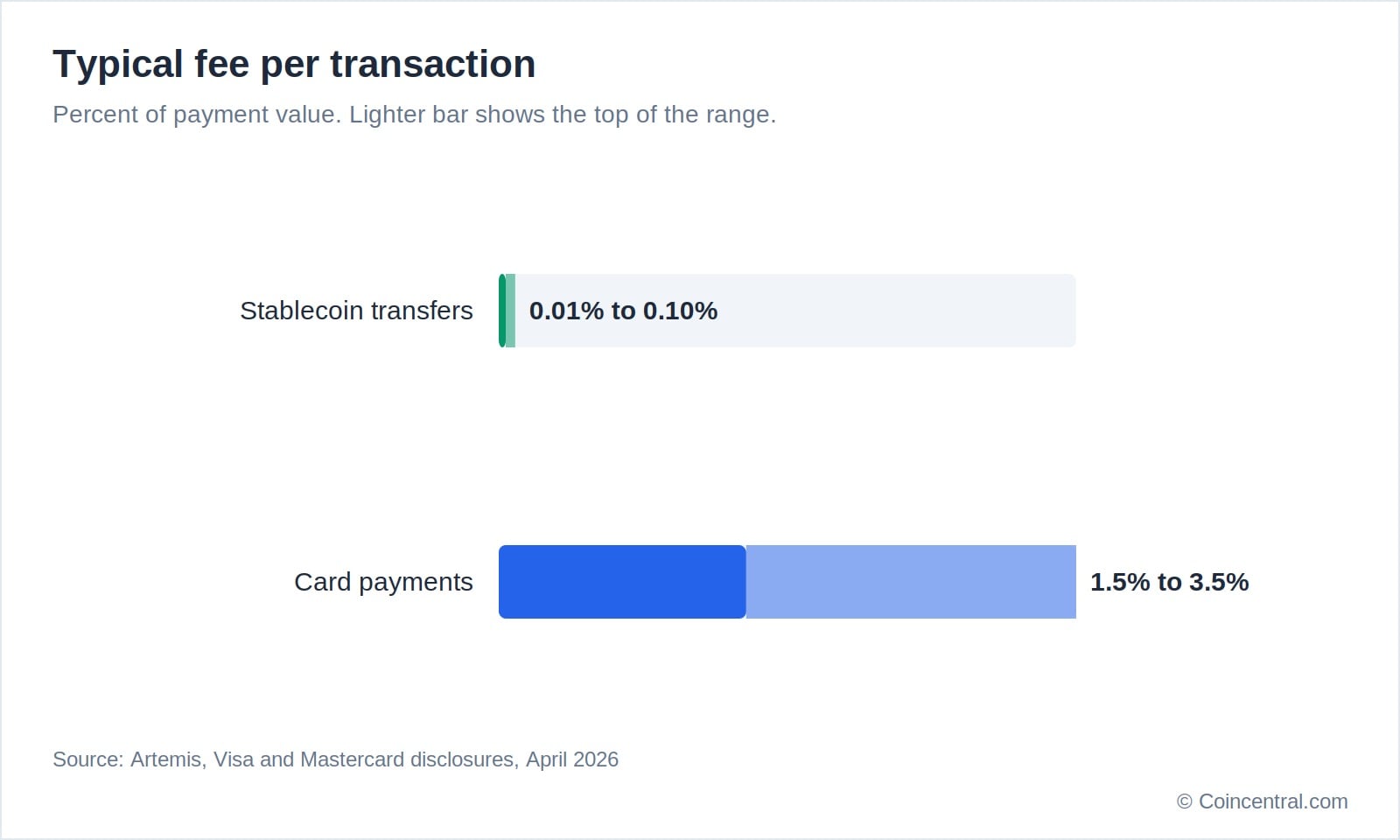
Cost and speed are where stablecoins differ most from cards. Stablecoin transfers cost 0.01% to 0.10% on most chains, according to the Artemis-based data. Card payments cost 1.5% to 3.5%, and international wire transfers cost $15 to $50.
Eco estimates that a $10,000 card payment in the United States carries about $150 to $250 in interchange, network and acquirer fees. The same value sent as USDC on Base or Solana costs a few cents in gas. On low-fee chains like Tron and Solana, a $1 million transfer typically costs under $1 in network fees.
Settlement time also differs. Card networks settle merchants on a T+1 or T+2 basis through banks. Stablecoins settle in 2 to 15 seconds, and public blockchains run all day, every day.
A cross-border B2B payment through the legacy system can take three to five business days. Eco says a USDC payment routed through CCTP or LayerZero clears in under fifteen minutes. Gas fees do not rise with payment size, while interchange does.
| Metric | Stablecoins | Visa | Mastercard |
|---|---|---|---|
| Average settlement time | 2 to 15 seconds | 1 to 3 days | 1 to 3 days |
| Average fee | 0.01% to 0.10% | 1.5% to 3.5% | 1.5% to 3.5% |
| Merchant acceptance | Limited but growing | 130M+ merchants | 100M+ merchants |
Eco points out that card fees pay for services. These include rewards, fraud cover and chargeback reserves. A bare stablecoin transfer does not include them.
Debit cards show a different picture. The Federal Reserve’s Regulation II caps debit interchange near $0.22 to $0.24 per transaction, according to Eco. That makes high-value debit payments close to stablecoins on cost, and a 2023 proposal to lower the cap is still pending.
Eco describes the shift as unbundling. Stablecoins let each function, such as issuing, acceptance and dispute handling, be priced on its own. The point is not that stablecoins beat cards on every payment.
Stablecoin Market Size and Top Coins
DeFiLlama data shows the stablecoin market reached $315.3 billion on June 5, 2026. Tether’s USDT supply was $187.2 billion and Circle’s USDC was $75.6 billion. That leaves about $52.5 billion spread across all other tokens.
CoinGecko, cited by The Motley Fool, put dollar-linked stablecoins at $303 billion. It gave Tether a 61% share and USDC 25%. The small gap with DeFiLlama reflects different dates and token lists.
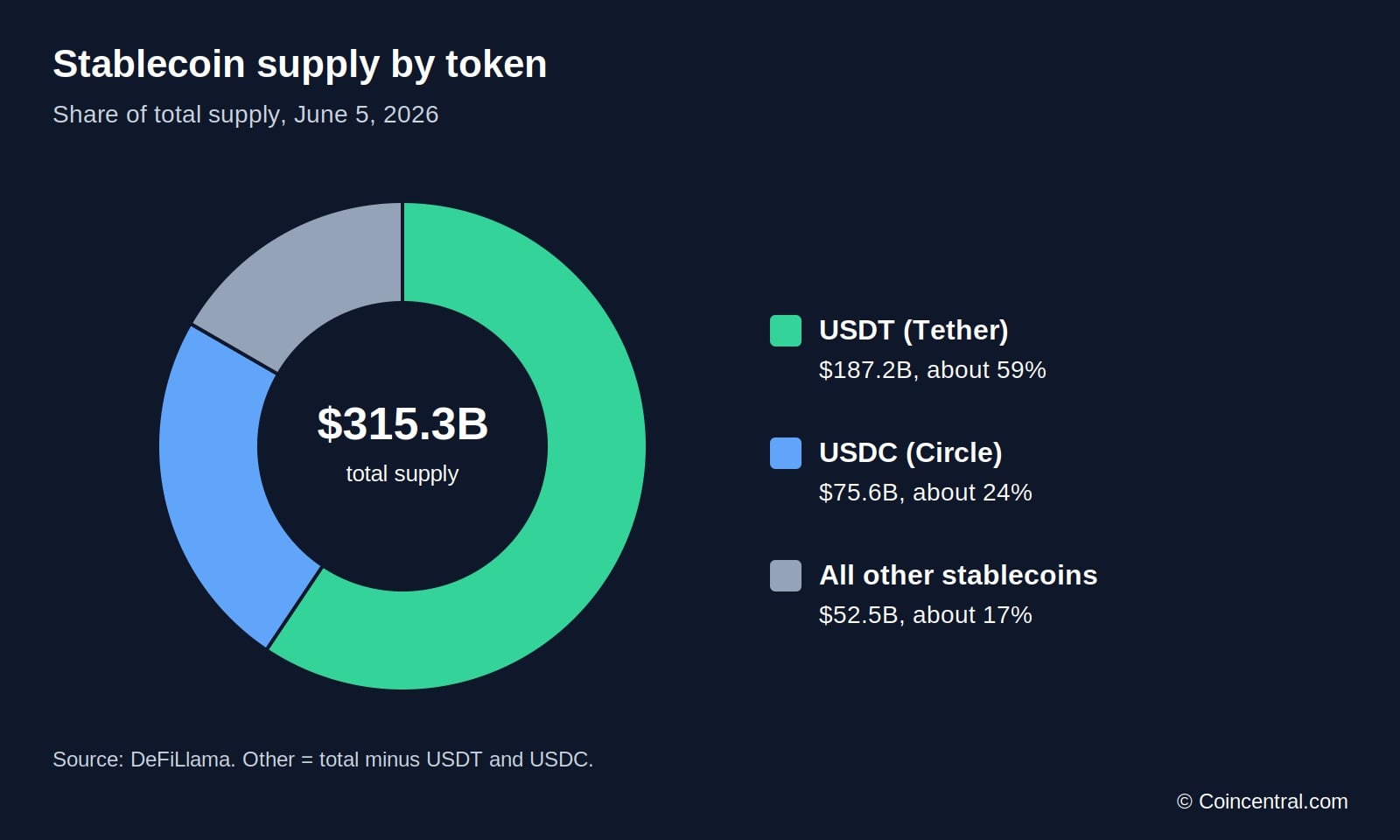
Transaction volume is even more concentrated. CryptoQuant data from April 2026 shows USDT and USDC account for about 88% of volume, with USDT responsible for over 60% of on-chain transfers. Earlier that month, USDT supply was about $165 billion and USDC about $62 billion.
Smaller tokens are growing from a low base. Ethena’s USDe passed $10 billion in supply by the second quarter of 2026. PayPal’s PYUSD, FDUSD and regional euro and yen stablecoins make up the rest.
Chain choice matters too. Tron leads in transaction count and emerging-market USDT use. Ethereum and Solana lead in dollar-value settlement, while Base and Arbitrum held a combined 15% share by April 2026.
USDT dominates emerging-market activity, especially on Tron, where fees are below one cent. Circle’s USDC leads in regulated and institutional flow. Circle listed on the NYSE in 2025 and has full MiCA compliance in the EU, which has made USDC a common choice for corporate treasuries and fintech links.
| Stablecoin | Supply | Date |
|---|---|---|
| USDT (Tether) | $187.2 billion | June 5, 2026 |
| USDC (Circle) | $75.6 billion | June 5, 2026 |
| USDe (Ethena) | Over $10 billion | Q2 2026 |
| Total market | $315.3 billion | June 5, 2026 |
What Is Driving Stablecoin Growth
The sources point to three main drivers. They are cross-border B2B payments, on-chain treasury and DeFi activity, and demand for dollars in emerging markets. Each adds a different share of total volume.
Citi estimated that companies settled $2.4 trillion in B2B stablecoin payments in 2025. It expects that figure to double in 2026. Forbes reported that about 77% of companies use stablecoins for supplier payments, and 41% report cost savings of at least 10%.
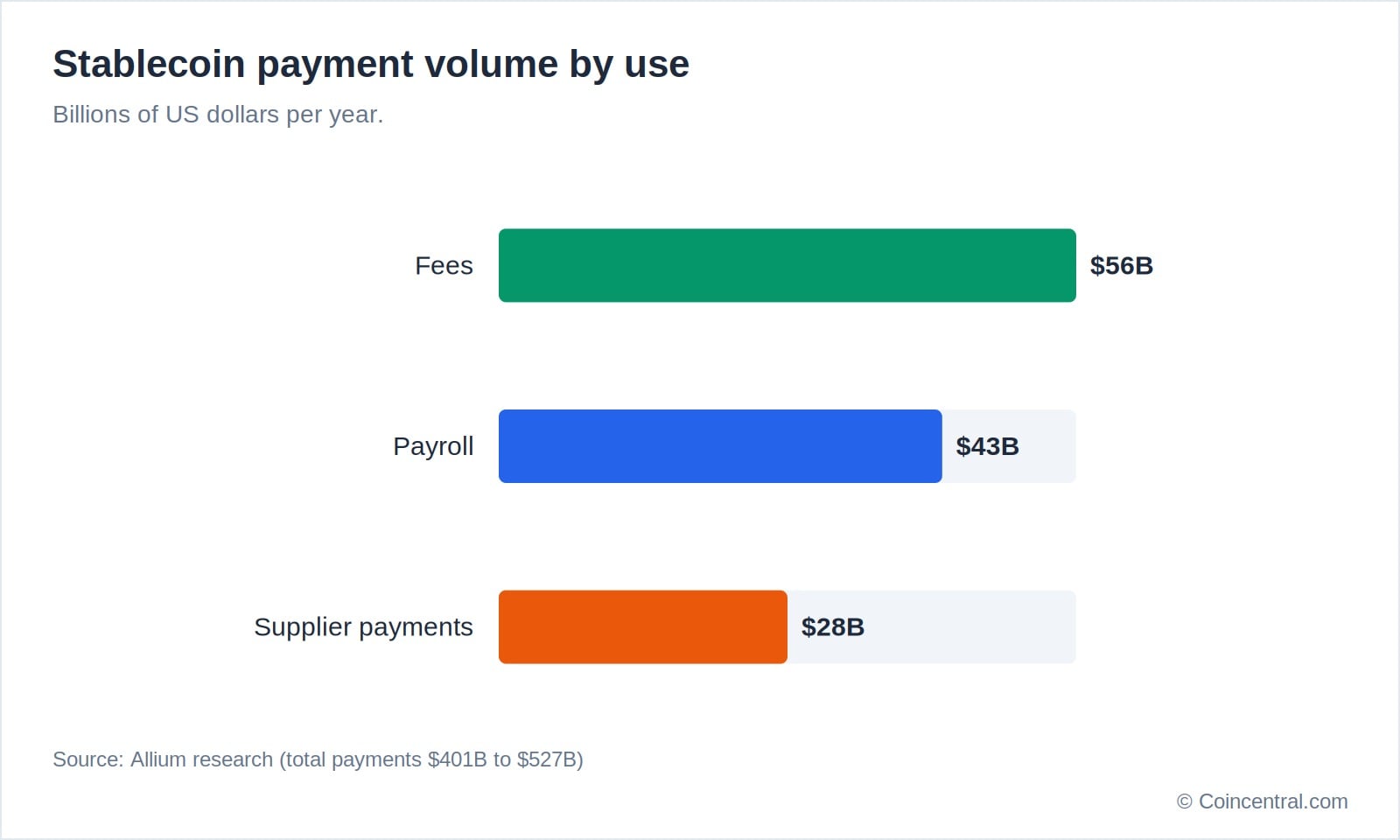
Allium research found that payments are the fastest-growing use for stablecoins. It estimates annual payment volume at $401 billion to $527 billion. B2B cross-border payments make up 43% of that total.
DeFi remains the second pillar. Aave and Sky held over $80 billion in stablecoin deposits as of April 2026, according to DeFiLlama. In Latin America, Chainalysis reported that retail transfers under $10,000 grew 78% year over year in March 2026.
Companies including SpaceX, ScaleAI and several commodities traders have said they use USDC and USDT for supplier payments. These are markets where SWIFT is slow or costly. The appeal is settlement in seconds, fees under 10 basis points and no correspondent banking delays.
A basis point is one hundredth of a percent. Treasury managers are also placing idle cash in tokenized money market funds denominated in USDC.
Demand is strongest in Argentina, Turkey, Nigeria and parts of Southeast Asia. Chainalysis described the growth as consumer adoption rather than speculative flow.
| Driver | Statistic | Source |
|---|---|---|
| Cross-border B2B | $2.4T settled in 2025 | Citi |
| Supplier payments | 77% of companies use stablecoins | Forbes |
| Payments overall | $401B to $527B a year | Allium |
| DeFi deposits | Over $80B (Aave and Sky) | DeFiLlama |
| Latin America retail | Up 78% year over year | Chainalysis |
How Visa and Mastercard Are Responding
The card networks are adding stablecoins to their own systems. Visa said payment volume for its stablecoin-linked cards rose nearly 200% year over year. Support now covers more than 160 card programs, and about 17% of that volume in fiscal 2026 came from business and commercial cards.
Deals show the same direction. Stripe closed its $1.1 billion purchase of Bridge in February 2025. Mastercard agreed in March 2026 to buy BVNK for up to $1.8 billion.
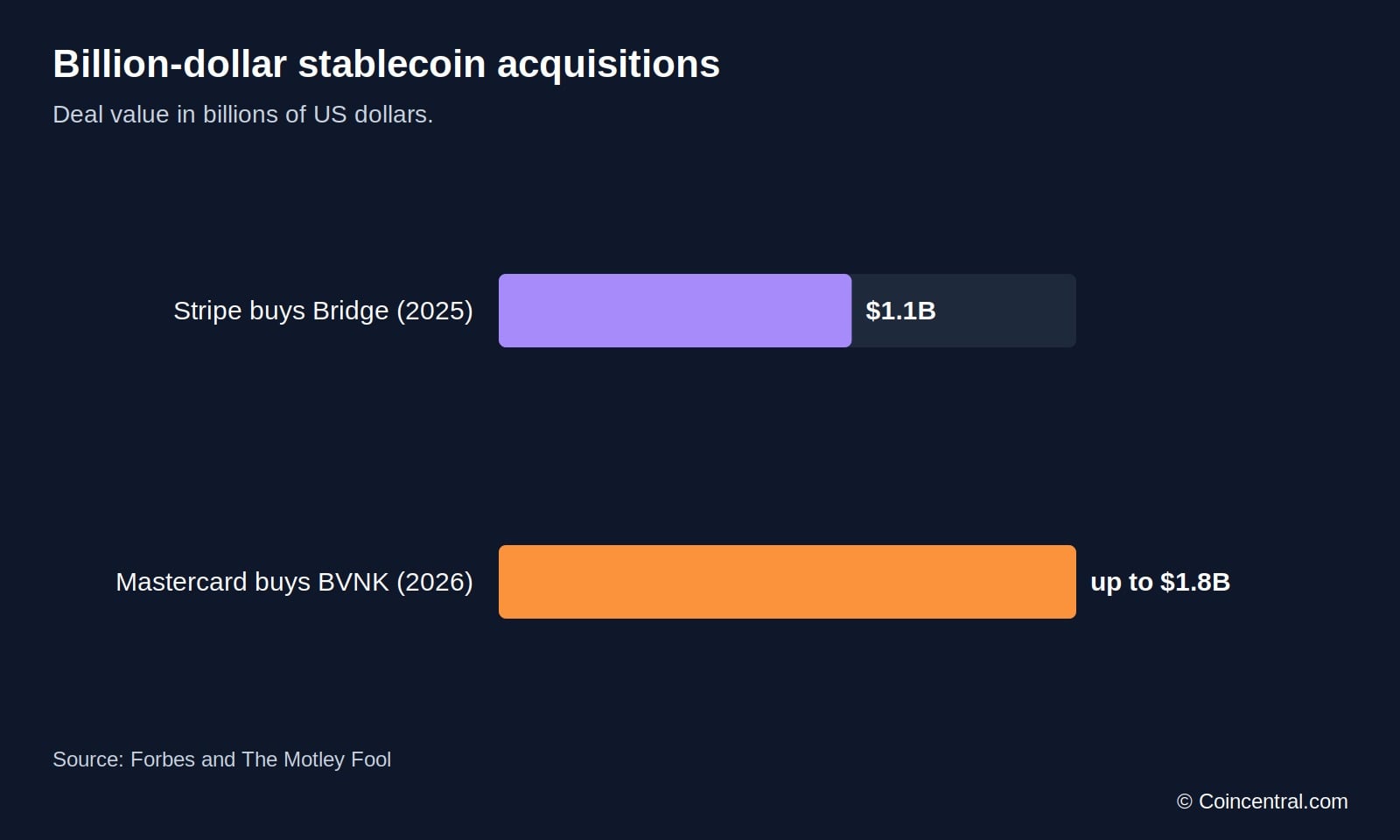
BVNK helps businesses move money across more than 130 countries. Its clients include Worldpay, Deel and Flywire. As of late April, Visa was running a stablecoin settlement pilot across nine blockchains.
CoinDesk reported on June 3 that Visa, Mastercard and Stripe are in talks to launch a joint stablecoin platform. Coinbase may also take part. These reports have not been confirmed as final deals.
| Deal or move | Party | Detail |
|---|---|---|
| Bridge acquisition | Stripe | $1.1 billion, closed February 2025 |
| BVNK acquisition | Mastercard | Up to $1.8 billion, March 2026 |
| Settlement pilot | Visa | Nine blockchains, April 2026 |
| Stablecoin-linked cards | Visa | Volume up nearly 200%, 160+ programs |
Issuers are also large holders of US debt. Forbes said stablecoin issuers hold $155 billion in Treasury bills, more than Germany or Saudi Arabia. Tether alone held over $100 billion in US government debt in the first quarter of 2026.
Visa’s global head of products, Mark Nelsen, said businesses want trusted ways to move funds. He said stablecoins appear more often in supplier payments, treasury operations and cross-border commerce.
Visa has also partnered with Stripe’s Bridge so people can spend stablecoin balances through Visa cards. Mastercard’s chief product officer, Jorn Lambert, said he expects most financial institutions and fintechs to offer digital currency services in time.
Mizuho analyst Dan Dolev said the BVNK deal shows digital dollars are becoming part of mainstream financial infrastructure. The Motley Fool argued that network effects give Visa and Mastercard an edge, since they connect consumers, merchants and banks.
Where Cards Still Lead and Where Risks Remain
Cards keep a wide lead in reach. Visa has more than 4.5 billion cards and 130 million merchants, and Mastercard has more than 3.4 billion cards and 100 million merchants. Stablecoins have about 250 million wallets.
Consumer protection is the other gap. Card networks have codified chargeback rights, fraud cover and liability rules. Once a stablecoin transfer finalizes, a reversal needs the other party to agree, or a court order, according to Eco.
Regulation is changing the picture. The US GENIUS Act became Public Law 119-27 on July 18, 2025. It requires one-to-one reserve backing, monthly reserve disclosure and Bank Secrecy Act anti-money-laundering duties.
Europe’s MiCA framework is in effect. Asian markets range from open, such as Singapore and Hong Kong, to restrictive, such as China and India. Companies working across borders must follow several rule sets.
Concentration is a further risk. Two issuers handle nearly 90% of volume, so a technical failure or sanction on USDT or USDC would reach most exchanges and DeFi apps. Tether and Circle can also freeze tokens, and both have done so to meet sanctions rules.
Tether continues to draw scrutiny over its reserves, despite quarterly attestations. A loss of confidence in a major issuer could trigger redemptions large enough to affect short-term Treasury markets. Both major issuers publish regular reserve attestations and hold most reserves in short-term US Treasuries.
The source material notes that USDC offers stronger transparency under MiCA and the GENIUS Act, while USDT offers deeper global liquidity. It suggests spreading large holdings across issuers.
| Use case | Stronger rail today | Reason |
|---|---|---|
| In-store retail | Cards | Universal acceptance |
| Consumer disputes | Cards | Chargeback rules |
| B2B settlement | Stablecoins | Speed and cost |
| Cross-border transfers | Stablecoins | No correspondent banks |
| Weekend and holiday payments | Stablecoins | Runs 24 hours a day |
Stablecoin Volume Forecasts
Forecasts vary widely. Bernstein, in a March 2026 note, projects $80 trillion to $100 trillion a year by 2028. Bloomberg Intelligence projects $56 trillion by 2030, and Morph says volume could pass $50 trillion as early as 2026.
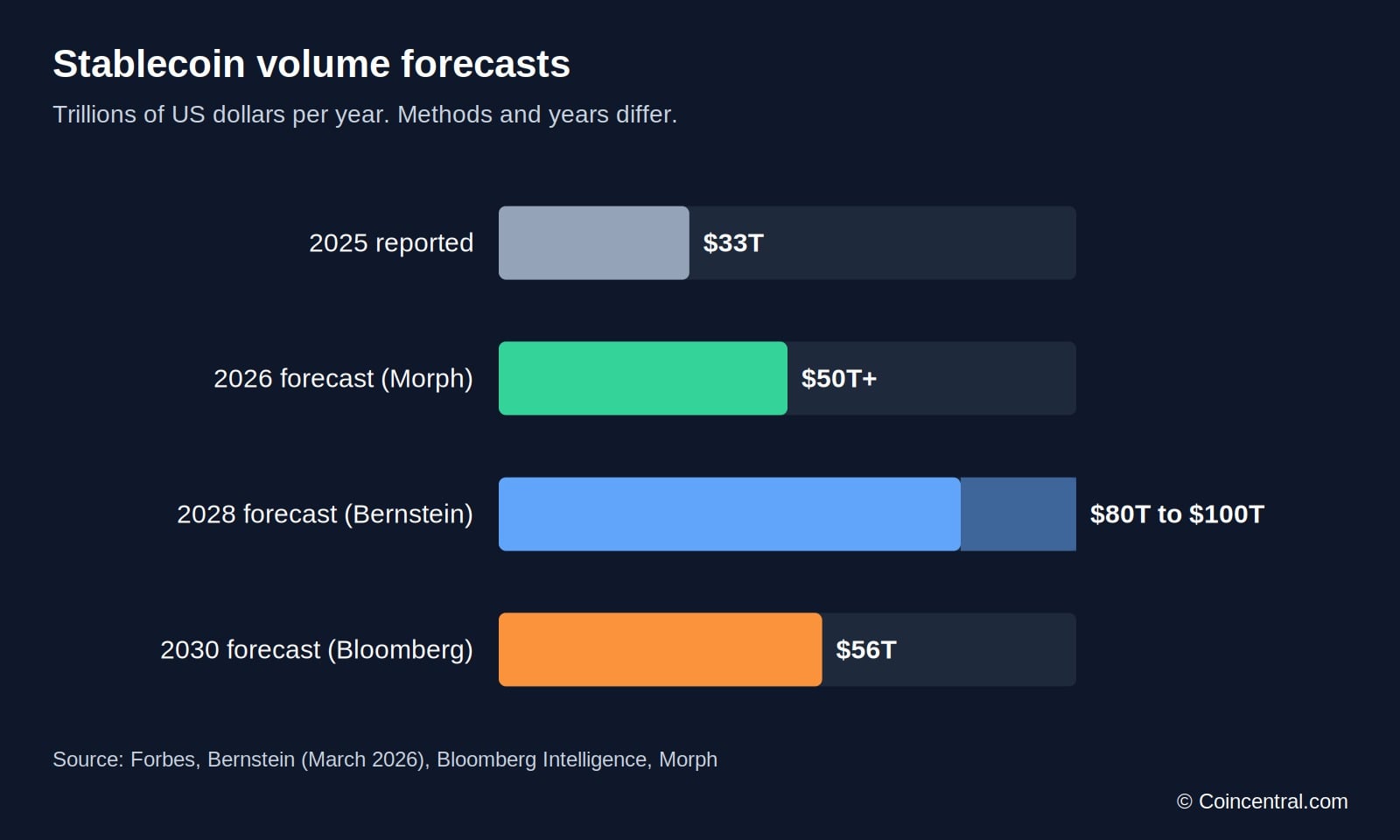
The gap shows how much the answer depends on definitions. Some forecasts count raw on-chain volume, while others count payments only. Readers should check which measure each forecast uses.
Three trends are expected to shape the next phase. Banks such as JPMorgan and Citi are launching deposit tokens and stablecoins under the GENIUS Act. BlackRock expects tokenized real-world assets to reach $2 trillion by 2030, and many of those trades settle in stablecoins.
Activity is also moving off Ethereum mainnet to Tron, Solana, Base and Arbitrum. Fees below one cent make small and automated payments affordable. Forecasts remain estimates, and actual results will depend on regulation and issuer trust.
Eco expects a hybrid result. Open rails would handle settlement, and other layers would add dispute handling and compliance routing. Card networks would keep consumer commerce, and stablecoins would take more B2B, cross-border and programmable flows.
Forbes said the main question for banks is how and when to act, not whether. Building in-house is slow and costly, partnering adds dependence, and buying is fast but the best assets are going quickly.
| Forecaster | Target year | Projected volume |
|---|---|---|
| Morph | 2026 | Over $50 trillion |
| Bernstein | 2028 | $80 trillion to $100 trillion |
| Bloomberg Intelligence | 2030 | $56 trillion |
| BlackRock (tokenized assets) | 2030 | $2 trillion market |
Conclusion
The data shows stablecoins ahead of Visa and Mastercard on raw volume, with 2025 volume reported at $33 trillion and 2026 projected at $40 trillion or more. After bots and exchange transfers are removed, organic volume of $9 trillion to $11 trillion is still close to the size of Mastercard.
Stablecoins lead on settlement speed and fees, especially for B2B and cross-border payments. Cards lead on merchant reach, consumer protection and everyday retail. Both networks are now moving toward each other through acquisitions, pilots and reported joint talks.
Regulation, reserve transparency and issuer concentration are the main risks to watch. Forecasts range from $50 trillion to $100 trillion depending on the year and definition. The next few years will show how much of that volume turns into real payments.
Sources
- Stablecoin Transaction Volume in 2026: How Stablecoins Surpassed Visa and Mastercard (citing Standard Chartered, Artemis, Visa Onchain Analytics, Citi, Chainalysis, CryptoQuant, DeFiLlama, Bernstein)
- Visa Says Stablecoin-Linked Card Payment Volume Rose Nearly 200%, Binance News
- Stablecoin Payment Networks vs Visa and Mastercard, Eco
- Stablecoins Just Out-Processed Visa. Now What? Zennon Kapron, Forbes
- Visa and Mastercard Reportedly Want to Run Stablecoins, Not Fight Them, Neil Patel, The Motley Fool
- Visa vs. Mastercard: Buy vs. Partner in the Stablecoin Race, Phoebe Duong
- DeFiLlama stablecoin data
- CoinGecko stablecoin category
- Allium research
- CoinDesk
- Chainalysis
- CryptoQuant
- Mastercard
- GENIUS Act, S.1582, 119th Congress


