






TLDR
- US spot Bitcoin ETFs recorded $1.42 billion in net outflows last week — the third largest weekly exit ever.
- BlackRock’s IBIT accounted for ~$966 million of those outflows, with single-day redemptions hitting $448 million.
- Around 19,021 BTC was sold by ETFs in one week, equal to 42 days of newly mined supply.
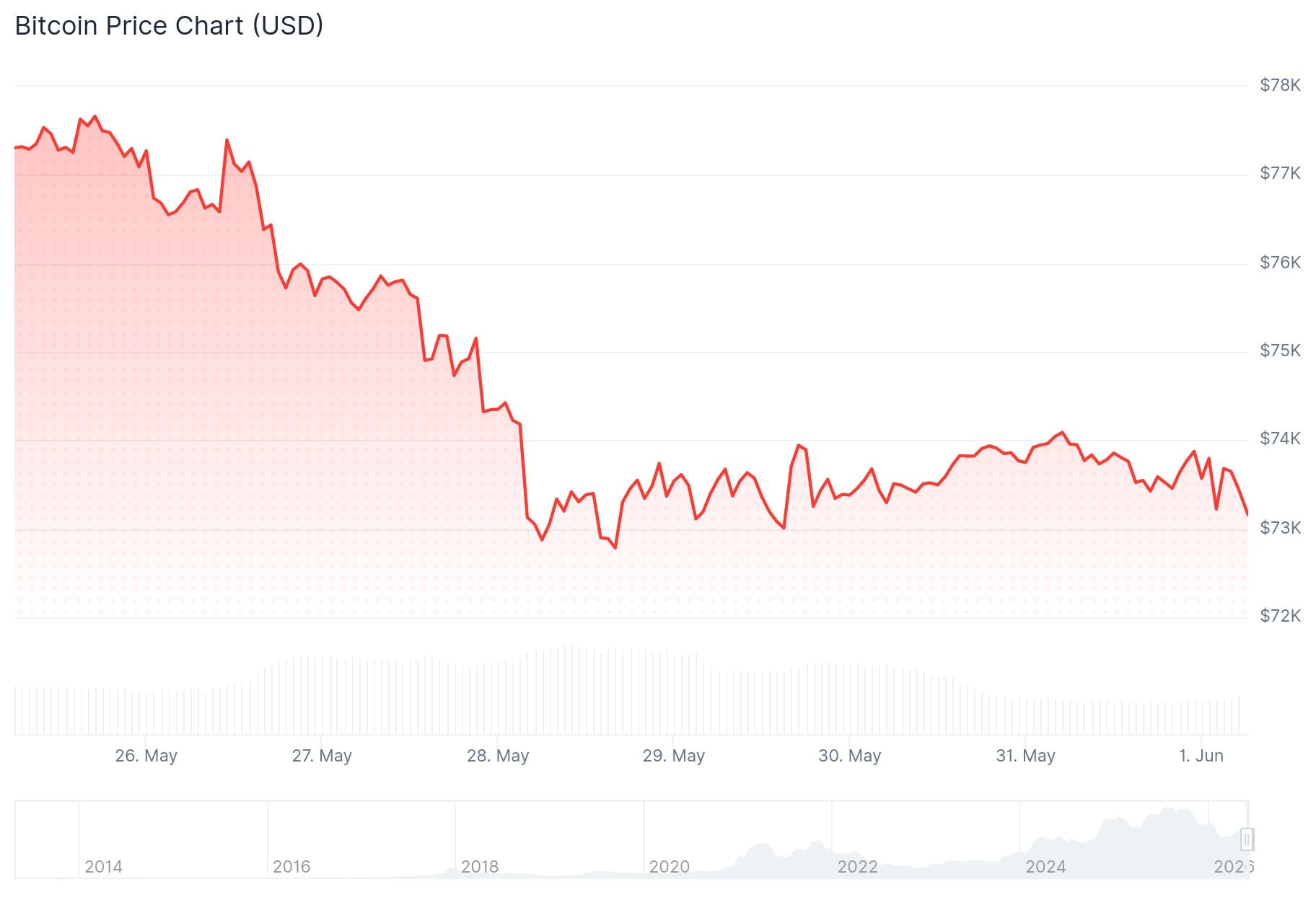
- Bitcoin’s price dropped over 4% in the past week, falling to around $73,000.
- Macro pressures — including high inflation, rising Treasury yields, and geopolitical tensions — are driving the pullback.
Bitcoin fell over 4% last week, dropping to around $73,000 after briefly reclaiming $82,000 in May. The move lower came as US spot Bitcoin ETFs posted $1.42 billion in net outflows — the third largest weekly total since these products launched, according to available data.
This was the third straight week of heavy redemptions. The three-week running total has now passed $3.5 billion.
BlackRock’s IBIT Leads the Outflows
BlackRock’s IBIT, the largest spot Bitcoin ETF by assets, led the selling. The fund saw roughly $966 million exit in a single week. On its worst single day, redemptions hit $448 million.
Crypto ETF Flows — May 26–29th 📊$BTC: -$1.42B$ETH: -$242M$SOL: +$1M
Bitcoin and Ethereum funds saw heavy outflows, but Solana quietly held up better than the majors 👀 pic.twitter.com/D9eFbPsEvm
— CoinCentral (@realcoincentral) May 31, 2026
When ETF shares are redeemed, the issuer must sell the underlying Bitcoin to cover them. Across all spot ETFs last week, that amounted to roughly 19,021 BTC being offloaded onto the market — the equivalent of 42 days of newly mined supply.
Crypto analyst Ali Charts (@alicharts) highlighted a key level to watch, saying: “I’m watching $72,650 closely on Bitcoin, as the MVRV Pricing Bands continue to identify it as a critical support level. If it fails, the next major demand zone sits between $54,300 and $51,000.” That level sits just below where Bitcoin is currently trading.
I’m watching $72,650 closely on Bitcoin $BTC, as the MVRV Pricing Bands continue to identify it as a critical support level.
If it fails, the next major demand zone sits between $54,300 and $51,000. https://t.co/wfcCrStSPU pic.twitter.com/eCXcHUtgOI
— Ali Charts (@alicharts) May 31, 2026

What’s Driving the Selling
The macro backdrop is the main driver. Inflation data released in May reduced expectations for a Federal Reserve rate cut. Higher rates make risk-free assets like Treasury bonds more attractive, reducing appetite for volatile assets like Bitcoin.
Geopolitical tension — including a potential re-escalation of the US-Iran conflict — has added pressure. Rising oil prices tied to that tension could push inflation higher still, making rate cuts even less likely.
Analyst AlphaBTC (@mark_cullen) shared a near-term view, saying he’s watching for a push back to $79,000 before a potential move to the low $60,000s later in the summer.
#Bitcoin LTF plan
I'm hoping for a push higher back to 79K in the coming week(s), and not ruling out a run of the 83K high before going lower into the summer. BUT i do think we see the low 60K's or even a sweep of the 60K level, before this is all said and done. #Crypto #BTC https://t.co/rHLQwUpHGZ pic.twitter.com/YOnv2cTg7J
— AlphaBTC (@mark_cullen) June 1, 2026
The Crypto Fear & Greed Index remained in “fear” territory throughout the week.
One point of stability: the fact that 19,021 BTC was absorbed by spot market buyers without a sharper price crash suggests some demand remains at current levels.
Bitcoin was trading around $73,000 as of the latest data, with the $72,650 MVRV support level closely watched by analysts.


