






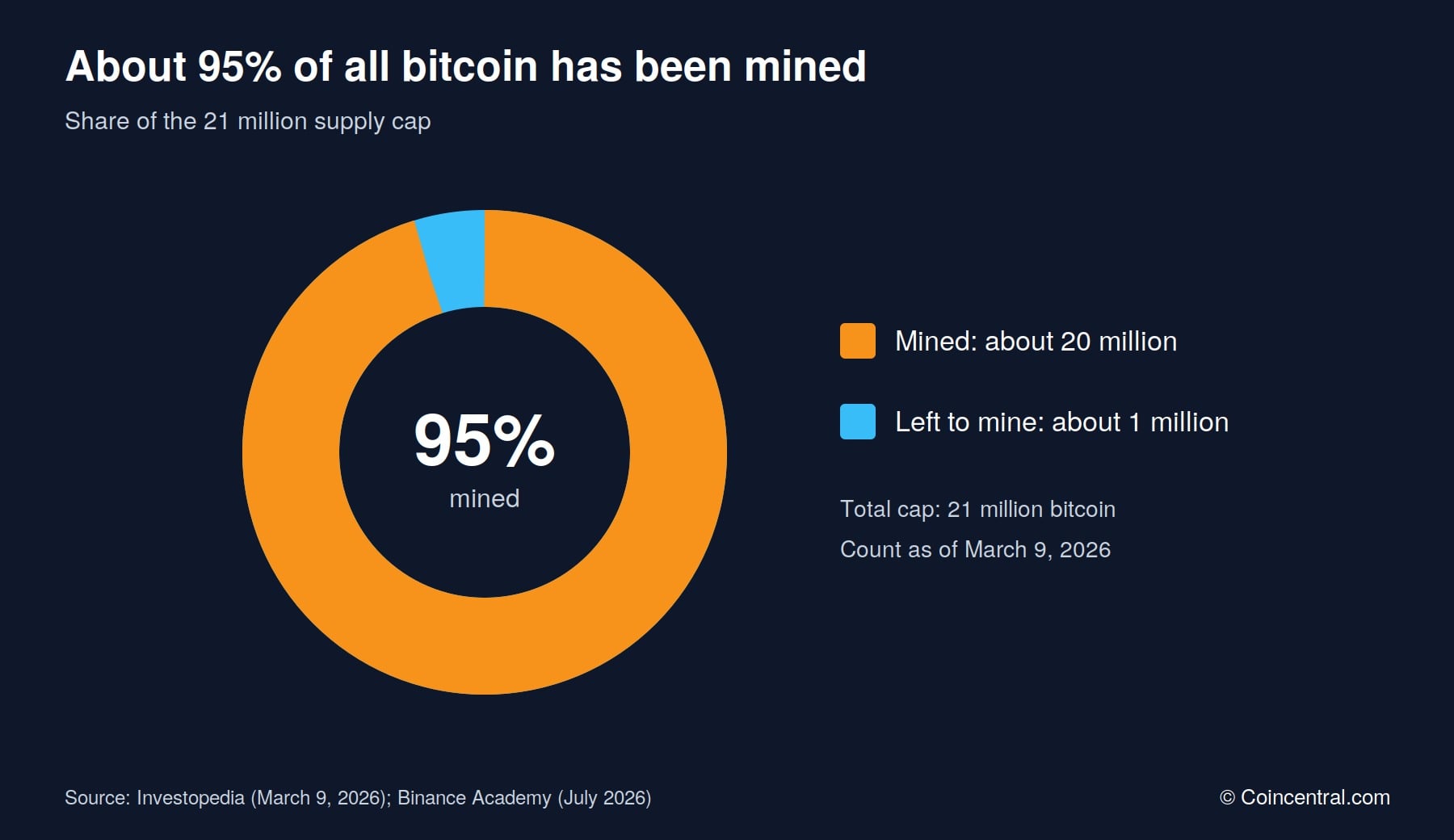
Bitcoin has a fixed supply of 21 million coins. As of mid-2026, about 20 million have already been mined, which is roughly 95% of the total.
Fewer than one million coins remain. They will reach the market slowly, with the last one expected around the year 2140.
This article uses figures from published guides to explain how Bitcoin supply works. It covers the halving schedule, the future of miner income, lost coins and what the cap means for investors.
| Measure | Figure |
|---|---|
| Maximum supply | 21 million bitcoin |
| Coins mined (March 9, 2026) | 20 million |
| Share of supply mined | About 95% |
| Current block reward | 3.125 bitcoin |
| Next halving | About April 2028, to 1.5625 bitcoin |
| Blocks between halvings | 210,000 |
| Final coin expected | Around 2140 |
| Estimated lost coins | 1 million to 4 million |
| All-time high price | $126,210 (Oct. 6, 2025) |
Why Bitcoin Has a 21 Million Supply Limit
Bitcoin’s 21 million limit is written into its software. Every full node on the network enforces the rule, so no central authority can issue more coins or change the release schedule.
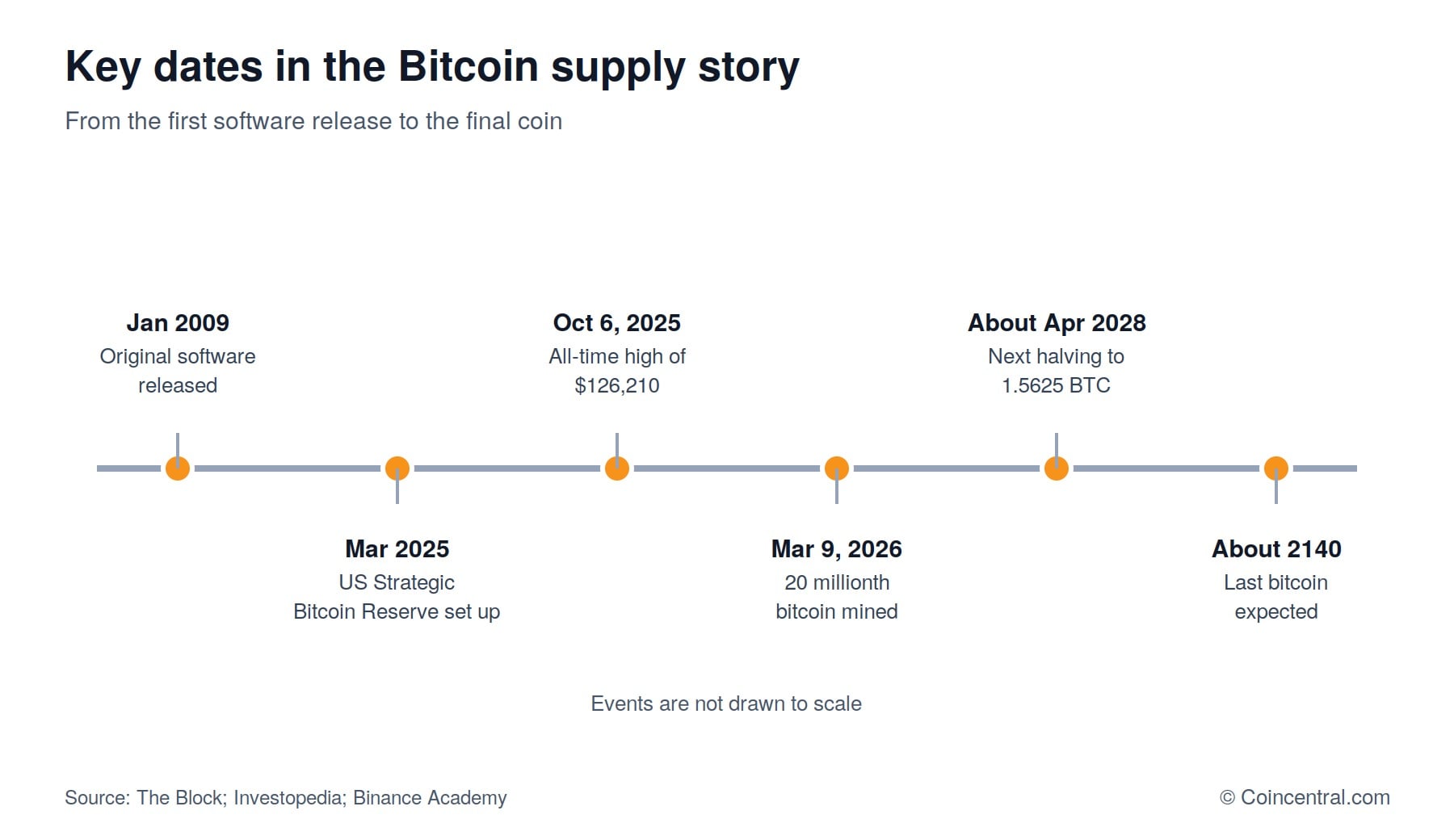
Satoshi Nakamoto, the pseudonymous creator of Bitcoin, set the limit in the original software released in January 2009. Nakamoto’s identity has never been confirmed. The limit has stayed the same for more than fifteen years.
Because the schedule is fixed, anyone can calculate how many bitcoin will exist at any point in the future. That predictability is a key difference from government money.
The number 21 million comes from a formula. The first block reward was 50 bitcoin, and the reward is cut in half every 210,000 blocks. Add up every reward and the total lands just under 21 million.

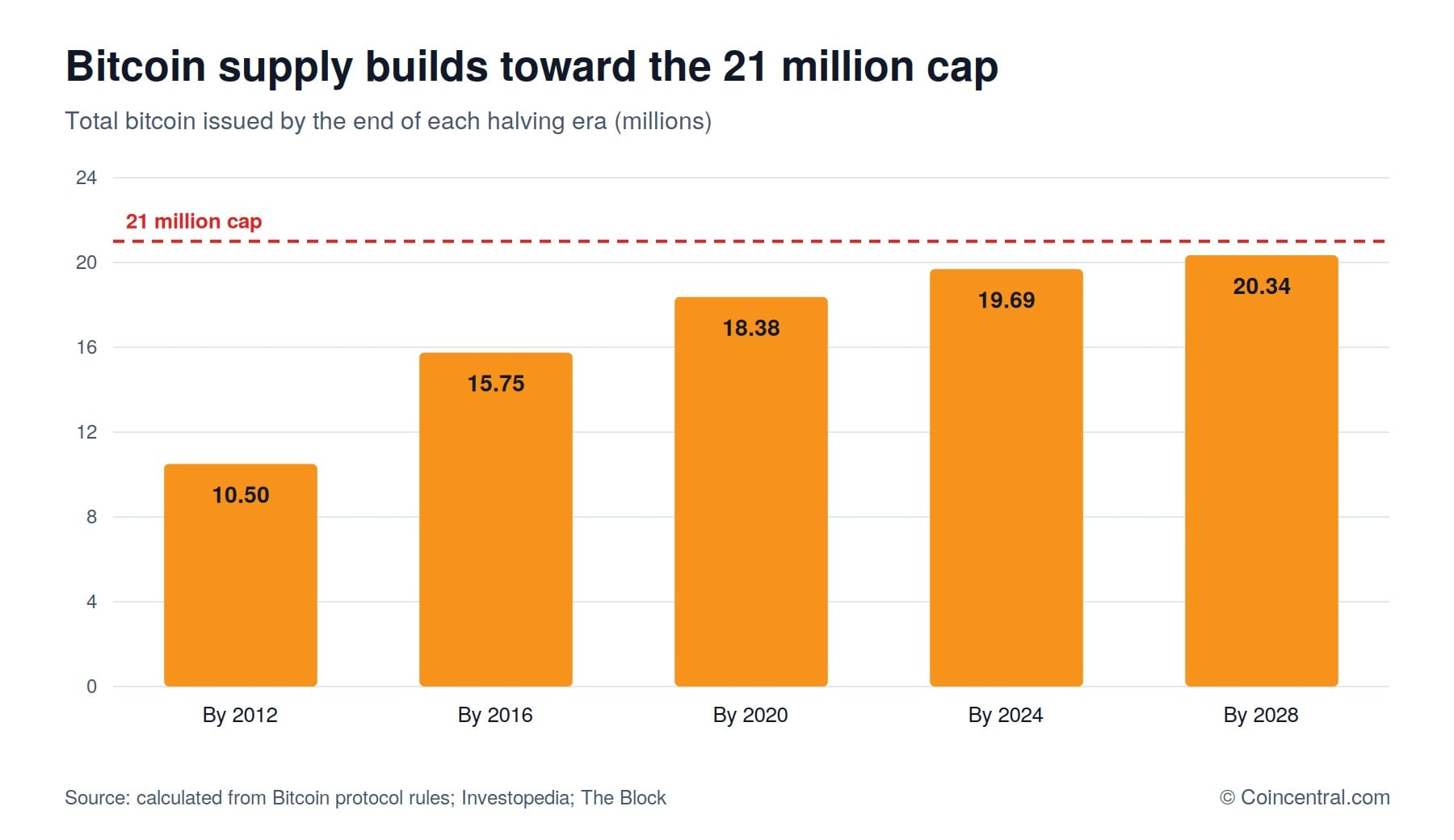
The math is simple. The first era issued 210,000 blocks times 50 coins, or 10.5 million bitcoin. Each later era issues half as much, so the full series adds up to about twice the first era.
| Era | Block reward | Coins issued in era | Total issued | Share of cap |
|---|---|---|---|---|
| 2009 to 2012 | 50 | 10,500,000 | 10,500,000 | 50.0% |
| 2012 to 2016 | 25 | 5,250,000 | 15,750,000 | 75.0% |
| 2016 to 2020 | 12.5 | 2,625,000 | 18,375,000 | 87.5% |
| 2020 to 2024 | 6.25 | 1,312,500 | 19,687,500 | 93.8% |
| 2024 to 2028 | 3.125 | 656,250 | 20,343,750 | 96.9% |
These figures are calculated from the protocol rules. They match the 96.8% issued by 2028 that Investopedia reports.
Bitcoin was created after the 2008 financial crisis. The US dollar was tied to gold until 1971, and since then governments have been free to print money and reduce its value. Nakamoto’s design aimed to remove that risk.
No one knows why Nakamoto picked 21 million. One theory, drawn from Nakamoto’s emails, says it was an educated guess that 0.001 bitcoin would be worth one euro if Bitcoin were used for some fraction of world commerce.
Another theory says the number follows naturally from the four-year cycle and the 210,000-block spacing. The answer remains as mysterious as Nakamoto’s identity.
How New Bitcoin Is Created and How Halvings Work
New bitcoin enters circulation through one process: mining. Computers compete to add the next block of transactions to the blockchain by solving a puzzle set by the proof-of-work system.
The first miner to find a valid answer broadcasts the block. The rest of the network checks that it follows the rules and accepts it.
The winning miner receives a block reward of newly created bitcoin. That reward is the only source of new coins in the system. The miner also collects the transaction fees in the block.
The protocol aims for one block every 10 minutes and adjusts mining difficulty to keep that pace. If more miners join, difficulty rises. If miners leave, difficulty falls.
The block reward started at 50 bitcoin in 2009. It fell to 25 in 2012, 12.5 in 2016, 6.25 in 2020 and 3.125 in April 2024. Each cut is called a halving and happens every 210,000 blocks, or about every four years.
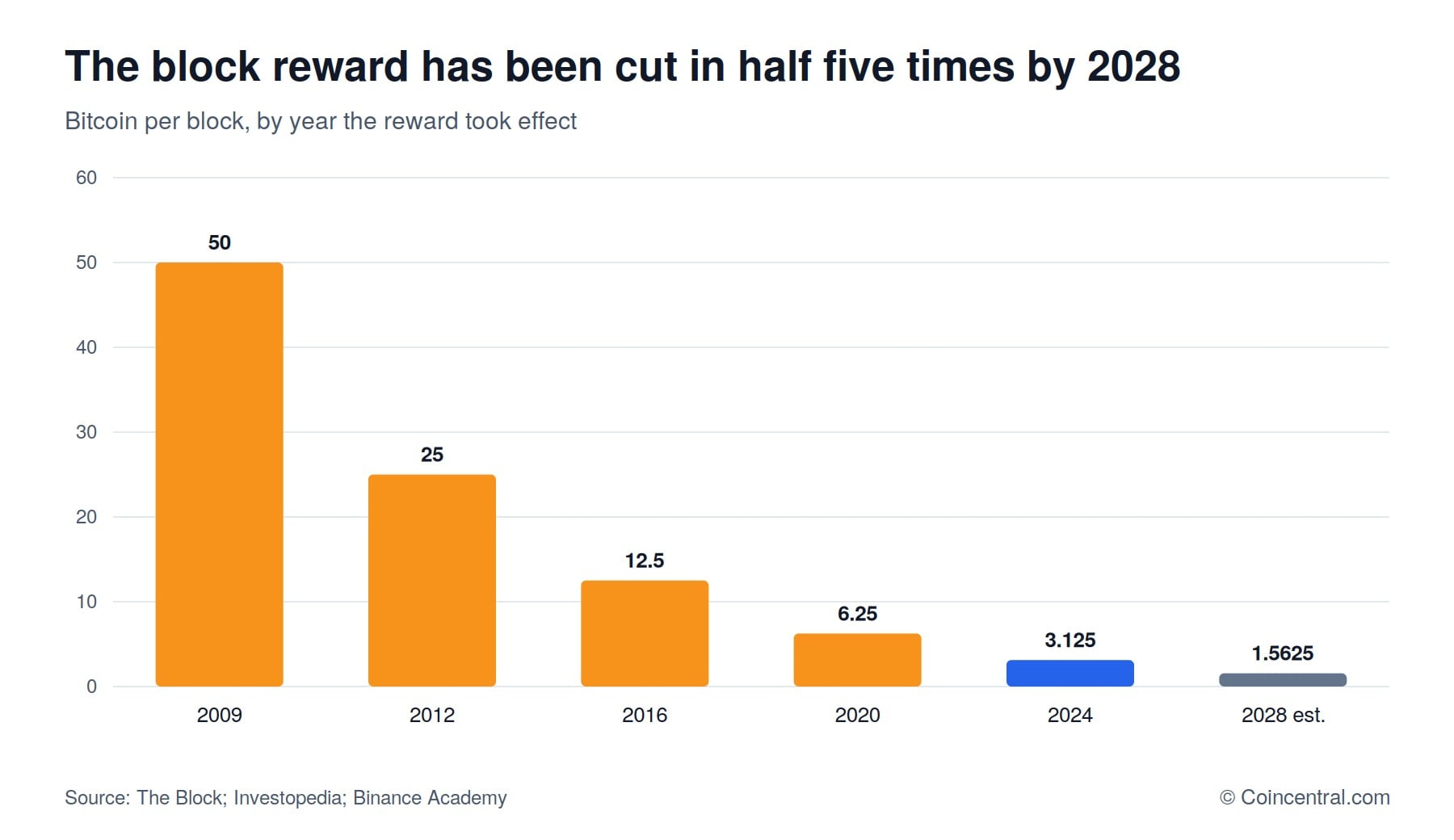
The next halving is expected around April 2028. The reward will then fall to 1.5625 bitcoin per block. Investopedia counts 29 more halvings after the 2024 event.
At 3.125 bitcoin per block and one block every 10 minutes, the network creates about 450 bitcoin a day. That is roughly one bitcoin every 3.2 minutes, as Binance Academy notes. Over a full year, it adds up to about 164,000 coins.
This schedule creates disinflation, which means the rate of new supply keeps falling. Once the last halving has passed, yearly inflation will be close to zero.
Miners can sell the coins they earn, which is the incentive that keeps the network running today. As the reward shrinks, each block adds less new supply to the market.
How Many Bitcoin Have Been Mined?
The 20 millionth bitcoin was mined on March 9, 2026, according to Investopedia. That leaves about one million coins still to be issued. More than 95% of the supply is already out.
Binance Academy gave a similar picture in July 2026, with roughly 20 million coins mined and about 95% of supply issued. It also cited a circulating figure of about 19.87 million. Small gaps between sources come from different dates and counting methods.
| Source | Date | Coins mined | Share of cap |
|---|---|---|---|
| The Block | March 2026 | 20 million | Over 95% |
| Investopedia | March 9, 2026 | 20 million | About 95% |
| Binance Academy | July 2026 | About 20 million | About 95% |
| Investopedia (forecast) | 2028 halving | About 20.3 million | Over 96.8% |
The next million coins will take far longer than the last million. The current era releases about 656,000 coins over four years. After the 2028 halving, that falls to about 328,000 coins per era.
The Block says the remaining supply will trickle into circulation over the next century rather than the next decade.
The pace of issuance has changed a great deal. In the first four years, the network released 10.5 million coins. In the current four-year era, it will release about 656,000, or roughly one sixteenth of that amount.
Investopedia expects the share issued to pass 96.8% by 2028. That means the change over the next few years is small compared with the earlier eras.
When Will the Last Bitcoin Be Mined?
The last fraction of a bitcoin is expected around the year 2140. The exact date can change because the protocol counts blocks, not calendar years. If blocks arrive faster or slower than every 10 minutes, the date moves.
The total will likely fall slightly short of 21 million. Bitcoin’s code uses bit-shift operators, which round down to the nearest whole satoshi each time the reward is halved. A satoshi is 0.00000001 bitcoin and cannot be split.
If the halving keeps its four-year rhythm, the final reward will be a single satoshi. After that, the protocol issues nothing more. It rejects any block that tries to create coins above the schedule.
Investopedia says the final reward of one satoshi comes after the 29 halvings that follow 2024, if the four-year spacing holds. The final date could come earlier depending on how block times behave.
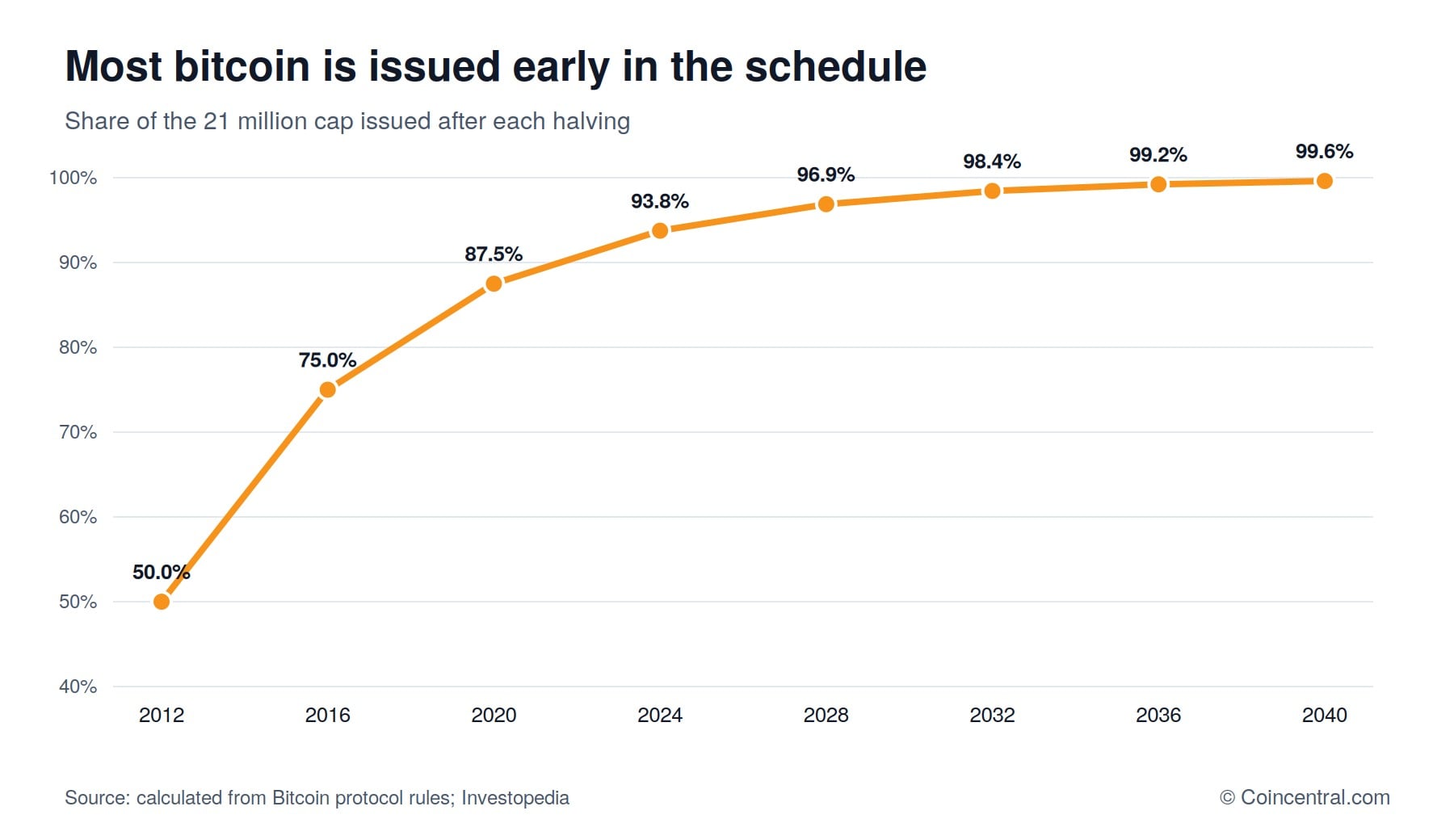
The table shows how much supply comes early. Each halving era issues half of the coins that were left.
| Halving year | Share issued | Coins left (millions) |
|---|---|---|
| 2012 | 50.00% | 10.500 |
| 2016 | 75.00% | 5.250 |
| 2020 | 87.50% | 2.625 |
| 2024 | 93.75% | 1.313 |
| 2028 (expected) | 96.88% | 0.656 |
| 2032 (expected) | 98.44% | 0.328 |
| 2036 (expected) | 99.22% | 0.164 |
| 2040 (expected) | 99.61% | 0.082 |
After the last coin is mined, Bitcoin’s inflation will be 0%. All bitcoin will either be in circulation or otherwise accounted for, including lost coins.
One guide notes that price will then depend only on demand, because supply will be constant. Whether demand rises or falls is something no source can predict.
What Happens to Miners When Issuance Ends?
Three things change when the last coin is issued. Total supply locks at just under 21 million. The network keeps running. Miners stop receiving new coins.
Blocks will still be added, transactions will still be confirmed and full nodes will still enforce the rules. The change is in how miners are paid, not in whether the network exists.
Today miners earn from two sources: the block reward and transaction fees. The reward is the larger part on most blocks. Binance Academy says block rewards currently make up the majority of miner revenue.
Periods of heavy on-chain activity have briefly flipped that ratio. Fees rise when users compete for limited block space.
| Feature | Block rewards | Transaction fees |
|---|---|---|
| Source | Newly created bitcoin | Paid by users sending bitcoin |
| Schedule | Halves every 210,000 blocks | No fixed schedule, set by demand |
| Cap | Limited by the 21 million supply | No cap |
| Status today | Largest share of miner revenue | Smaller share most of the time |
| Status after 2140 | Zero | Only source of miner revenue |
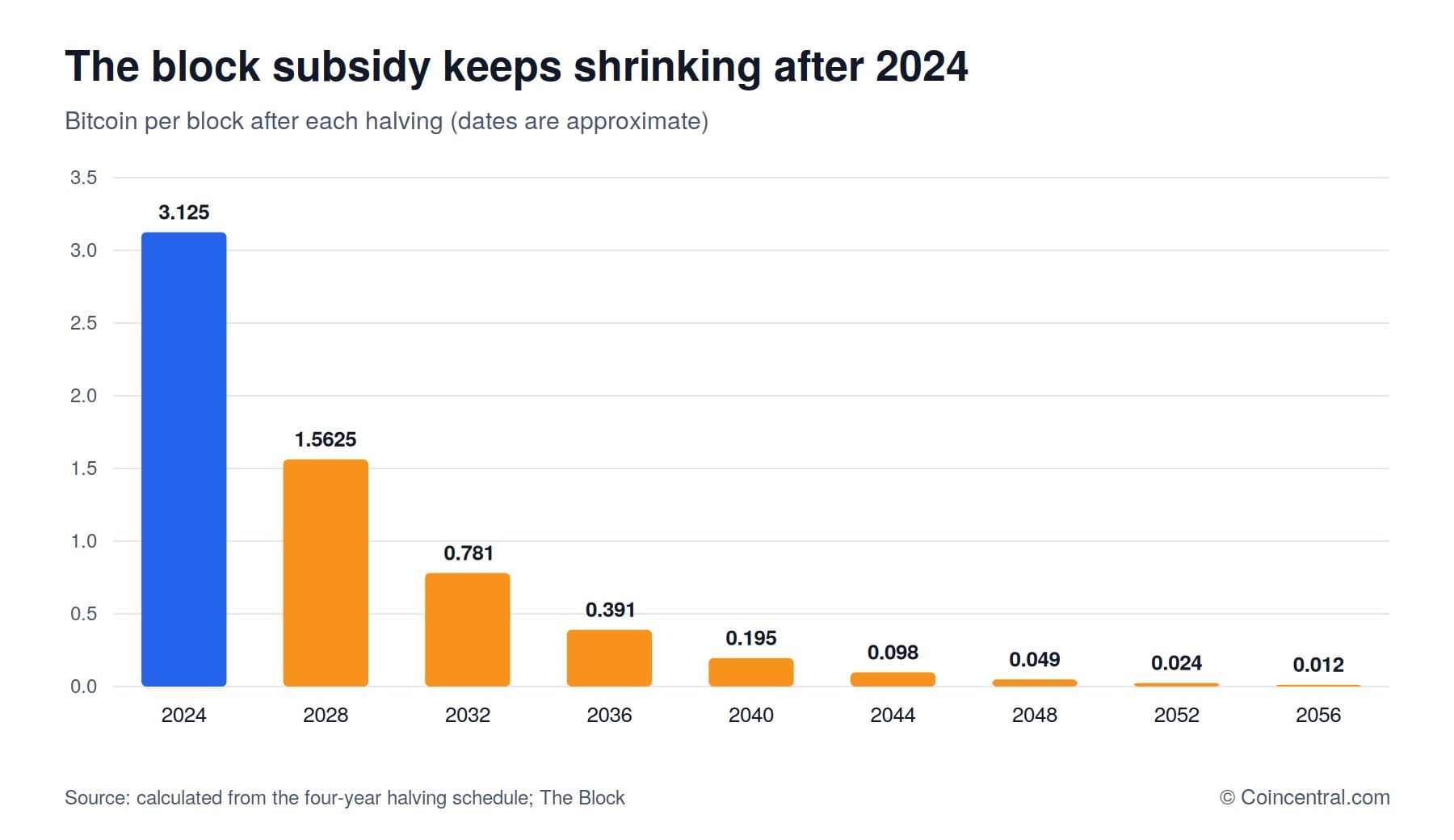
The subsidy shrinks quickly. By the 2044 halving it is below 0.1 bitcoin per block, and it keeps falling until it reaches zero. Fees must fill the gap.
Whether fees can replace the subsidy depends on demand for block space at the time. Binance Academy says no one can say with certainty how this will play out over a 100-year timeline.
Critics point to security. Miners keep hardware online to deter attacks, and some researchers argue fee income may be too volatile to keep enough computing power running. Heavy reliance on fees could also make transactions costlier in busy periods.
Supporters point to several offsets. The Lightning Network moves small, frequent payments off the main chain, leaving the base layer for higher-value settlement. Lightspark adds that more efficient ASIC mining hardware lowers costs, and that a rising bitcoin price can raise miner income.
Lightspark also says fewer new coins could ease some energy concerns, though this depends on mining technology and energy sources.
Binance Academy lists three possible paths for the fee market: higher fees, growth in Layer 2 use, or changes to how block space is used. If Layer 2 use grows, base layer transactions could become fewer but higher in value.
Lightspark adds that miners may prioritize transactions with higher fees once fees are their main income. That could increase competition and raise costs for users.
If Bitcoin works mainly as a store of value, Investopedia says miners could still profit from a smaller number of high-value transactions.
Lost Coins and the Effective Supply
The 21 million cap is a ceiling, not a count of usable coins. Many bitcoin appear to be lost for good. Owners have lost private keys, discarded hard drives, sent coins to invalid addresses or died without sharing recovery details.
The Block puts industry estimates of lost coins between roughly one million and four million bitcoin. Binance Academy says analysts estimate up to 20% of all mined coins may be permanently lost. Exact figures cannot be verified.
| Estimate | Lost coins | Usable coins | Share of 21M cap |
|---|---|---|---|
| Low (The Block) | 1 million | 19 million | 90.5% |
| High (The Block) | 4 million | 16 million | 76.2% |
| Up to 20% of mined (Binance Academy) | 4 million | 16 million | 76.2% |
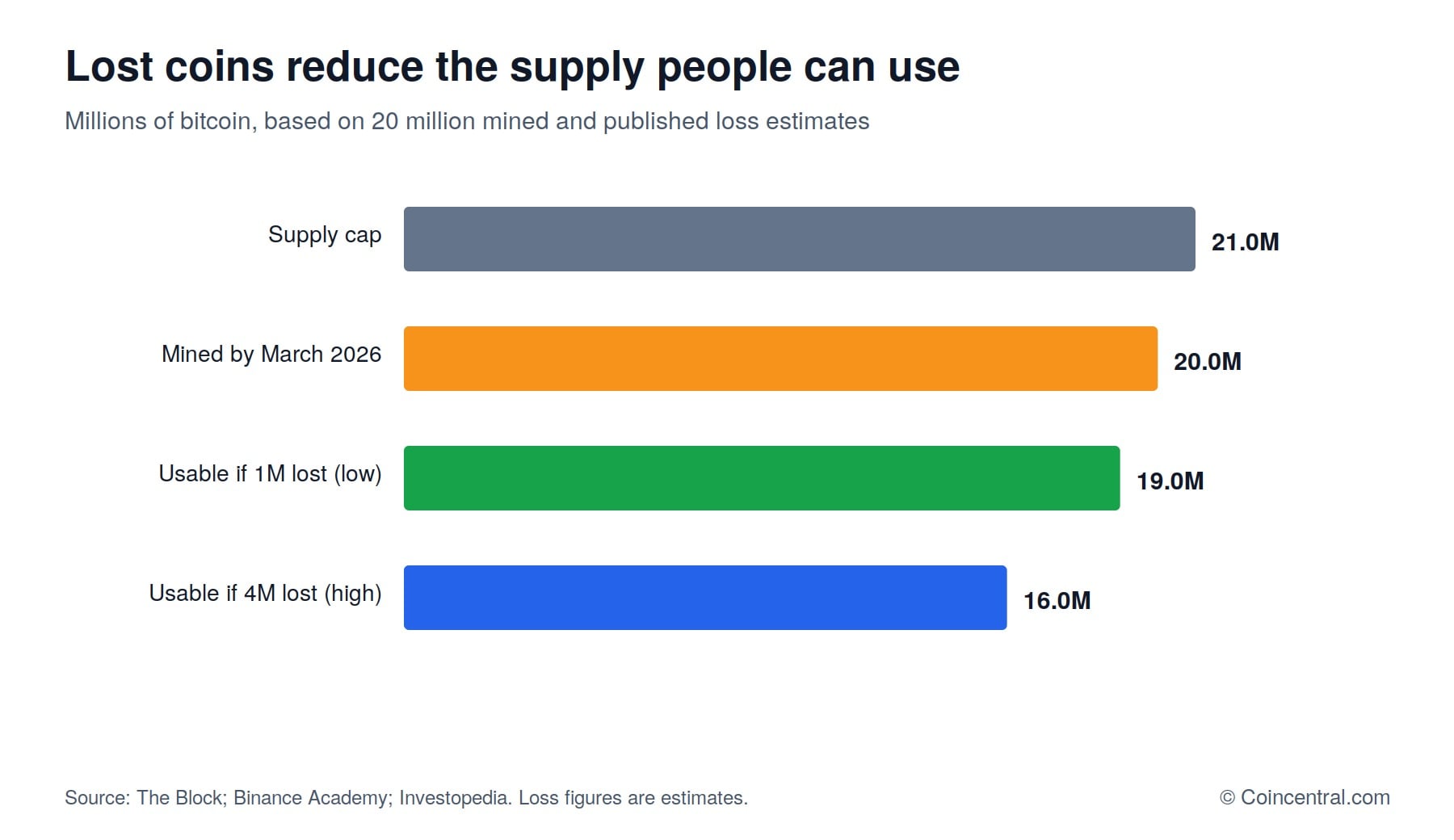
Lost coins cannot be recovered by anyone. They reduce the supply available to the market, which adds scarcity beyond the cap.
The tradable supply is smaller still. Long-term holders, corporate treasuries, ETFs and sovereign reserves hold large amounts. The Block says ETF bitcoin sits in cold storage, which reinforces the scarcity story.
Analysts separate total supply from circulating supply for this reason. The supply that actively trades on exchanges is only part of what has been mined.
The gap between 20 million mined and the 19.87 million circulating figure shows how hard counting is. Neither number removes lost coins, so the usable supply is likely lower than both.
Bitcoin’s Supply Cap Compared With Fiat Currency
Bitcoin’s supply rules differ from those of fiat currency. The table compares the two systems.
| Feature | Bitcoin | Fiat currency |
|---|---|---|
| Total supply | Capped at about 21 million | No fixed cap |
| Issuance schedule | Set in advance and public | Set by central bank policy |
| Issuer | Protocol code, no central party | Central bank, such as the Federal Reserve |
| Inflation | Pre-programmed disinflation | Depends on policy and the economy |
| Changing supply | Needs near-universal consensus | Adjustable by the monetary authority |
| Backing | None, relies on scarcity and demand | Government recognition and legal tender status |
The Block says the contrast is not about which system is better. It is about trade-offs. Fiat gives governments room to respond to economic shocks but exposes holders to inflation and political risk. Bitcoin offers predictability but has no lever to address shocks.
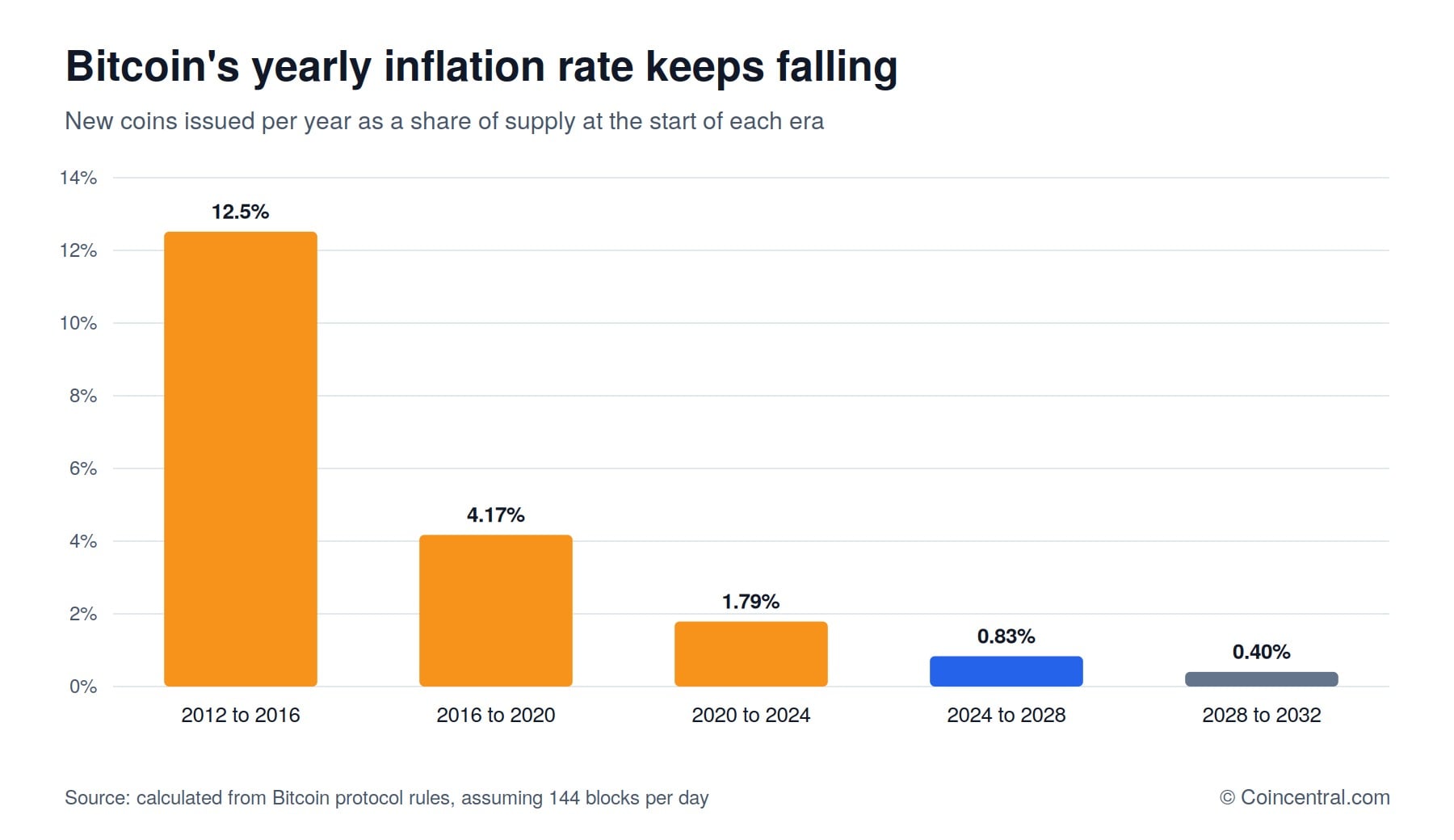
Bitcoin’s own inflation rate falls with each halving. We calculated the yearly rate by dividing the coins issued in a year by the supply at the start of the era. The rate was above 12% after the 2012 halving and is below 1% today.
Bitcoin is scarcer than gold on one measure. Its supply is capped, while the world’s gold supply grows as more is mined each year. Gold, however, has thousands of years of monetary history that Bitcoin lacks.
Critics add that strict caps can encourage hoarding and leave a currency open to deflation cycles. Supporters reply that Bitcoin is better seen as a savings asset than as everyday money. Economists remain divided on the question.
Institutions, Criticism and the Outlook
Fixed supply combined with growing demand is generally seen as a tailwind for Bitcoin. That is a view, not a guarantee. Lightspark notes that if demand falls, the price may fall too.
Institutions have started to treat bitcoin as a reserve asset. Tesla and Strategy have placed parts of their balance sheets in bitcoin, citing the cap as a hedge against currency debasement.
In March 2025, the United States set up a Strategic Bitcoin Reserve. It is funded by coins the federal government already held from forfeiture cases.
Spot Bitcoin ETFs offer a third route. They let asset managers and pension funds buy bitcoin through registered securities.
The Block says the appeal for many institutional buyers is less about technology and more about monetary properties. A verifiably scarce asset that cannot be diluted is rare.
Lightspark says the code-enforced limit is publicly auditable, which supports confidence in its scarcity. Trust in the limit does not guarantee demand, though.
Bitcoin reached an all-time high of $126,210 on Oct. 6, 2025, according to Investopedia. Price moves depend on many factors beyond supply.
Can the cap change? In theory, yes. It would need near-universal agreement among node operators, miners, exchanges and users. The Block says it would face overwhelming opposition, and Binance Academy says there has been no serious movement to change it.
Lightspark suggests businesses prepare by adding Lightning payments and tracking regulatory and technology changes. The Lightning Network is built to offer faster and cheaper transactions than the base layer.
Frequently Asked Questions
When will the final bitcoin be mined?
Around the year 2140, based on the halving schedule. The date can shift because the protocol counts blocks, not years.
What happens when all bitcoin is mined?
The network keeps operating. New bitcoin stops being issued, and miners earn income only from transaction fees.
Will all 21 million bitcoin ever exist?
Probably not. Rounding down to the nearest satoshi means the total will fall slightly short of 21 million.
When is the next halving?
It is expected around April 2028. The block reward will fall from 3.125 to 1.5625 bitcoin.
Can the supply limit be changed?
It would take near-universal consensus across the network. Sources describe the cap as one of Bitcoin’s core properties.
Conclusion
Bitcoin’s supply is one of the most predictable of any asset. About 95% of the 21 million coins are mined, and the remaining coins will arrive over more than a century.
The end of new issuance is a planned change, not a surprise. Miners will move from block rewards to fees, and researchers still debate whether fees can cover the cost of network security.
Lost coins, long-term holders and institutional buyers add another layer to the supply picture. The cap sets the ceiling, but the usable supply is smaller.
Sources
- The Block Research, “What Happens When Bitcoin Reaches 21 Million Supply?” (June 19, 2026)
- Adam Hayes, Investopedia, “What Happens to Bitcoin After All 21 Million Are Mined?” (updated December 18, 2025)
- Binance Academy, “What Happens After All Bitcoins Are Mined?” (updated July 24, 2026)
- Lightspark Team, “What Happens When All 21 Million Bitcoins are Mined?” (March 11, 2023)
- “What Happens to Bitcoin After All 21 Million Are Mined?” (January 16, 2025)


