





Caesars and DraftKings have built two of the most recognisable brands in regulated US online gambling. Both platforms are well-funded, well-run, and competitive within their lane. For the right type of player, either is a reasonable choice. But that lane is a fiat one — built on bank accounts, card payments, and a regulatory framework that treats crypto as an afterthought at best. In 2026, players who think in BTC, ETH, and USDT are finding their answer elsewhere. ZunaBet is where that conversation is happening.
Caesars: Brand Prestige Built on Land, Limited by Fiat Online
The Caesars name carries more history than almost any other in gambling. Decades of land-based dominance across Las Vegas and beyond translated into meaningful brand trust when Caesars moved online. Players arrive with a level of confidence in the name that purely digital operators spend years trying to build from scratch.
The sportsbook is competitive. All major US sports are covered with solid odds and a clean interface that reflects the premium positioning the Caesars brand demands. The casino product is substantial — slots, table games, and live dealer content delivered through a polished platform.
Caesars Rewards is the platform’s most distinctive feature for a specific type of player. Linking online gambling activity to real-world resort benefits — hotel stays, dining, entertainment at Caesars properties — creates genuine value for players who engage with those properties regularly. For that audience, the loyalty crossover is a meaningful differentiator that purely digital platforms cannot replicate.
For crypto players, none of that changes the fundamental reality. Caesars runs on fiat. Payments go through banks and cards. Crypto is not part of the product. The loyalty program, while strong for resort customers, follows the same opaque points model as every other traditional operator for everyone else — accumulate, redeem, never quite know the actual return rate.
DraftKings: Daily Fantasy Roots, Full Platform Built on the Same Fiat Rails
DraftKings built its user base through daily fantasy sports and converted it effectively into a full sportsbook and casino product. The sportsbook is strong — wide US sports coverage, solid same-game parlay functionality, and a mobile app that handles the demands of live betting without issues.
The casino has grown steadily. Slots, live dealer tables, and RNG games in licensed states are delivered through an interface that carries the energetic aesthetic DraftKings has maintained across all its products. The overall platform is coherent and well-executed.

DraftKings Rewards runs on a tiered structure — Silver through Diamond+ — with points that accumulate through activity and unlock benefits including site credit and free bets at higher tiers. It’s a reasonably organised program that rewards regular players. The actual percentage return on play is never stated explicitly. Players earn points, the platform sets the conversion rate, and the real value coming back is never made transparent. That’s a design choice, not an oversight.
Payments at DraftKings are entirely conventional. Cards, bank transfers, approved e-wallets. Crypto is not a meaningful part of the payment infrastructure. For players who move funds on-chain as a default, the platform doesn’t connect to how they actually operate.
The Structural Wall Both Platforms Hit
DraftKings and Caesars are not poorly built products. The limitations that make them irrelevant to crypto players are baked into the regulatory framework they operate within. Licensed US gambling operators work within rules that require traditional financial infrastructure — banking partnerships, identity verification tied to conventional financial systems, state-level compliance structures that make meaningful crypto integration practically impossible.
That framework protects consumers and creates reliable, regulated products. It also creates platforms that fundamentally cannot serve players whose financial lives run on-chain. No product improvement at Caesars or DraftKings addresses that structural reality because the structure itself is the constraint.
ZunaBet: The Platform Designed Around the Player Both Platforms Ignore
ZunaBet launched in 2026 under Strathvale Group Ltd with an Anjouan gaming license and a founding team that brings over 20 years of combined industry experience. It arrived as a complete, fully operational platform — not a work in progress, but a crypto-first gambling destination built with a clear and specific player in mind from the outset.
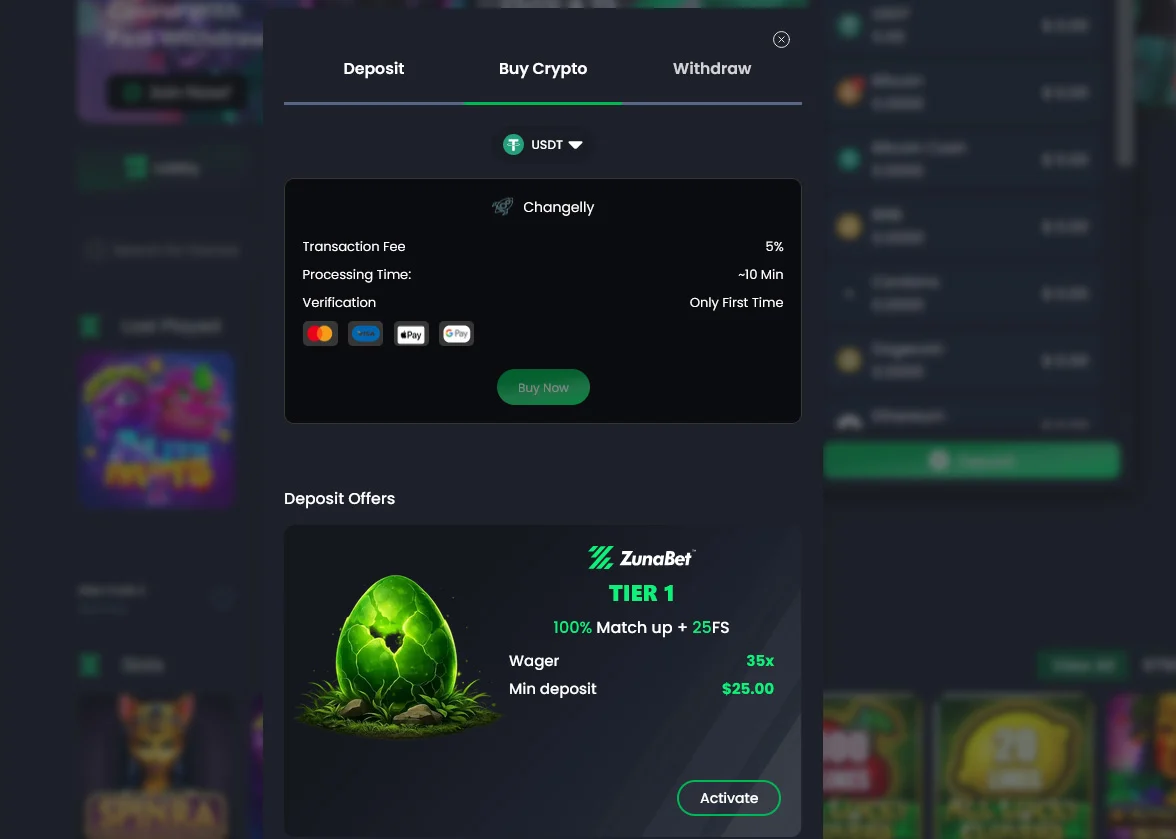
Crypto support is comprehensive and structural. Over 20 digital assets are live — BTC, ETH, SOL, USDT across multiple chains, XRP, ADA, DOGE, and others. No platform processing fees. Withdrawals settle at network speed. The payment layer was built around digital assets as the primary transaction method from day one. For players whose default is a self-custody wallet, the difference between a platform that accommodates crypto and one that’s built for it is immediately clear in practice.
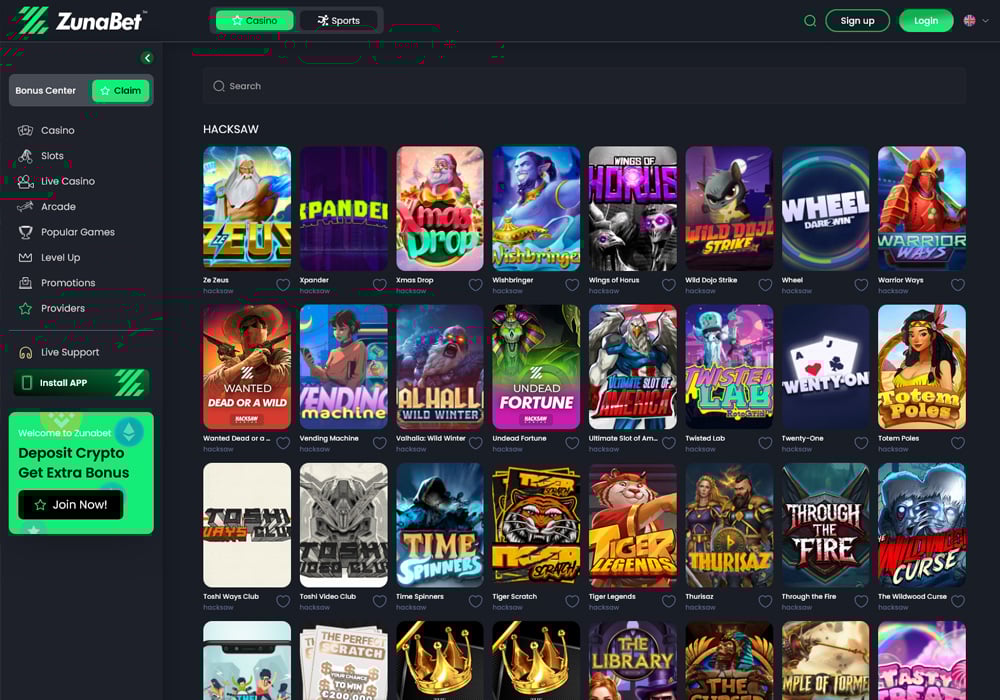
The game library sits at over 11,000 titles from more than 60 providers. Pragmatic Play, Evolution, Hacksaw Gaming, Yggdrasil, and BGaming all feature in a catalogue covering slots, live dealer content, and RNG table games at a scale that places ZunaBet among the largest libraries in the broader market. This isn’t a crypto casino with a modest curated selection. It’s a library that competes with the biggest names on volume and variety simultaneously.
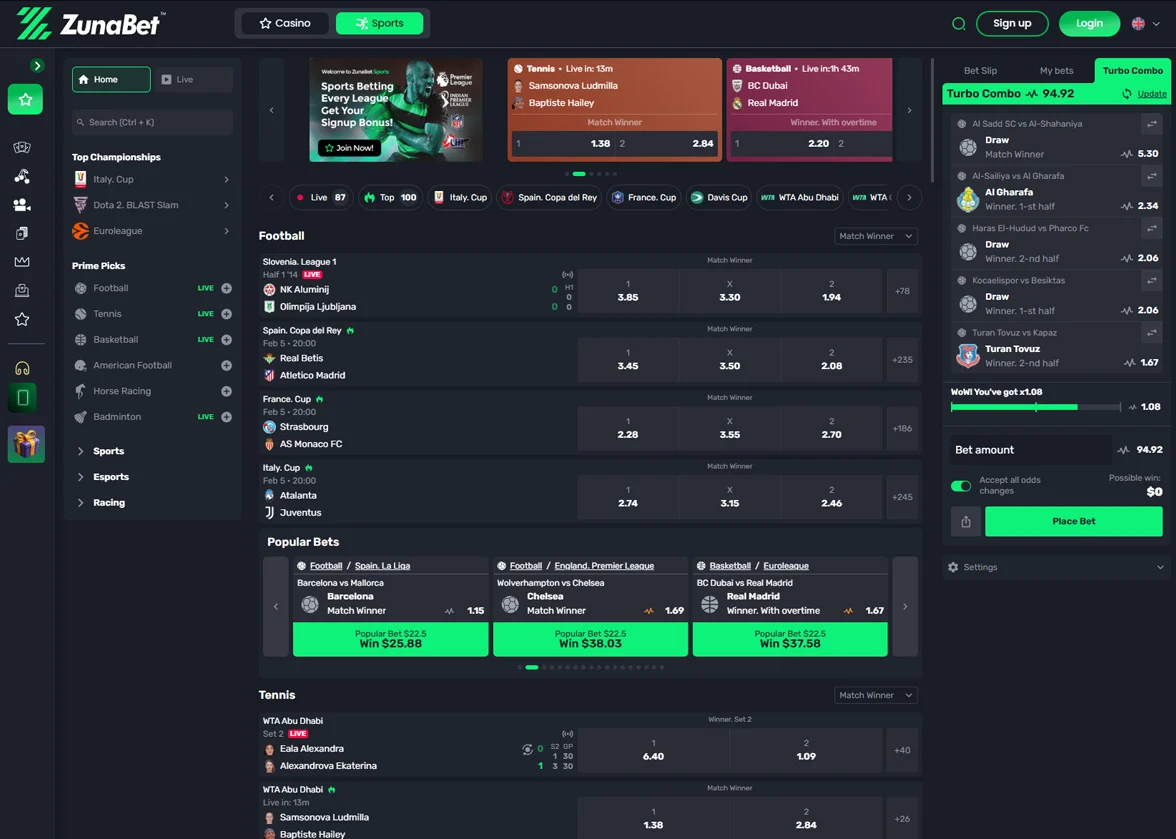
The sportsbook is fully integrated and genuinely complete. Global sports, US leagues, and a proper esports section — CS2, Dota 2, League of Legends, Valorant — alongside virtual sports and combat sports. Casino, sportsbook, and esports under one roof with crypto running through all of it. This is a hybrid platform built as one coherent product, not assembled from loosely connected parts.
Welcome Bonus: $5,000 and 75 Free Spins Across Three Deposits
ZunaBet’s welcome package delivers up to $5,000 plus 75 free spins across the first three deposits. The first deposit earns a 100% match up to $2,000 with 25 spins. The second earns 50% up to $1,500 with 25 spins. The third earns 100% up to $1,500 with the remaining 25 spins.
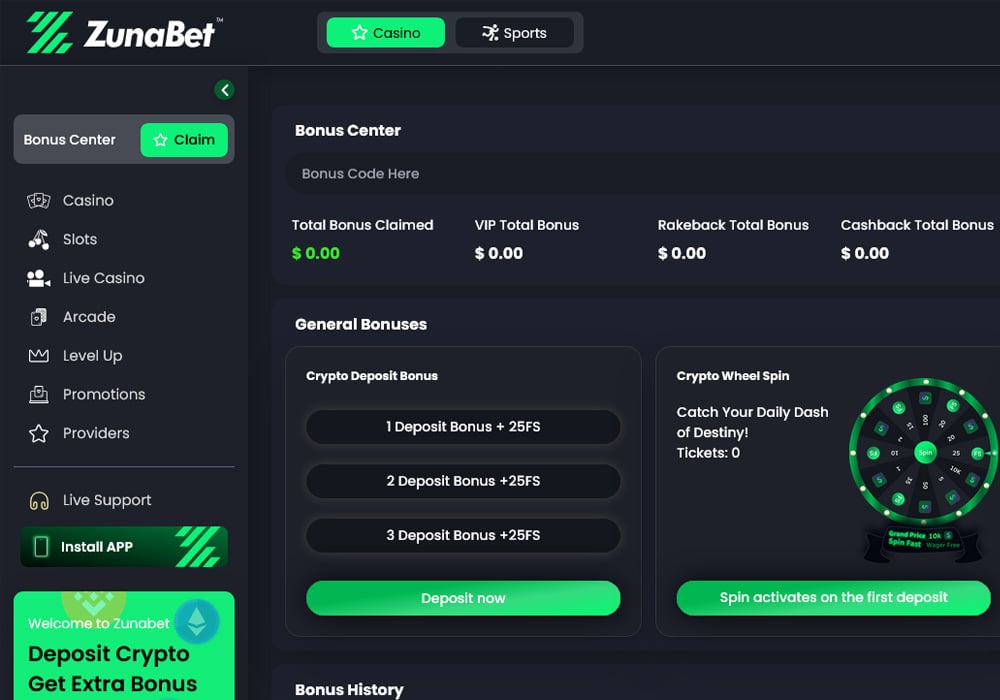
The multi-deposit structure distributes genuine value across an onboarding period rather than concentrating everything into a single front-loaded offer. For crypto players who deposit incrementally — which reflects how most on-chain players naturally operate — the structure fits without requiring artificial behaviour just to maximise a bonus window.
Loyalty: The Transparency Gap Is Not Subtle
Caesars Rewards has real value for resort customers. DraftKings Rewards has a reasonable tier structure for regular sports bettors. Both operate on the same fundamental model — points accumulate, the platform controls the conversion, and the actual return rate is never disclosed clearly. That opacity is a feature of traditional loyalty programs, not a bug. It keeps players earning without a clear picture of what they’re genuinely receiving.
ZunaBet’s Zuno program removes that opacity entirely. Six tiers — Squire, Warden, Champion, Divine, Knight, and Ultimate — each carry a fixed, published rakeback rate. One percent at Squire. Two at Warden. Four at Champion. Five at Divine. Ten at Knight. Twenty percent at Ultimate. Every number is stated upfront. No conversion table to decode, no ambiguity about what comes back at any level.
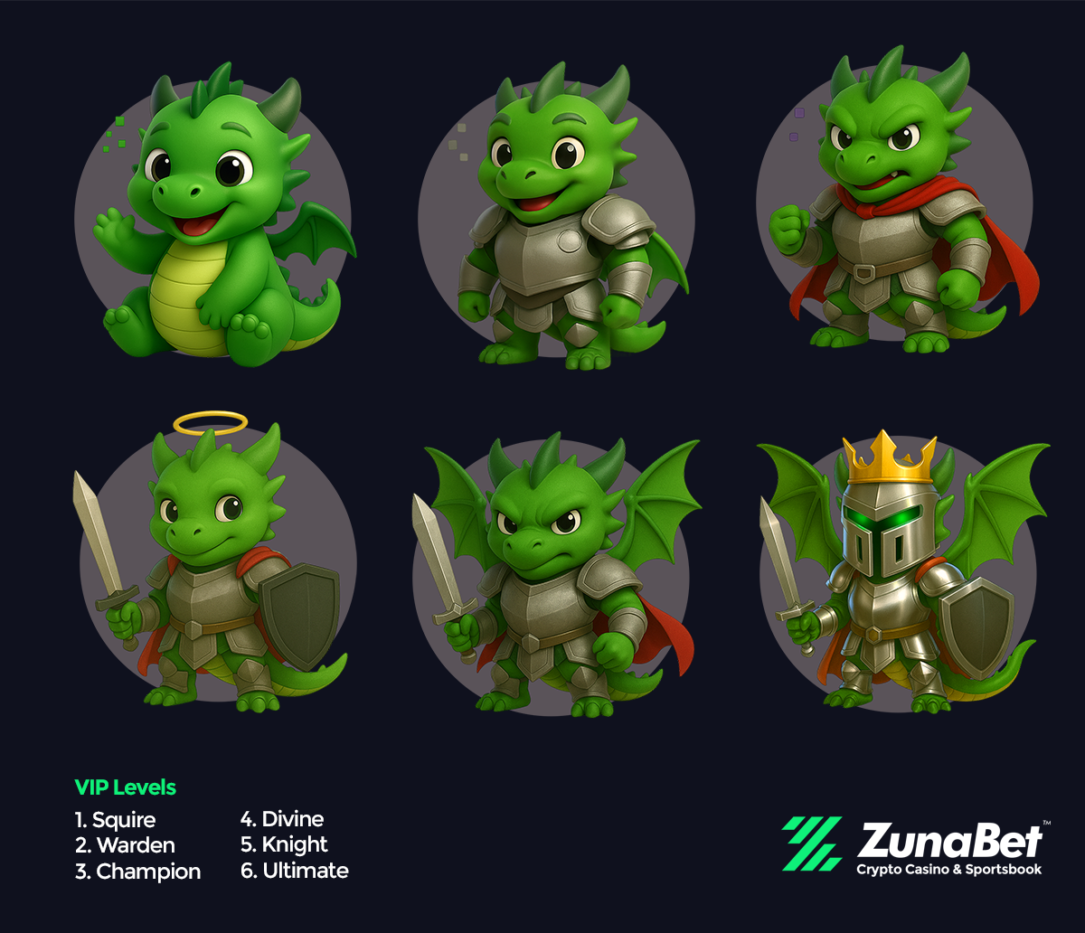
Tier progression also unlocks up to 1,000 free spins, VIP club access, double wheel spins, and a gamified dragon evolution experience built around platform mascot Zuno. Financial transparency and genuine engagement mechanics in the same program. For high-volume crypto players, a clearly stated 20% rakeback ceiling changes the economics of regular play in a way that no points program at any traditional operator comes close to matching.
The Direction of Travel Is One Way
The number of players who default to crypto for financial transactions is growing, not shrinking. The expectations that come with that default — fast settlement, no banking friction, transparent returns — are becoming standard rather than niche. Traditional US operators cannot meet those expectations within their current framework and are not going to restructure to do so.
ZunaBet was built on the right side of that divide from day one. The platform doesn’t need to adapt to the crypto-native player because it was designed for that player from the start. That positioning becomes more relevant with every year that crypto adoption continues to expand.
The Read
Caesars is the right platform for players who value land-based brand crossover and want online activity to feed into resort rewards. DraftKings is the right platform for US sports bettors who want a competitive regulated sportsbook with a casino attached. Both deliver for their intended audience.
That audience is not the crypto player. ZunaBet is. Launched in 2026 with 20+ cryptocurrencies, 11,000+ games, a complete sportsbook including full esports coverage, a $5,000 multi-deposit welcome bonus, and rakeback up to 20% at the top loyalty tier — it’s the platform that was built for the player Caesars and DraftKings were never going to serve.


