





TLDR
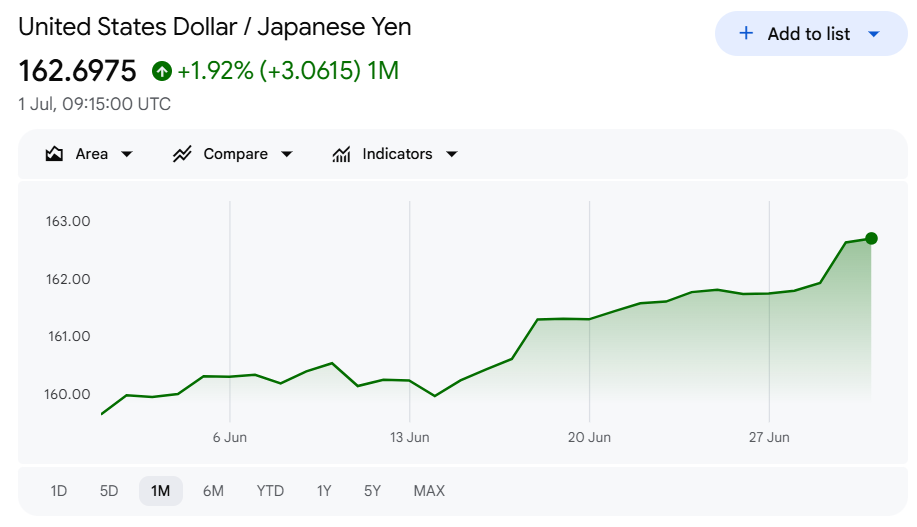
- The dollar reached a 40-year high against the yen, trading as high as 162.84 yen on Wednesday.
- Rising U.S. Treasury yields drove dollar strength across major currencies.
- Markets now price a 67% chance of a Fed rate hike in September, up from 20.5% a month ago.
- Japan’s Ministry of Finance may be preparing to intervene again to support the yen.
- The Iran conflict is also supporting dollar demand, with some analysts warning of a potential correction.
The U.S. dollar climbed to its strongest level against the Japanese yen in 40 years on Wednesday, July 1, 2026, driven by rising Treasury yields and growing bets on a Federal Reserve interest rate hike.
The dollar hit 162.84 yen during trading, a level that previously prompted Japan to intervene in currency markets. It last traded around 162.71 yen, up about 0.1% on the day.
Treasury Yields Fuel Dollar Demand
U.S. Treasury yields rose sharply on Tuesday, with the 10-year yield climbing as much as 9 basis points before pulling back slightly. By Wednesday it was up 4 basis points at 4.465%, outpacing moves in European bond yields.
Analysts said there was no single clear reason for the selloff in Treasuries. Month-end repositioning may have played a part.
The move added fuel to an already strong dollar. The euro fell 0.14% to $1.1404, while sterling dropped 0.2% to $1.3240. The dollar index held steady at 101.31.
Traders now see a 67% chance of a Fed rate hike in September, according to the CME FedWatch tool. That compares with just 20.5% a month ago.
Data released overnight showed U.S. job openings rose to a two-year high in May. However, sluggish hiring weighed on how workers felt about the labor market. The more closely watched non-farm payrolls report is due Thursday.

Japan Watches for a Window to Act
The yen’s fall is putting pressure on Japan’s Ministry of Finance to act. Japan intervened in currency markets about two months ago, and its top currency diplomat said that move was effective and had the backing of some U.S. officials.
Wells Fargo’s Chidu Narayanan said markets are “close to potential action.” He noted the ministry may need to intervene to protect its credibility, even if there is no fixed level that automatically triggers a response.
Traders see Friday’s U.S. public holiday as a potential window for Japan to buy yen, since thinner market liquidity could amplify the effect.
HSBC’s Joey Chew said Japan may also be waiting for a weak U.S. jobs report on Thursday, which could push the dollar lower on its own. She also raised the possibility that officials are letting short positions build up to make any future intervention more effective.
Meanwhile, geopolitical risk is also supporting the dollar. Commerzbank noted the dollar is likely to stay firm while the Iran conflict continues. However, the bank warned that once the situation clears, rate hike expectations may not hold up, opening the door to a dollar pullback.
Fed Chair Kevin Warsh is scheduled to speak at the ECB Forum on Central Banking in Portugal later Wednesday. Analysts do not expect him to offer strong forward guidance, based on his approach in June.
The dollar’s strength reflects both higher U.S. yields and uncertainty in global markets, with Japan now watching closely for the right moment to step in.
Stop guessing and start investing with confidence. KnockoutStocks gives you the AI insights, market intelligence, and stock research you need to spot opportunities, cut through the noise, and make smarter investment decisions — all in one powerful platform.
Sign up today and get 50% OFF full access to our premium stock picks.
Simply use coupon code SPECIAL50 at checkout to claim your exclusive discount.
Get 3 Free Stock Ebooks
Discover top-performing stocks in AI, Crypto, and Technology with expert analysis.
- Top 10 AI Stocks - Leading AI companies
- Top 10 Crypto Stocks - Blockchain leaders
- Top 10 Tech Stocks - Tech giants



