





TLDR
- Gold is trading near a one-month low around $4,590–$4,594 an ounce after falling 2.4% over two sessions
- The ongoing U.S.-Iran war and closure of the Strait of Hormuz are driving inflation fears
- President Trump told aides to prepare for a prolonged naval blockade of Iran
- The Federal Reserve is widely expected to hold interest rates unchanged at its Wednesday meeting
- Gold has lost about 13% of its value since the conflict began in late February
Gold prices steadied on Wednesday after two days of steep losses, holding near a one-month low as traders watched developments in the U.S.-Iran war and waited for the Federal Reserve’s latest interest rate decision.
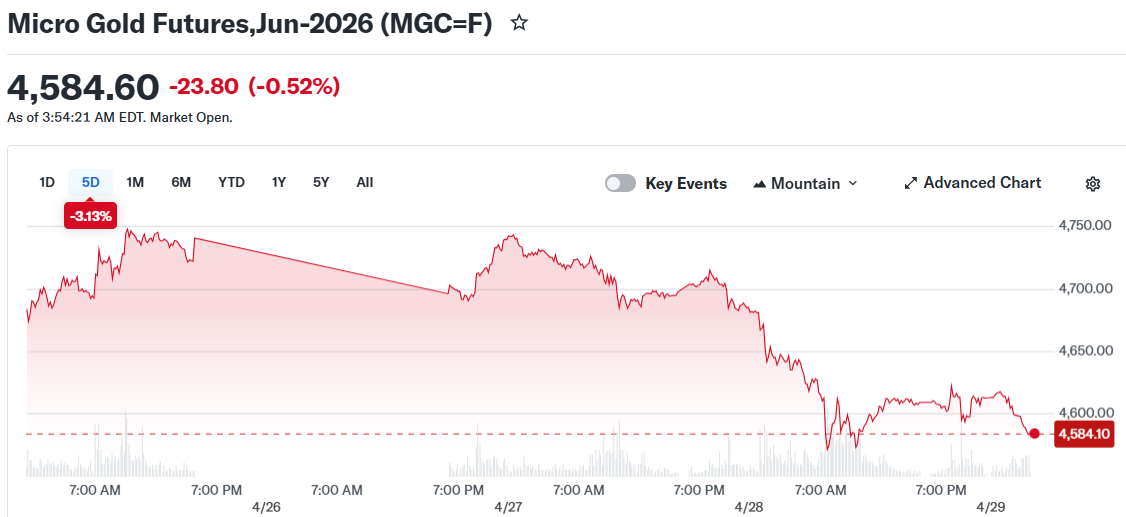
Spot gold was trading around $4,593 an ounce in early trading, while gold futures sat at $4,606.31 per ounce. The metal has dropped roughly 13% since the U.S.-Iran conflict began at the end of February.
The Strait of Hormuz has been closed indefinitely due to the conflict, disrupting oil supplies and pushing crude prices higher. That has raised fears of oil-driven inflation, which could force central banks to keep interest rates higher for longer.
Higher interest rates are generally bad for gold. The metal does not pay any yield, so when rates rise, the cost of holding gold increases compared to bonds or other interest-bearing assets.
"Iran has just informed us that they are in a “State of Collapse.” They want us to “Open the Hormuz Strait,” as soon as possible, as they try to figure out their leadership situation (Which I believe they will be able to do!)." – President Donald J. Trump 🇺🇸 pic.twitter.com/XKSQRRRDRh
— The White House (@WhiteHouse) April 28, 2026
President Trump told aides to prepare for a prolonged naval blockade of Iran, according to a Wall Street Journal report published Tuesday. The blockade is designed to cut off Iran’s oil exports and push Tehran toward a deal.
Iran has asked the U.S. to lift the naval blockade while both sides negotiate. Mediators in Pakistan say Tehran is expected to submit a revised proposal within days, according to CNN.

Earlier reports said Trump was unhappy with a previous Iranian proposal that called for delaying talks on Iran’s nuclear activities. That proposal was seen as insufficient by the U.S. side.
Inflation Fears Keep Pressure on Gold
The continued closure of the Strait of Hormuz is seen as the main driver of inflation risk right now. Oil supply disruptions push energy prices higher, which feeds into broader inflation.
Analysts at OCBC said gold needs either a drop in oil prices or signs that geopolitical tensions are easing before it can recover. Those two conditions remain out of reach for now.
Ole Hansen, head of commodity strategy at Saxo Bank, said a break below support at $4,650 triggered technical selling. He said a reopening of the Strait of Hormuz would be the biggest short-term boost for gold prices.
Fed Decision and Rate Outlook
The Federal Reserve is expected to leave interest rates unchanged when its two-day meeting concludes on Wednesday. Investors are also watching whether Jerome Powell will remain as Fed chair after his term ends.
Growing bets suggest the Fed will hold rates steady for the rest of 2026, given ongoing inflation pressures from the war.
Rate decisions from the European Central Bank and the Bank of England are also due this week. The Bank of Japan left its benchmark rate unchanged at 0.75% on Tuesday.
Silver rose 0.8% to $73.66 an ounce. Platinum and palladium edged lower.
Stop guessing and start investing with confidence. KnockoutStocks gives you the AI insights, market intelligence, and stock research you need to spot opportunities, cut through the noise, and make smarter investment decisions — all in one powerful platform.
Sign up today and get 50% OFF full access to our premium stock picks.
Simply use coupon code SPECIAL50 at checkout to claim your exclusive discount.
Get 3 Free Stock Ebooks
Discover top-performing stocks in AI, Crypto, and Technology with expert analysis.
- Top 10 AI Stocks - Leading AI companies
- Top 10 Crypto Stocks - Blockchain leaders
- Top 10 Tech Stocks - Tech giants



