






TLDR
- Gold rose 0.7% to around $4,400 an ounce on Wednesday ahead of the U.S. CPI release
- ETF inflows into gold extended to a fifth straight session, hitting a six-week high in holdings
- Uncertainty over the Strait of Hormuz closure is keeping energy markets volatile and supporting gold
- China’s central bank bought gold for a 21st consecutive month in July, adding around 640,000 troy ounces
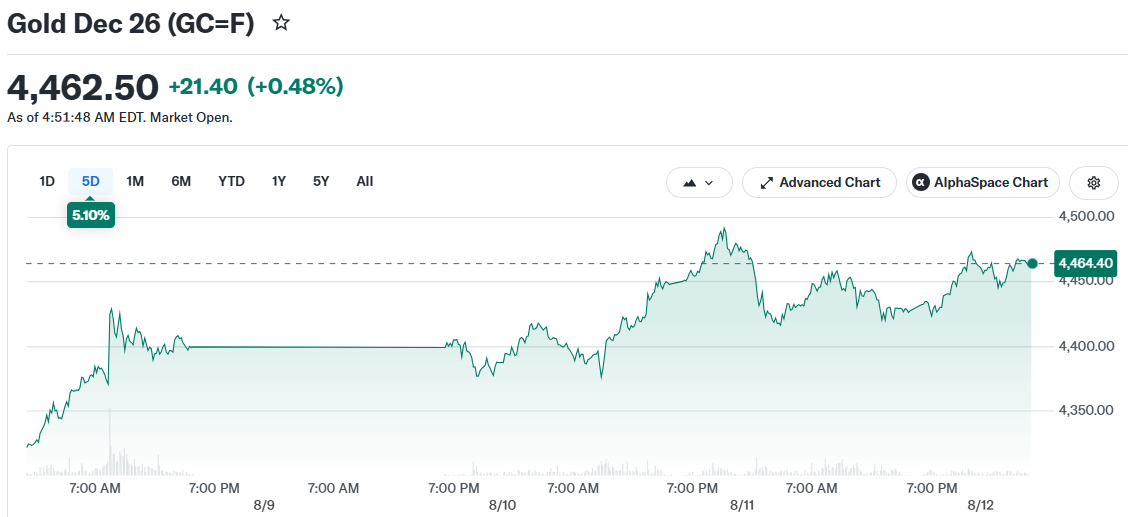
- Gold faces key resistance near $4,460 to $4,495, with $5,000 seen as the next major target if those levels break
Gold prices pushed higher on Wednesday as traders held back from big moves ahead of the U.S. Consumer Price Index report, the key inflation reading that could shape the Federal Reserve’s next interest rate decision.
At around 07:22 GMT, spot gold rose 0.7% to $4,400.02 an ounce. Gold futures gained 0.4% to $4,459.30. Silver climbed 1.8% to $65.88 an ounce, and platinum added 0.7% to $1,755.16.
CPI Data in Focus
Markets are closely watching Wednesday’s CPI print. A softer reading could ease pressure on the Fed to keep rates high, while a hotter number could revive rate hike expectations. Swaps markets currently put the odds of a quarter-point September hike at around 50-50.
Saxo Bank analysts said traders are watching whether gold’s breakout above $4,200 has enough momentum to push toward the 200-day moving average near $4,500. That level, along with resistance around $4,460, is seen as the next hurdle for the metal.
Tony Sycamore, senior market analyst at IG, said gold’s recent pullback from $4,435 came from profit-taking ahead of the CPI report, hawkish Fed commentary, and rising energy prices. He said a sustained break above $4,460 and the 200-day moving average around $4,495 would be needed to open the path toward $5,000.
Investor demand has been building. ETF inflows into gold extended to a five-session winning streak, pushing total holdings to a six-week high.
Hormuz Uncertainty Adds Pressure
Ongoing tensions around the Strait of Hormuz are adding another layer of uncertainty. Iran has said the waterway will stay closed until the U.S. lifts its blockade on Iranian ports and pays compensation for military strikes.

Pakistan’s defense minister said the U.S. and Iran were close to a deal, and reports pointed to active Oman-Iran diplomacy. But Iran has not budged on its conditions.
Separate attacks on shipping in the Strait of Hormuz and Bab el-Mandeb were reported by both U.S. and Houthi forces. A U.S. Navy helicopter also fired on a cargo vessel in the Gulf of Oman. A drone struck a refinery in Libya.
Higher energy prices driven by these disruptions could push inflation higher, which would likely keep the Fed cautious about cutting rates. That in turn raises the opportunity cost of holding gold, which pays no interest.
China Keeps Buying
The People’s Bank of China increased its gold reserves for a 21st straight month in July, adding roughly 640,000 troy ounces to bring total holdings to 76.08 million ounces. Chinese gold-backed ETFs also continued to attract buyers, pointing to steady institutional demand.
Producer price data is due Thursday, giving markets another inflation reading to digest before the Fed’s next meeting.
Stop guessing and start investing with confidence. KnockoutStocks gives you the AI insights, market intelligence, and stock research you need to spot opportunities, cut through the noise, and make smarter investment decisions — all in one powerful platform.
Sign up today and get 50% OFF full access to our premium stock picks.
Simply use coupon code SPECIAL50 at checkout to claim your exclusive discount.
Get 3 Free Stock Ebooks
Discover top-performing stocks in AI, Crypto, and Technology with expert analysis.
- Top 10 AI Stocks - Leading AI companies
- Top 10 Crypto Stocks - Blockchain leaders
- Top 10 Tech Stocks - Tech giants



