





TLDR
- Gold climbed over 1% on Friday after Iran declared the Strait of Hormuz open for commercial vessels during a ceasefire
- Trump announced a 10-day Israel-Lebanon ceasefire and said the US and Iran are “very close” to a deal
- Oil prices dropped sharply, with Brent futures falling 8.3% after Iran’s foreign minister made the announcement
- Gold is on track for its fourth straight weekly gain, though it remains about 9% below pre-conflict levels
- Hedge funds have cut their net long positions on gold to the lowest level in over two years
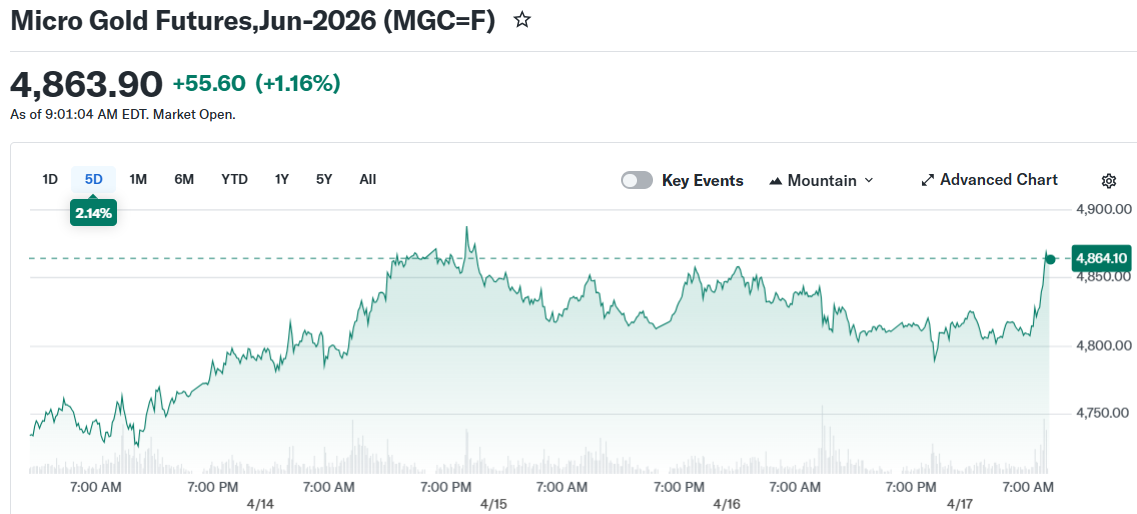
Gold spot prices rose to $4,843.17 per ounce on Friday morning, a gain of 1.1%, after Iran’s foreign minister Abbas Araghchi posted on X that the Strait of Hormuz was open to all commercial vessels for the duration of the ceasefire.
The Strait of Hormuz carries roughly one-fifth of the world’s oil and gas supply. Its effective closure since the conflict began in late February caused the largest energy supply disruption in history and sent oil prices sharply higher.
Brent crude futures fell 8.3% following Araghchi’s statement. US equity futures extended gains on the back of the news.
BREAKING: President Trump thanks Iran for reopening the Strait of Hormuz. pic.twitter.com/rPDGtMWLZW
— The Kobeissi Letter (@KobeissiLetter) April 17, 2026
President Trump announced a 10-day ceasefire between Israel and Lebanon on Thursday. Israeli Prime Minister Benjamin Netanyahu confirmed the agreement.
Trump said Iran had agreed to terms on nuclear weapons it had long resisted, and added that Washington and Tehran are “very close” to a full deal. He said Iran has agreed not to possess a nuclear weapon for more than 20 years.
Iran has called for the removal of international sanctions in return. Trump said he would consider extending the ceasefire if negotiations with Tehran remained on track.

Talks between Washington and Tehran may resume as early as this weekend, Trump suggested. Some European and Gulf Arab leaders have predicted a full deal could still take up to six months.
What the Ceasefire Means for Gold
Gold has been under pressure for much of the seven weeks since the conflict began. Higher oil prices raised inflation fears, leading traders to expect central banks to hold rates steady or raise them. Gold tends to perform poorly when interest rates are elevated.
The US dollar also strengthened during the conflict, partly because heavy domestic energy exports shielded the American economy from supply disruptions. A stronger dollar makes gold more expensive for buyers using other currencies. The dollar index was on track for a 0.5% weekly loss on Friday.
Gold has recovered in recent weeks but is still down about 9% since the conflict started in late February.
Federal Reserve Bank of New York President John Williams said Thursday that uncertainty makes it hard to give strong guidance on rates, though he still expects cuts over the longer term.
Hedge Fund Positioning at Two-Year Low
Hedge funds cut their net long positions on gold to the lowest level in more than two years in the week ending April 7, according to the latest data.
Ole Hansen, head of commodity strategy at Saxo Bank, said the lighter positioning “reduces the risk of further long liquidation” and creates room for fresh buying if conditions stay supportive.
Gold futures were trading at $4,865.09 per ounce as of Friday morning in New York, up 1.2% on the day. Silver rose 0.7% to $78.96 per ounce.
Stop guessing and start investing with confidence. KnockoutStocks gives you the AI insights, market intelligence, and stock research you need to spot opportunities, cut through the noise, and make smarter investment decisions — all in one powerful platform.
Sign up today and get 50% OFF full access to our premium stock picks.
Simply use coupon code SPECIAL50 at checkout to claim your exclusive discount.
Get 3 Free Stock Ebooks
Discover top-performing stocks in AI, Crypto, and Technology with expert analysis.
- Top 10 AI Stocks - Leading AI companies
- Top 10 Crypto Stocks - Blockchain leaders
- Top 10 Tech Stocks - Tech giants



