





TLDR
- Kioxia is preparing to list American depositary shares on a U.S. stock exchange, moving beyond OTC markets
- The KXIAY ADR is up 460% year-to-date, outpacing Micron’s 167% gain in the same period
- Full-year revenue rose 37% to ¥2.34 trillion, with EPS roughly doubling year-on-year
- Kioxia and Dell announced a 2U server configuration supporting up to 9.8 petabytes of flash storage for AI workloads
- The company is co-developing GPU-adjacent SSDs with Nvidia that could partially replace high-bandwidth memory
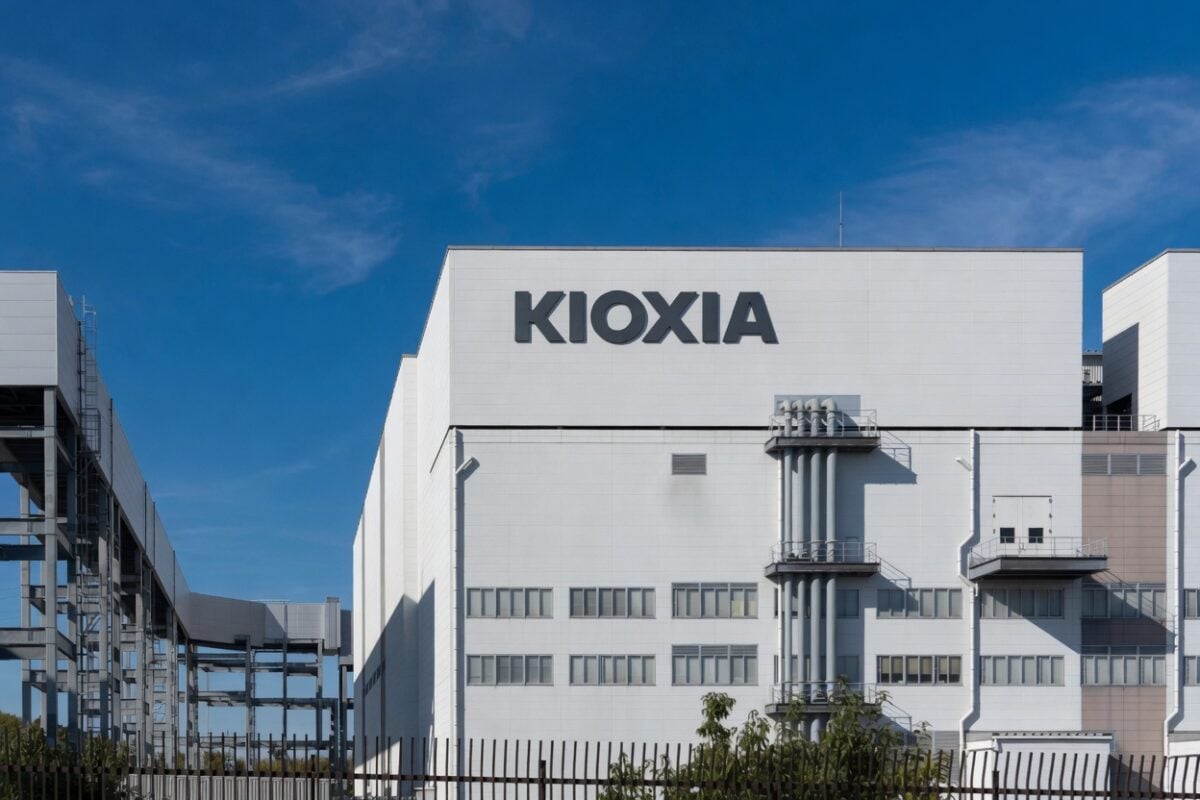
Kioxia Holdings (KXIAY) is preparing to list on a U.S. stock exchange, the company confirmed, as it looks to expand its investor base beyond the over-the-counter market where it currently trades in America.
The Japanese memory chipmaker said the listing is contingent on regulatory approval, and that details — including timing, market, and method — have not yet been decided.
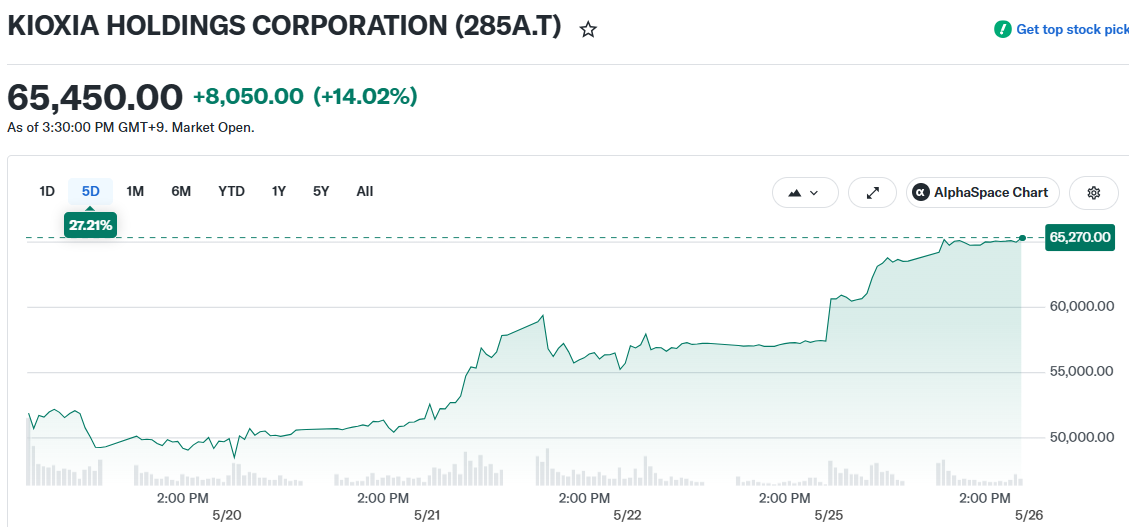
The OTC-traded KXIAY ADR has surged 460% year-to-date. Micron (MU), one of its closest U.S. peers, is up around 167% over the same stretch.
Kioxia reported full-year results for the period ended March 31, 2026, with revenue climbing 37% year-on-year to ¥2.34 trillion. Net income hit ¥554.49 billion, and basic EPS roughly doubled compared to the prior year.
Operating margin expanded to 37.2% from 26.5% a year earlier. Return on equity rose to 51.9% from 45.9%, while return on assets improved from 12.8% to 23.7%.
Cash from operating activities came in at ¥616.54 billion, up from ¥476.41 billion. The company closed the year with a cash balance of ¥470.71 billion, ahead of its short-term debt of ¥203.37 billion.
AI Product Pipeline
On the product side, Kioxia is developing a Super High IOPS SSD targeting over 10 million input and output operations per second. Samples are planned for the second half of 2026.

The company is also working on its CM9 series, a high-performance SSD built specifically for AI systems requiring both speed and reliability.
In partnership with Nvidia, Kioxia is developing GPU-adjacent SSDs that could connect directly to GPUs and partially replace high-bandwidth memory in generative AI servers.
Its 10th-generation BiCS FLASH, going beyond 300 layers, is set to enter production in 2026.
Dell Partnership and Storage Density
Dell and Kioxia recently announced a 2U server configuration supporting up to 9.8 petabytes of flash storage, targeting AI and data-heavy enterprise workloads. The system uses PCIe 5.0 flash and is positioned as a high-density, energy-efficient option for AI infrastructure.
The partnership was announced alongside Dell’s new Deskside Agentic AI product, part of its AI Factory with Nvidia initiative.
Analyst Kazuyoshi Saito of Cosmo Securities noted that Kioxia’s NAND production costs run 20%-30% lower than competitors, with storage capacity per unit area that is higher and read/write speeds 10%-20% faster than rivals.
The company’s joint venture with SanDisk operates some of the world’s largest NAND production sites in Yokkaichi and Kitakami, sharing equipment and R&D costs.
Kioxia also recently agreed to subscribe to new shares issued by Nanya, alongside a long-term DRAM supply agreement — a move to reduce its historical dependence on outside DRAM vendors.
One area analysts are watching: Kioxia’s competitors, including SK Hynix, are accelerating quad-level cell enterprise drives for AI data centers. Kioxia has confirmed it is not currently pursuing high-bandwidth flash development, a gap that could leave it underrepresented in a fast-growing enterprise segment.
The stock is up 29.1% following the earnings release on the Tokyo Stock Exchange, where it trades as TSE:285A.
Stop guessing and start investing with confidence. KnockoutStocks gives you the AI insights, market intelligence, and stock research you need to spot opportunities, cut through the noise, and make smarter investment decisions — all in one powerful platform.
Sign up today and get 50% OFF full access to our premium stock picks.
Simply use coupon code SPECIAL50 at checkout to claim your exclusive discount.
Get 3 Free Stock Ebooks
Discover top-performing stocks in AI, Crypto, and Technology with expert analysis.
- Top 10 AI Stocks - Leading AI companies
- Top 10 Crypto Stocks - Blockchain leaders
- Top 10 Tech Stocks - Tech giants



