





TLDR
- Brent crude rose about 1% to $103.64 a barrel and WTI gained 0.9% to $90.21 a barrel on Wednesday, recovering from steep losses a day earlier.
- Saudi Arabia restarted crude loadings at its Red Sea port of Yanbu after restoring its East-West Pipeline to roughly 3.5 million barrels per day.
- The Strait of Hormuz remains closed since late February following the joint U.S. and Israel assault on Iran, keeping supply risks elevated.
- Qatar is mediating talks between Washington and Tehran that could include reopening the strait, though no breakthrough has been reached.
- U.S. diesel prices hit $6.53 a gallon last week, over 70% above prewar levels, pushing the Trump administration to consider a possible export ban.
Oil prices moved higher on Wednesday after a sharp drop in the previous session. Traders are weighing signs of recovering exports from the Middle East against ongoing worries about shipping disruptions.
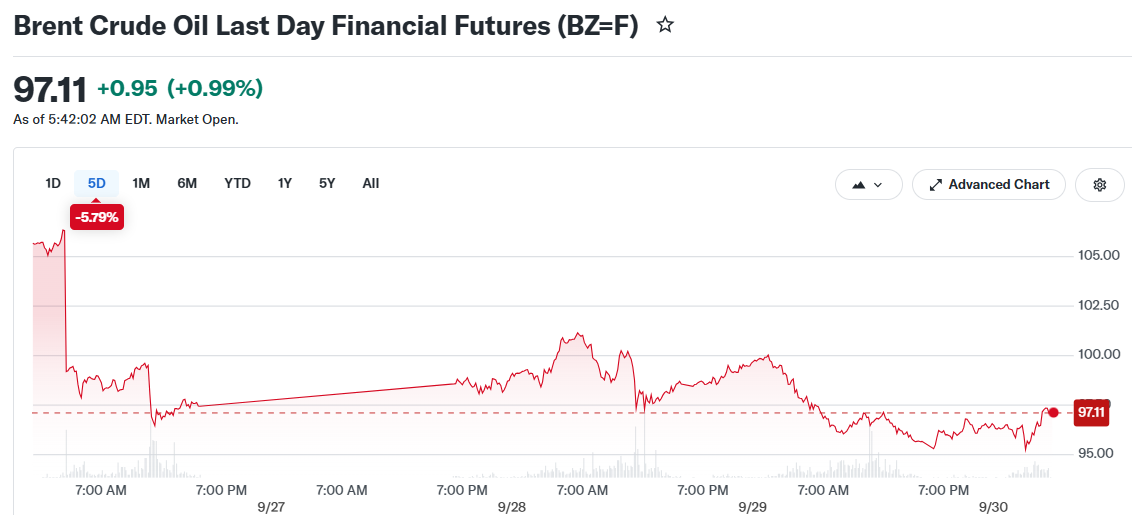
Brent crude futures for November delivery rose 1% to $103.64 a barrel. West Texas Intermediate crude gained 0.9% to reach $90.21 a barrel. On Tuesday, Brent had fallen 2.6% and WTI dropped 3.5%.
Saudi Arabia Restores Key Pipeline
The rebound followed news that Saudi Arabia resumed crude loadings at its Red Sea port of Yanbu. This came after the country restarted its East-West Pipeline, which offers a route around the Strait of Hormuz.
Crude oil flows from the Middle East are almost back to pre-war levels despite continued risks to shipping, according to JPMorgan https://t.co/jbMdovvXnY
— Bloomberg (@business) September 30, 2026
Saudi Aramco has already sent its October loading schedule to customers. Shipping data showed close to 10 million barrels of crude loaded at Yanbu and the nearby Al Muajjiz terminal.
Saudi Arabia has restored pipeline flows to about 3.5 million barrels per day. That is close to half of the pipeline’s total capacity, according to people familiar with the matter.
This recovery has eased some of the immediate supply risk tied to the ongoing conflict. Still, the Strait of Hormuz remains a major source of uncertainty for the oil market.

The strait has been effectively shut since shortly after the United States and Israel launched a joint assault on Iran in late February. Diplomatic talks aimed at reopening the waterway have not produced results so far.
Deutsche Bank analysts said traders are still pricing in a longer period of disruption. They noted that higher oil flows out of the Gulf have reduced near-term pressure on prices.
Diplomatic Talks and Rising Fuel Costs
Qatar is acting as a mediator between Washington and Tehran. The talks are focused on a possible deal that could include reopening the Strait of Hormuz and easing some U.S. pressure on Iran.
President Trump has denied reports that the U.S. offered Tehran sanctions relief. Iran continues to push for specific conditions tied to reopening the strait.
A separate report from the Financial Times said Trump is considering several steps to address rising domestic fuel prices. One option being reviewed is a possible ban on diesel exports.
U.S. diesel prices reached $6.53 a gallon last week. That price is more than 70% higher than levels seen before the conflict began.
Goldman Sachs estimated that Persian Gulf oil exports, including so called dark transits, reached 23.3 million barrels a day over the past week. That figure is in line with the 2025 average for the region.
Analysts say the key question going forward is whether this faster pace of shipments can continue through October. The market is closely watching for signs of stability in the flow of oil.
Brent’s December contract, which is more actively traded, was down 0.8% to $95.34 a barrel in early trading Wednesday. WTI futures slipped 0.6% to $88.87 a barrel during that same session.
Stop guessing and start investing with confidence. KnockoutStocks gives you the AI insights, market intelligence, and stock research you need to spot opportunities, cut through the noise, and make smarter investment decisions — all in one powerful platform.
Sign up today and get 50% OFF full access to our premium stock picks.
Simply use coupon code SPECIAL50 at checkout to claim your exclusive discount.
Get 3 Free Stock Ebooks
Discover top-performing stocks in AI, Crypto, and Technology with expert analysis.
- Top 10 AI Stocks - Leading AI companies
- Top 10 Crypto Stocks - Blockchain leaders
- Top 10 Tech Stocks - Tech giants



