





TLDR
- Brent crude rose to $91.70 and WTI to $88.43 as U.S.-Iran hostilities resumed
- The U.S. military struck Iranian targets after a U.S. Apache helicopter was downed
- Iran responded by targeting U.S. bases in Jordan and several Gulf states
- U.S. crude inventories fell by 9.12 million barrels last week, far above the 3.4 million expected
- The Strait of Hormuz, which carries a fifth of global crude oil, remains largely blocked by Iran
Oil prices steadied on Wednesday after an early rally faded, as fresh military exchanges between the U.S. and Iran kept traders on edge.
Brent crude futures edged up 0.27% to $91.70 a barrel. U.S. West Texas Intermediate rose 0.26% to $88.43. Both contracts had climbed nearly 2% earlier in the Asian session before pulling back.
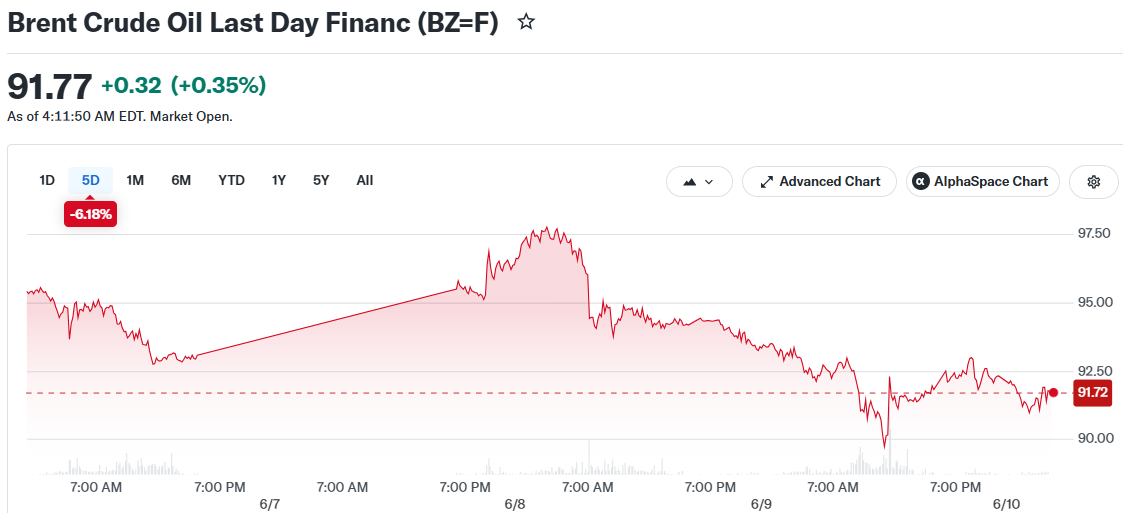
The moves follow a roughly 3% drop in the previous session, when oil hit its lowest level in seven weeks.
What Triggered the Latest Escalation
The latest flare-up began when a U.S. Apache attack helicopter was downed, reportedly by an Iranian drone. President Donald Trump ordered retaliatory strikes on Iranian military sites near the Strait of Hormuz.
BREAKING: US strikes have now hit two drinking water tanks in Sirik, southern Iran, cutting off all drinking water in the district, per IRIB.
Iran has warned 2 hours ago it will immediately place all regional Gulf energy infrastructure under continuous missile fire, and with…
— The Hormuz Letter (@HormuzLetter) June 9, 2026
Iran then said it targeted U.S. bases in Jordan and several Gulf states in response.
The escalation threatens to undo tentative progress made earlier in the week, when Iran and Israel had agreed to halt attacks following appeals from Trump.

Tehran also warned it would resume hostilities if Israel continued striking Hezbollah in Lebanon. Israel’s refusal to end that campaign has blocked efforts to turn a fragile ceasefire into a lasting deal.
Strait of Hormuz Remains a Pressure Point
Iran has continued to block most shipping through the Strait of Hormuz. The waterway normally carries around a fifth of the world’s crude oil and liquefied natural gas.
Washington has imposed its own blockade of Iranian ports in response.
U.S. Energy Secretary Chris Wright said on Tuesday that ship traffic and oil exports through the Strait are slowly rising, even as a formal deal between Washington and Tehran remains out of reach.
ING analysts warned that with no deal in sight and global oil markets tightening, prices could move higher — especially if disruptions last into the third quarter, when demand is seasonally stronger.
U.S. Crude Inventories Fall Sharply
A large draw in U.S. crude stockpiles also supported prices. The American Petroleum Institute reported a 9.12 million-barrel decline last week, well above the expected 3.4 million-barrel drop.
This was the eighth consecutive weekly decline in U.S. crude inventories.
Gasoline stocks also fell by 1.19 million barrels. Distillate inventories rose by 1.32 million barrels.
Analysts said the inventory data reinforced concerns that global supply could tighten further if Middle East tensions continue.
PVM analyst Tamas Varga noted that lower Chinese crude imports are helping limit how far prices rise, alongside the restricted flow through the Strait of Hormuz.
Traders are now awaiting official inventory data from the Energy Information Administration, along with U.S. consumer inflation figures, for more direction on markets and Federal Reserve policy.
Stop guessing and start investing with confidence. KnockoutStocks gives you the AI insights, market intelligence, and stock research you need to spot opportunities, cut through the noise, and make smarter investment decisions — all in one powerful platform.
Sign up today and get 50% OFF full access to our premium stock picks.
Simply use coupon code SPECIAL50 at checkout to claim your exclusive discount.
Get 3 Free Stock Ebooks
Discover top-performing stocks in AI, Crypto, and Technology with expert analysis.
- Top 10 AI Stocks - Leading AI companies
- Top 10 Crypto Stocks - Blockchain leaders
- Top 10 Tech Stocks - Tech giants



