






TLDR
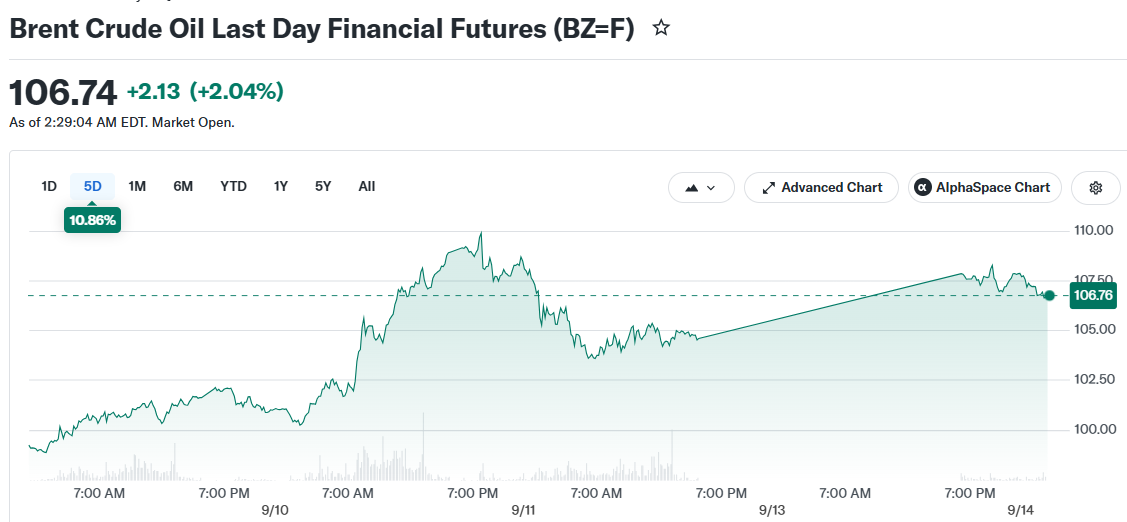
- Brent crude rose over 2% to $106.72 per barrel; WTI climbed to $102.15 following fresh Houthi attacks on Saudi Arabia
- Saudi Arabia shut its key East-West oil pipeline after a drone strike, threatening up to 4% of global oil supply
- Houthis seized control of the island of Perim, tightening their grip on the Bab el-Mandeb strait
- Planned Iran-Gulf talks in Oman on the Strait of Hormuz were postponed indefinitely
- Oil has now surged over 8% in the past week, trading above $100 for the first time since July
Oil prices climbed more than 2% on Monday after a fresh wave of Houthi attacks on Saudi Arabian energy infrastructure and new strikes in the Strait of Hormuz raised fears of major supply disruptions across the Middle East.
Brent crude futures rose to $106.72 per barrel, while West Texas Intermediate gained to $102.15. At one point during early trading, Brent surged as high as $108.41.
Saudi Arabia’s East-West Pipeline Shut Down
Saudi Arabia confirmed it had shut its East-West pipeline after a Houthi drone strike. The pipeline is a critical alternative route that lets Saudi Arabia move oil without passing through the Strait of Hormuz.
It seems most people don't understand how severe the energy situation is right now in the Middle East.
As of Friday, Saudi Arabia's East-West pipeline has officially been shut down after recent attacks, putting -4 million barrels of daily oil exports at risk.
Meanwhile, the Bab… pic.twitter.com/S71vSoFand
— The Kobeissi Letter (@KobeissiLetter) September 13, 2026
With the pipeline offline, the port of Yanbu has enough stored oil to cover just five to seven days of exports, according to three industry sources familiar with Saudi operations.
The shutdown puts up to 4% of global oil supply at risk. Analysts at ANZ warned that Saudi Arabia has now lost its western export option if conditions in the Strait of Hormuz worsen further.
Saudi state media released footage showing damage to homes and a mosque in the southern Jazan province from a Houthi attack. The Houthis also claimed a strike on a Saudi military base in a neighboring province.

Bab el-Mandeb Also Under Threat
The Houthis reached the strategic island of Perim on Friday, placing them in a position to launch attacks freely in the Bab el-Mandeb strait. That strait has been carrying 4% to 5% of global oil supply in recent months.
Last week, the group struck multiple major Saudi targets including an Aramco refinery, fuel terminals, airports, and ships. A vessel in the Strait of Hormuz was also struck by a projectile over the weekend, causing a fire and forcing a crew evacuation.
Iran reported one person killed and four crew members wounded on an Iranian commercial vessel struck near its coast.
ING commodity strategists noted the attacks on Saudi energy infrastructure were a clear escalation, though the full extent of damage and how long the pipeline would remain closed was still unclear.
Hormuz Talks Postponed
Oman’s Foreign Minister Badr Albusaidi confirmed on Sunday that a meeting planned for Monday between Iran and Gulf nations to discuss the Strait of Hormuz had been postponed. Markets had been watching that meeting closely, as hopes of diplomacy had briefly slowed oil’s rise last week.
With the talks now delayed indefinitely, supply risks through Hormuz are expected to remain elevated. Oil flows through the strait had already slowed to a fraction of prewar levels after renewed US-Iran tensions in August.
Oil is up more than 8% over the past week, crossing above $100 per barrel for the first time since July.
Stop guessing and start investing with confidence. KnockoutStocks gives you the AI insights, market intelligence, and stock research you need to spot opportunities, cut through the noise, and make smarter investment decisions — all in one powerful platform.
Sign up today and get 50% OFF full access to our premium stock picks.
Simply use coupon code SPECIAL50 at checkout to claim your exclusive discount.
Get 3 Free Stock Ebooks
Discover top-performing stocks in AI, Crypto, and Technology with expert analysis.
- Top 10 AI Stocks - Leading AI companies
- Top 10 Crypto Stocks - Blockchain leaders
- Top 10 Tech Stocks - Tech giants



