






TLDR
- Brent crude is on track for a 5% weekly gain, WTI up around 4%, despite flat Friday trading
- The U.S. launched fresh airstrikes on Iranian military targets Thursday to protect Strait of Hormuz shipping
- Iran retaliated with missile and drone attacks on Bahrain, Kuwait, Qatar, and Jordan
- Trump declared the fragile ceasefire effectively over after attacks on commercial vessels
- Markets believe the conflict will stay contained, with Gulf crude exports remaining broadly steady
Oil prices held steady on Friday but were set to close the week sharply higher after renewed military exchanges between the United States and Iran rattled energy markets earlier in the week.
U.S. West Texas Intermediate crude edged down 0.1% to $72.01 a barrel on Friday. Brent crude slipped 0.07% to $76.25. Despite the flat session, both benchmarks were heading for strong weekly gains — Brent up around 5% and WTI up roughly 4%.
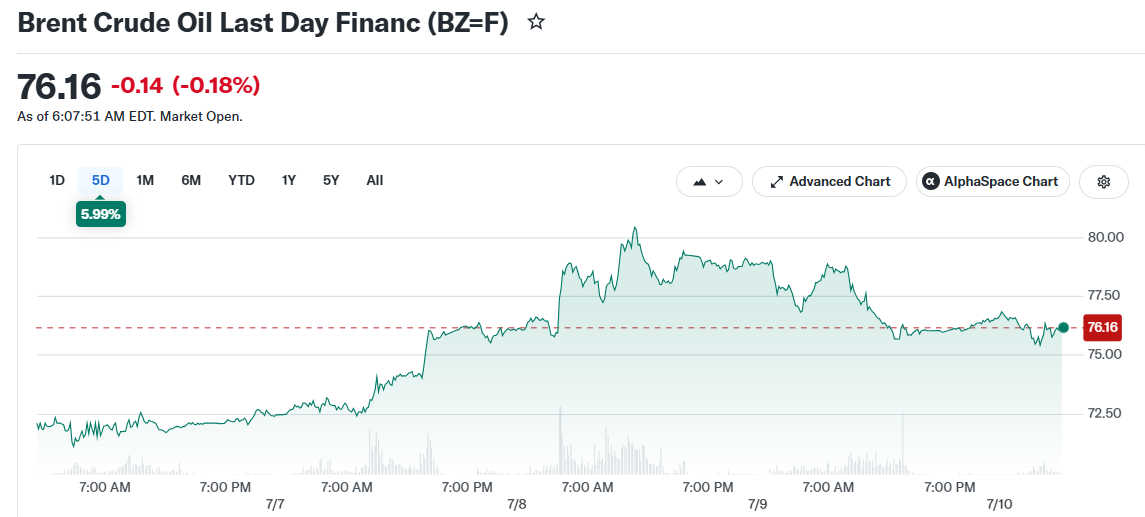
The week’s gains were driven by a spike in tensions around the Strait of Hormuz, one of the world’s most important oil transit routes. Fresh attacks on commercial vessels in and around the waterway prompted some shipping companies to delay or cancel voyages.
U.S. Strikes Iran, Iran Hits Back
On Thursday, the United States carried out another round of airstrikes on military targets inside Iran. Washington said the strikes were aimed at reducing Iran’s ability to threaten commercial shipping through the Strait of Hormuz.
🚨UPDATE: U.S. LAUNCHES SECOND STRIKE WAVE ON IRAN
The U.S. carried out a second round of strikes against Iran in 24 hours, hitting around 90 targets after Iran attacked ships in the Strait of Hormuz and escalated strikes across the region.
Iran also fired missiles and drones… pic.twitter.com/iLnoBgHp3a
— Coin Bureau (@coinbureau) July 9, 2026
Iran responded with missile and drone attacks on several U.S.-aligned countries, including Bahrain, Kuwait, Qatar, and Jordan. Analysts described it as one of the broadest military exchanges since last month’s interim ceasefire agreement.
President Donald Trump said the attacks on commercial shipping had effectively ended the ceasefire. He warned the United States would respond more forcefully if Iran targeted vessels again.

Despite Trump’s warning, diplomatic activity continued. Iranian Foreign Minister Abbas Araghchi held talks with counterparts from Saudi Arabia, Oman, and Turkey in an effort to prevent the conflict from widening.
Markets See Limited Risk to Oil Supplies
Analysts at IG said in a note that oil’s restrained price reaction reflects growing confidence that the conflict will stay limited rather than develop into a prolonged regional crisis.
They pointed out that U.S. strikes have targeted Iranian military infrastructure, not oil production or export facilities. Gulf crude exports have continued largely uninterrupted.
Tanker traffic through the Strait of Hormuz has gradually recovered since the June agreement reopened the waterway. However, movement remains below pre-conflict levels as insurers and shipowners continue to assess the risks.
IG said the main upside risks for oil would come if Washington tightened restrictions on Iranian crude exports or if the conflict directly hit energy infrastructure or shipping lanes.
For now, Gulf exports have held steady and regional resistance to disrupting commercial shipping has helped cap further price gains.
Markets are now watching weekend developments closely, including any new military activity, tanker movements, and signs that Gulf crude exports could begin to slow.
Stop guessing and start investing with confidence. KnockoutStocks gives you the AI insights, market intelligence, and stock research you need to spot opportunities, cut through the noise, and make smarter investment decisions — all in one powerful platform.
Sign up today and get 50% OFF full access to our premium stock picks.
Simply use coupon code SPECIAL50 at checkout to claim your exclusive discount.
Get 3 Free Stock Ebooks
Discover top-performing stocks in AI, Crypto, and Technology with expert analysis.
- Top 10 AI Stocks - Leading AI companies
- Top 10 Crypto Stocks - Blockchain leaders
- Top 10 Tech Stocks - Tech giants



