





TLDR
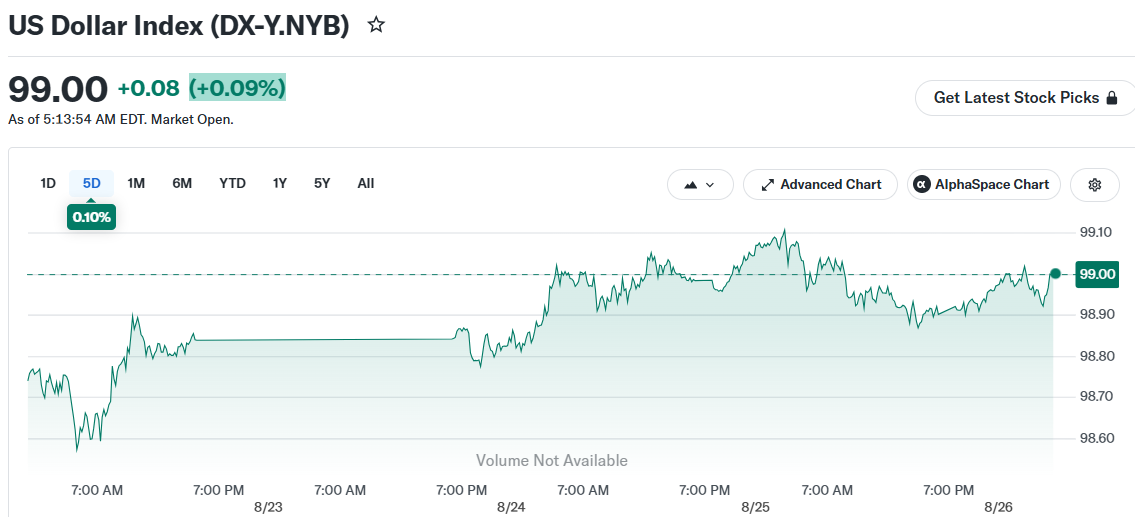
- The U.S. Dollar Index held near 99.00 ahead of key PCE inflation data and the Jackson Hole symposium
- The Australian dollar hit its highest level since early June after July CPI came in hotter than expected at 3.5%
- The Canadian dollar weakened after U.S.-Canada trade talks collapsed and both sides imposed retaliatory tariffs
- The Japanese yen steadied near 159.00 with markets watching for a possible Bank of Japan rate hike in September
- Gold pulled back from a three-month high near $4,700 and Brent crude fell over 2% on easing Middle East tensions
The U.S. dollar stayed in a tight range on Wednesday as traders waited for the Personal Consumption Expenditures price index, the Federal Reserve’s preferred inflation measure. The U.S. Dollar Index hovered near 99.00, close to last week’s three-month low.
Markets expect core PCE to rise 0.2% month-on-month, steady with where the annual rate has been sitting. Analysts at ING said a reading in line with forecasts should keep the dollar broadly stable, with limited room to move higher.
The Jackson Hole symposium this weekend is also on traders’ radar. The event could offer more direction on where the Fed takes rates next.
The U.S. Treasury’s expanded debt buyback program has taken some pressure off longer-dated yields, but analysts say it does not solve the bigger issue of rising government debt and interest costs.
Australian Dollar Rises as Inflation Beats Forecasts
The Australian dollar was one of the best performers of the day. The AUD/USD pair climbed 0.3% to $0.718, its highest point since early June.
Australia’s monthly CPI rose 1.0% in July, above the 0.8% forecast. The annual rate slowed to 3.5% from 3.8%, but still came in above the market expectation of 3.2%.
The trimmed mean measure, which the Reserve Bank of Australia watches closely, rose 0.5% on the month. Annual core inflation held at 3.6%. Markets lifted their bets on a fourth RBA rate hike this year.

Canada and Japan in Focus
The Canadian dollar stayed under pressure. The USD/CAD pair rose 0.2% to C$1.39 after U.S.-Canada trade talks broke down earlier in the week.
Washington imposed 50% tariffs on around $20 billion of Canadian goods. Canada responded with matching tariffs of 15%, 25%, and 50% on about $20 billion of U.S. imports, set to take effect September 8.
Analysts at Danske Bank said the retaliatory measures add uncertainty for businesses on both sides of the border and could pressure prices and supply chains.
The Japanese yen steadied near 159.00. A Reuters poll showed most economists now expect the Bank of Japan to raise rates sooner than expected, possibly as early as September.
Gold dipped below $4,630 after touching a three-month high near $4,700 on Tuesday. Brent crude fell more than 2% to around $87 a barrel after Iran resumed talks with Oman over the Strait of Hormuz, easing some supply concerns.
Nvidia is set to report earnings after the closing bell Wednesday, adding another market-moving event to a busy day.
Stop guessing and start investing with confidence. KnockoutStocks gives you the AI insights, market intelligence, and stock research you need to spot opportunities, cut through the noise, and make smarter investment decisions — all in one powerful platform.
Sign up today and get 50% OFF full access to our premium stock picks.
Simply use coupon code SPECIAL50 at checkout to claim your exclusive discount.
Get 3 Free Stock Ebooks
Discover top-performing stocks in AI, Crypto, and Technology with expert analysis.
- Top 10 AI Stocks - Leading AI companies
- Top 10 Crypto Stocks - Blockchain leaders
- Top 10 Tech Stocks - Tech giants



