





TLDR
- The U.S. Dollar Index hovered near its lowest level since mid-May, trading around 98.88
- The U.S. Treasury doubled long-end bond buybacks to $4 billion per operation, spooking traders
- U.S. federal debt has passed $40 trillion, with the deficit nearing $1.8 trillion
- The Canadian dollar weakened after the U.S. imposed 50% tariffs on $20 billion of Canadian goods
- Bitcoin and gold gained as investors looked to diversify away from U.S. assets
The U.S. dollar stayed near its lowest point in months on Monday. The U.S. Dollar Index was trading around 98.88, close to its weakest level since mid-May. The index had already fallen nearly 1% the previous week.
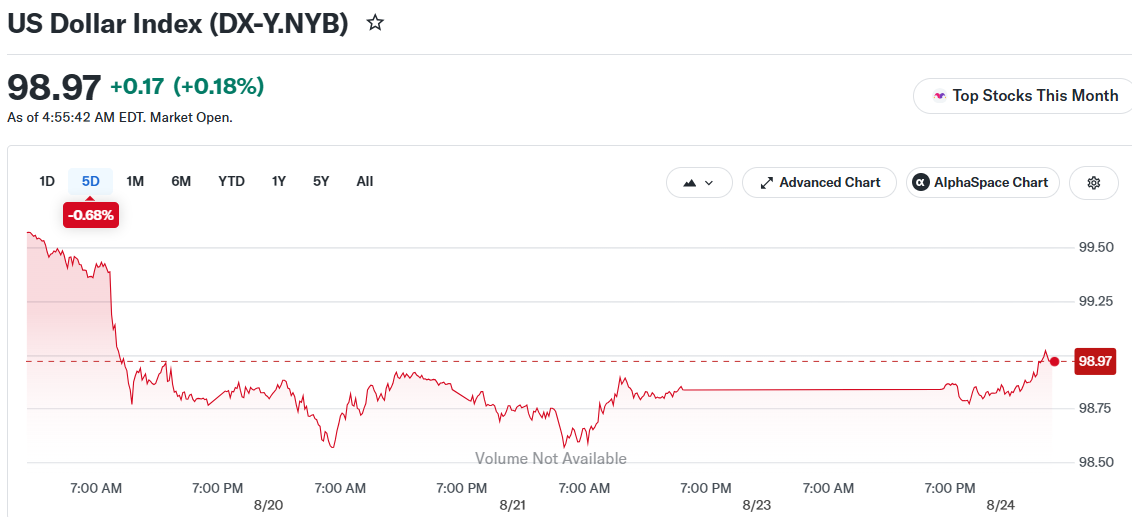
The weakness comes as investors grow more uncomfortable with the state of U.S. government finances. Federal debt has now surpassed $40 trillion, and the federal deficit is closing in on $1.8 trillion.
Last week, the U.S. Treasury said it would double its long-end bond buyback operations to $4 billion per session. The move was aimed at improving market liquidity and easing pressure on long-term yields.
While yields initially dipped, the signal that the Treasury was stepping in to manage the market rattled investors. Some analysts say the intervention may be backfiring.
“The more Bessent tries to push back, the more markets will push against him,” said Marc Ostwald, chief economist at ADM Investor Services International. He added that the situation is pushing investors toward gold and bitcoin over fears of currency debasement.
Bitcoin and Gold Benefit From Dollar Weakness
The dollar logged its largest weekly drop against bitcoin in nearly three and a half years. Gold has also climbed sharply as investors seek alternatives to U.S. dollar assets.
Ostwald noted that investors are looking to diversify away from G7 government bonds, driven by fears that budget deficits are not being brought under control.
The euro was trading at $1.1665, near a three-month high reached last week. Sterling held near a six-month high at $1.3628. China’s yuan hovered near a three-and-a-half-year high against the dollar.

Trade and Geopolitical Risks Add Pressure
Canada’s dollar weakened after the U.S. imposed 50% tariffs on $20 billion in Canadian goods following a breakdown in trade talks. Canada announced it would respond with dollar-for-dollar retaliatory tariffs starting September 8.
Markets were also waiting on U.S. Treasury Secretary Scott Bessent, who was expected to announce new Iran sanctions Monday. Bessent had threatened “the toughest sanctions in history” on Iran, with traders focused on whether China could be targeted.
Oil prices fell more than $1 a barrel ahead of the announcement as traders took profits, though risks around the Strait of Hormuz remained a concern.
Federal Reserve Chair Kevin Warsh is set to speak at Jackson Hole on Friday. Markets will watch closely for any comments on interest rates or the Treasury’s buyback program. Bank of Japan Deputy Governor Ryozo Himino is also speaking Thursday, with investors watching for signals on the pace of future rate hikes.
Nvidia’s earnings results are also due this week, adding another layer of uncertainty to global risk appetite.
Stop guessing and start investing with confidence. KnockoutStocks gives you the AI insights, market intelligence, and stock research you need to spot opportunities, cut through the noise, and make smarter investment decisions — all in one powerful platform.
Sign up today and get 50% OFF full access to our premium stock picks.
Simply use coupon code SPECIAL50 at checkout to claim your exclusive discount.
Get 3 Free Stock Ebooks
Discover top-performing stocks in AI, Crypto, and Technology with expert analysis.
- Top 10 AI Stocks - Leading AI companies
- Top 10 Crypto Stocks - Blockchain leaders
- Top 10 Tech Stocks - Tech giants



