



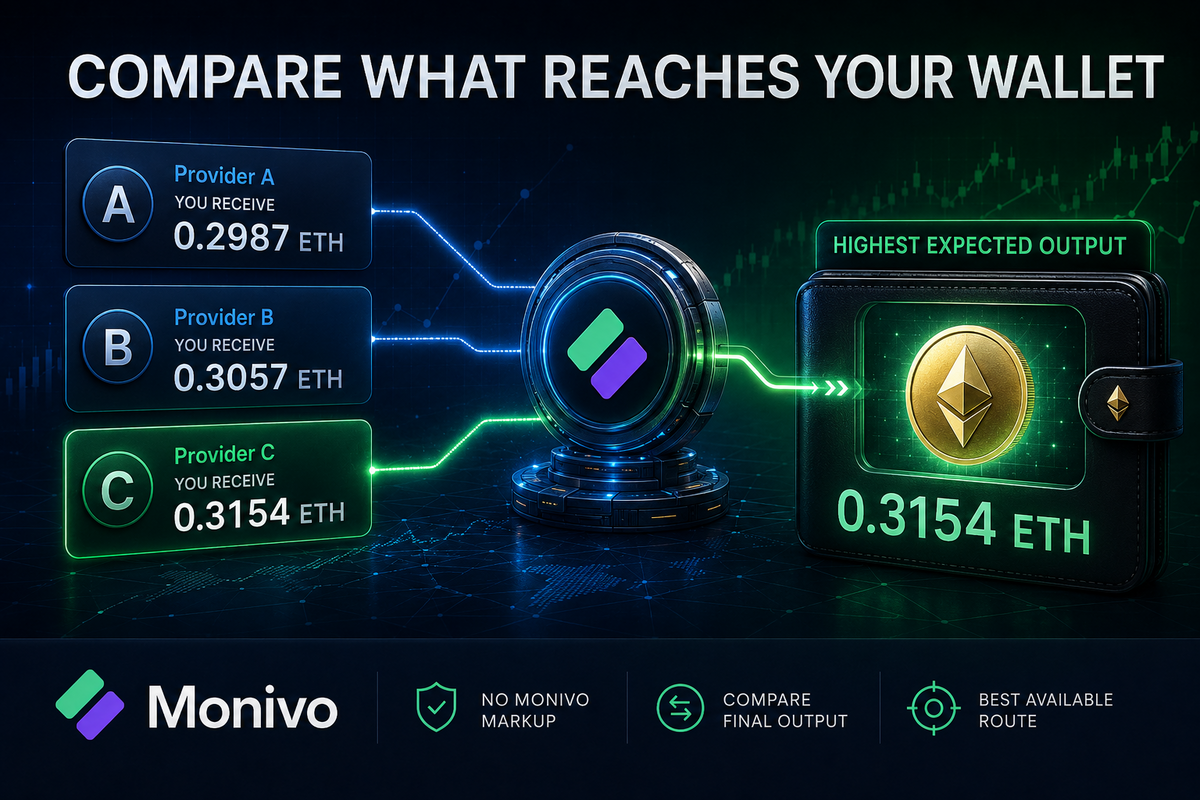


“Low fee” is one of the easiest claims to compare when swapping crypto. It is also one of the easiest numbers to misunderstand.
A provider may advertise a small fee, or even no separate fee at all, without necessarily returning the highest amount of crypto. The final quote can also reflect the provider’s spread, available liquidity, route, and network costs.
For someone looking for the best crypto swap rates, the better question is simple: after everything is priced in, how much crypto will actually reach the wallet?
Why the Lowest Fee Does Not Always Win
Monivo, a non-custodial crypto swap aggregator, has been collecting live provider quotes to compare the responses from different swap services for the same request.
Its Crypto Swap Rate Index groups quotes by trading pair, send amount, rate type, and observation moment. The comparison then examines the destination amount each provider quotes as the expected payout.
Crypto exchange fees are only part of that calculation.
Some providers include part of their margin in the exchange rate. Network costs can reduce the final amount as well, and liquidity can make one route more expensive than another.

The route itself can also change the quote. Two providers may source liquidity differently, use different trading venues, or face different network costs for the same pair.
Available liquidity can vary with the size of the transaction as well. A route that works well for a smaller swap may return a different relative payout when the amount increases.
Market conditions add another variable. Quotes are requested at the same observation moment for comparison, but each provider still prices the trade using the liquidity and route available to it at that time. Different payouts can therefore be legitimate even when every provider receives the same request.
So the provider advertising the lowest fee crypto swap may still return less crypto.
For example, one service may charge a visible fee but offer a better exchange rate. Another may promote a lower fee while pricing in a wider spread. On paper, the second option looks cheaper. In the wallet, the first one may leave the user with more crypto.
What Monivo’s Live Data Shows
Monivo’s Rate Index shows how much those quotes can differ under the same conditions.
When the 30-day dataset was checked on August 31, 2026, with the latest observation at 06:50 UTC, it contained 1,000 provider quotes from eight providers and 171 comparable quote sets.
The median gap between the best and worst quotes was 2.55%.
That 2.55% figure is not a trading fee. It represents the median percentage difference between the highest and lowest provider quote within a comparable set, where the pair, amount, rate type, and observation moment are the same. In practical terms, it shows how far apart provider payouts were under matching conditions.
The size of that gap also depended on the pair. Among the ten pairs with the most comparable sets shown at the time, BTC to ETH had a median spread of 1.96%. XMR to BTC reached 3.65%, while its widest recorded spread during the same window was 4.90%.
Monivo only calculates these spreads when the quotes belong to the same comparable set. Providers receive the same pair, amount, and rate type at the same observation moment. That keeps normal market movement between separate requests out of the comparison.
The numbers are not a permanent ranking of swap providers. They show how providers priced specific requests during the selected observation window.
Compare What Reaches the Wallet
Finding the cheapest crypto swap comes down to more than the fee shown on the screen.
A useful crypto swap comparison looks at delivered output. If two providers quote the same request, the better offer is the one returning more of the destination asset under the same conditions.
Fixed and floating rates also need to be compared separately. The amount sent can also affect the result, as liquidity and routing costs may vary with the size of the swap.
Quotes can change quickly as well. Monivo notes that quoted amounts differ from executed amounts. A quote may expire or be repriced when the order is created, especially when a floating rate is used.
A wider gap between two quotes does not necessarily mean one provider is overcharging. Liquidity depth, network costs, route availability, and current market conditions can all lead to different payouts. The point of comparing several executable quotes is to see which option works best for that specific transaction, not to label one provider as permanently expensive.
Users are better off checking fresh quotes rather than assuming that yesterday’s cheapest provider will still have the best offer today.
Anyone who wants to compare crypto swap rates can check the Monivo Crypto Swap Rate Index. The figures come from stored live provider observations and are updated as new quote sets are added.
For the user making the swap, the comparison is straightforward: look at how much you send and how much each provider says you will get back. A low fee sounds good, but the amount reaching the wallet tells you more.


